


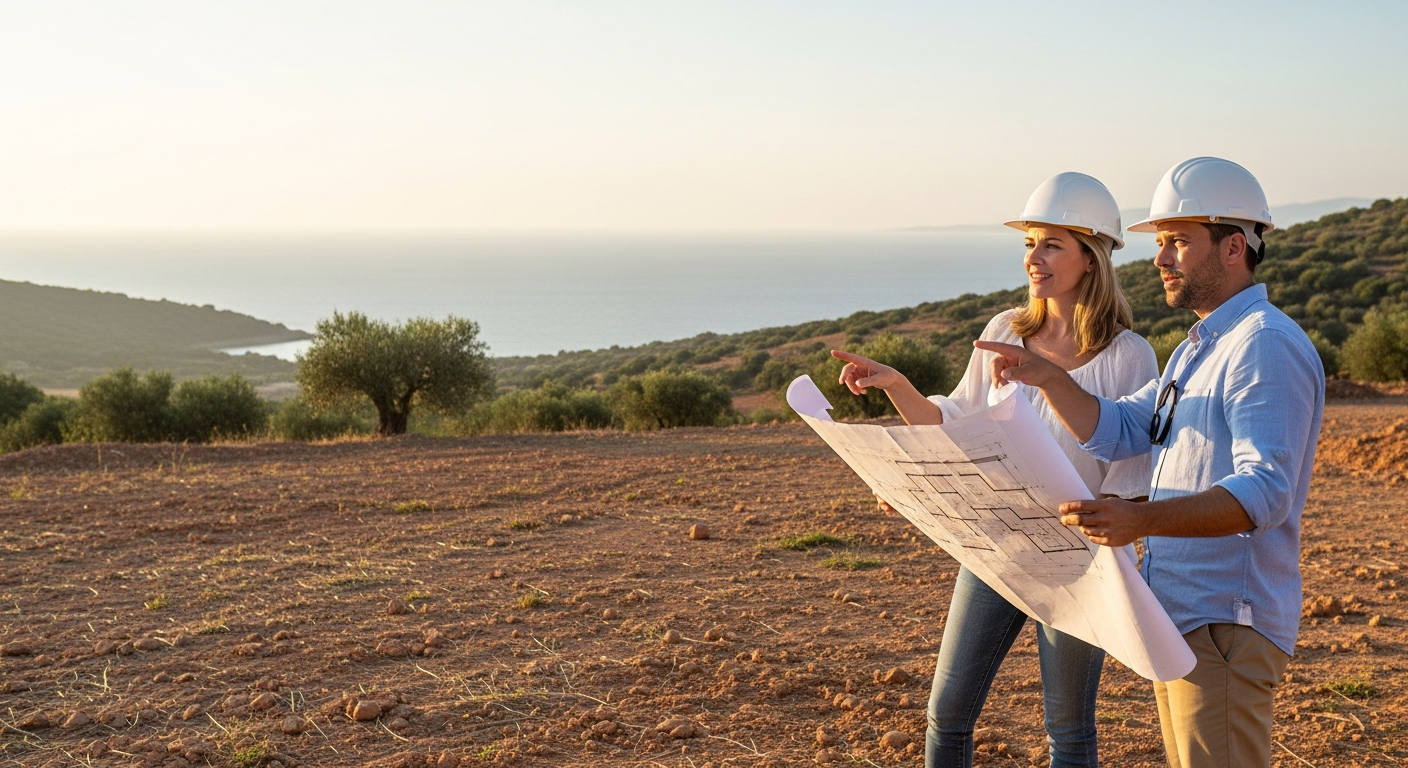
The Dream vs the Reality of Building in Spain
Buying a plot of land in Spain and building your dream home is one of the most appealing ideas in the Mediterranean property market. You choose the location. You design the layout. You select every finish, every tile, every window position. The result is a home built exactly to your specifications, on a plot you selected for its views, orientation, and setting.
The reality is more complex than the dream. Building in Spain involves navigating a legal framework that confuses even many Spanish buyers, dealing with bureaucracy that operates on its own timeline, and managing a construction process in a country where you may not speak the language or understand the customs. Projects routinely take longer and cost more than expected. And the first mistake — buying the wrong type of land — can be catastrophic and irreversible.
This guide covers everything you need to know before buying land in Spain. We focus on the legal classifications that determine what you can build, the permit process that determines when you can build, the costs that determine your budget, and the risks that determine whether you should build at all. We draw on real experiences from foreign buyers who have gone through this process on the Costa Blanca, Costa del Sol, Costa Brava, and the islands — some successfully, some not.
Land Classification: The Foundation of Everything
Spain classifies all land into three legal categories. This classification determines absolutely everything: whether you can build, what you can build, how much you can build, and what permits you need. Getting this wrong is the single most expensive mistake you can make in Spanish property.
Suelo Urbano (Urban Land)
This is land that is already classified for building and has the necessary infrastructure in place — roads, water supply, electricity connection, and sewage. It is either already built up or designated as ready for construction. Suelo urbano is subdivided into two categories:
Suelo urbano consolidado: Land within an established urban area where infrastructure is complete. This is the safest category for buyers. You can apply for a building permit directly, provided your project complies with the local planning regulations (PGOU — Plan General de Ordenacion Urbanistica). Plots in established urbanisations along the coast typically fall into this category.
Suelo urbano no consolidado: Land classified as urban but where infrastructure is not yet complete. This means the area needs further development — roads need to be built, utilities need to be connected, and the costs of this urbanisation process will typically be shared among plot owners. This can add €30,000-€80,000 or more to your costs and years to your timeline. Crucially, you cannot build until the urbanisation process is complete.
When buying suelo urbano, always verify that it is consolidado and that all urbanisation charges (cargas de urbanizacion) have been paid by the seller. Outstanding charges transfer to the buyer and can be substantial.
Suelo Urbanizable (Developable Land)
This is land that the local town plan designates as suitable for future urban development, but which has not yet been developed. Think of it as land that could become urban but is not there yet. This category is further divided:
Suelo urbanizable sectorizado (or programado): Land included in a specific development plan with a defined timeline. A development programme exists, and the land will eventually become urban — but "eventually" can mean years or even decades. You cannot build until the entire sector has been urbanised, which requires road construction, utility installation, green space allocation, and public facility provision. The costs are shared among landowners through the reparcelacion process.
Suelo urbanizable no sectorizado (or no programado): Land identified as potentially developable in the long-term future but with no active development plan. Building on this land is essentially impossible in the medium term. Many foreign buyers have been sold plots of urbanizable land with promises that "building permission is coming soon." In many cases, that permission has never materialised, even after ten or fifteen years.
The critical warning: suelo urbanizable is NOT the same as suelo urbano. The word "urbanizable" sounds like it means "buildable" to many foreign ears. It does not. It means "potentially developable in the future." Buying urbanizable land with the intention of building quickly is one of the most common and most costly mistakes foreign buyers make in Spain.
Suelo Rustico / Suelo No Urbanizable (Rural / Non-Developable Land)
This is land designated for agricultural, forestry, livestock, or environmental protection purposes. It is not intended for residential construction, and in most cases, building a standard home on rustic land is not possible.
However — and this is where it gets complicated — there are limited exceptions. In some autonomous communities, you can build on rustic land if the plot meets minimum size requirements, the construction is related to agricultural activity, or you obtain a special declaration of community interest (declaracion de interes comunitario). The rules vary significantly between regions.
In the Valencian Community, for example, you may be able to build a single dwelling on a rustic plot of at least 10,000 m² (one hectare), subject to strict conditions: maximum built area of 2% of the plot, maximum height of two storeys, and approval from the municipal authorities. In Andalusia, the minimum plot size is typically 25,000 m² (2.5 hectares) for rustic land construction. In Catalonia, different rules apply depending on the specific classification of the rustic land.
The reality: building on rustic land is technically possible in some circumstances, but it is slow, bureaucratic, expensive, and uncertain. Many applications are denied. Those that succeed often take two to three years just for the permits. And the resulting property may have limited resale value because future buyers face the same restrictions and uncertainties.
Do not buy rustic land with the intention of building a home unless you have received written confirmation from the town hall (ayuntamiento) that your specific project on your specific plot is permissible, and you have an experienced local lawyer who has verified this.
The PGOU: Your Local Planning Bible
Every municipality in Spain has (or should have) a Plan General de Ordenacion Urbanistica (PGOU) — the general urban planning plan that governs all development within its boundaries. This document determines:
What can be built on every piece of land in the municipality. How tall buildings can be. How much of the plot you can cover (the building coefficient or coeficiente de edificabilidad). Minimum setbacks from boundaries. Maximum buildable area relative to plot size. Aesthetic requirements (roof styles, exterior materials, colours). Parking requirements. Green space requirements.
Before buying any plot, you or your architect must obtain and review the specific PGOU provisions that apply to that plot. This is called a consulta urbanistica or an informe urbanistico — a written statement from the town hall confirming what can be built on a specific plot. This document typically costs €50-€200 and takes two to four weeks to obtain. It is the single most important document in the entire process. Never buy land without it.
The PGOU also defines the ficha urbanistica for each zone — the specific building parameters. This tells you the maximum built area (for example, 0.5 m² of building per 1 m² of plot), the maximum height (typically 7-9 metres or two storeys for residential), and the minimum setbacks (typically 3-5 metres from each boundary). These parameters determine the maximum size of house you can build on a given plot, which directly affects the value of the land.
Minimum Plot Sizes
Spain imposes minimum plot sizes that vary by land classification and by region. These are general guidelines — always verify with the specific municipality:
Suelo urbano: Minimum plot sizes in urban areas vary by zone but typically range from 200 m² to 800 m² for detached houses. In some urbanisations, plots as small as 400 m² are common for standard villas. Terraced house plots can be smaller, starting from 100-150 m².
Suelo rustico (where building is permitted): Minimum plot sizes are much larger. In the Valencian Community: 10,000 m² (1 hectare). In Andalusia: typically 25,000 m² (2.5 hectares). In the Balearic Islands: varies by island and zone, from 7,000 m² to 50,000 m². In Catalonia: typically 5,000-25,000 m² depending on zone.
Plot size affects not just what you can build but the economics of the project. A 500 m² urban plot with a building coefficient of 0.6 allows you to build a 300 m² house. At €1,200/m² construction cost, that is €360,000 for the build alone — before you have paid for the land, permits, architect, taxes, or utility connections.
Building Permits: The Two-Stage Process
Building a house in Spain requires a licencia de obra mayor — a major works licence. This is not a quick rubber stamp. The process involves multiple stages, multiple professionals, and multiple government approvals.
Step 1: The Proyecto Basico (Basic Project)
Your architect prepares a proyecto basico — a basic architectural project that includes the overall design, floor plans, elevations, site plan, structural concept, and compliance with all planning regulations. This document is submitted to the town hall (ayuntamiento) with your licence application.
The proyecto basico must demonstrate compliance with the PGOU, the building code (Codigo Tecnico de la Edificacion — CTE), accessibility regulations, energy efficiency requirements, and any specific local rules. It must be signed by a qualified Spanish architect (arquitecto) — foreign qualifications must be validated (homologado) in Spain, which is a separate process that can take months.
The town hall reviews the proyecto basico and, if everything complies, grants the licencia de obra mayor. This process typically takes three to six months, though some municipalities are faster and many are slower. Rural areas with small town halls and limited staff can take nine to twelve months.
The licence fee (tasa de licencia) is calculated as a percentage of the estimated construction budget — typically 2-4% of the declared construction cost. On a €300,000 build, expect to pay €6,000-€12,000 in licence fees.
Step 2: The Proyecto de Ejecucion (Execution Project)
Once the licence is granted based on the proyecto basico, the architect (and often a technical architect — aparejador) prepares the proyecto de ejecucion. This is the detailed construction document: complete structural calculations, mechanical and electrical systems, plumbing, material specifications, construction methodology, health and safety plan, and detailed budget breakdown.
The proyecto de ejecucion must be submitted to the official college of architects (colegio de arquitectos) for review and visa (stamp of approval). Only after this visa is obtained can construction legally begin.
The combined architect fees for proyecto basico and proyecto de ejecucion typically run 6-10% of the construction cost for a standard villa. On a €300,000 build, architect fees of €18,000-€30,000 are normal. This includes the design, the technical documentation, and the obligatory construction supervision (direccion de obra) that the architect must provide throughout the build.
Licencia de Obra Menor (Minor Works Licence)
For smaller works — renovations, extensions under a certain size, swimming pools, boundary walls — a licencia de obra menor may be sufficient. These are faster to obtain (typically two to eight weeks) and cheaper. However, a new build always requires a licencia de obra mayor. The boundary between "major" and "minor" varies by municipality, so always check.
Construction Costs: What It Really Costs to Build
Construction costs in Spain in 2025-2026 range from approximately €800 to €1,500 per square metre of built area, depending on location, specification level, and market conditions. Here is what that range means in practice:
€800-€1,000/m² (basic specification): Standard finishes, builder-grade tiles and sanitary ware, basic kitchen, standard aluminium windows, minimal landscaping. Adequate for a functional home but not the "dream villa" most people imagine. This budget requires careful management and trade-offs.
€1,000-€1,200/m² (mid-range specification): Good quality finishes, porcelain tiles, decent kitchen, thermally broken aluminium or PVC windows, basic air conditioning, reasonable landscaping and pool. This is where most foreign buyers end up. The result is a comfortable, well-finished home that compares favourably with properties on the resale market at similar price points.
€1,200-€1,500/m² (high specification): Premium finishes, natural stone or large-format porcelain, designer kitchen with appliances, high-performance windows, full climate control, smart home features, infinity pool, professional landscaping. This delivers a genuinely luxurious result but the budget can escalate quickly if not managed tightly.
Above €1,500/m²: Ultra-luxury specification with bespoke elements, imported materials, complex architecture, and premium features. At this level, €2,000-€3,000/m² is not unusual for architect-designed contemporary homes in prime locations.
What Is Not Included in Per-Square-Metre Costs
The "per square metre" figure quoted by builders and architects typically covers the structure and interior finishes but often excludes several significant cost items:
External works: Swimming pool (€15,000-€40,000 depending on size and type), boundary walls and fencing (€5,000-€15,000), driveways and parking (€3,000-€8,000), landscaping and irrigation (€5,000-€20,000), exterior lighting and terracing (€3,000-€10,000).
Utility connections: Water connection (€1,000-€3,000), electricity connection (€2,000-€6,000 for standard residential, more for higher capacity), sewage connection or septic tank (€2,000-€8,000), telecommunications (€500-€1,500).
Professional fees: Architect (6-10% of construction cost), technical architect / quantity surveyor (3-5%), structural engineer if required (€2,000-€5,000), topographic survey (€500-€1,500), geotechnical study (€1,500-€3,000).
Taxes and permits: Building licence (2-4% of construction cost), ICIO — tax on constructions (2-4%), first occupation licence fees, declaration of new build (obra nueva) notary and registry costs (€1,500-€3,000).
A realistic total budget for a 200 m² villa with pool, on a plot you already own, is therefore approximately: construction €200,000-€300,000, external works €30,000-€80,000, professional fees €20,000-€40,000, taxes and permits €15,000-€30,000, utility connections €6,000-€15,000, contingency 10% — totalling €300,000-€500,000 or more, excluding the land itself.
The Ley de Costas: Coastal Law Restrictions
Spain's Ley de Costas (Coastal Law), originally enacted in 1988 and modified in 2013, creates significant restrictions on building near the coast. Every buyer considering coastal land must understand these rules, because violating them can result in demolition of your property.
The maritime-terrestrial public domain (dominio publico maritimo-terrestre): This includes the beach, cliffs, marshes, dunes, and a strip of land defined by the highest storm waves. This land belongs to the state and cannot be built on or privately owned. Period.
The protection easement zone (servidumbre de proteccion): A strip of 100 metres measured inland from the inner edge of the public domain. Within this zone, new residential construction is generally prohibited. Only extensions or modifications of existing buildings may be permitted, and even these are subject to strict conditions. This 100-metre rule is the one that catches most buyers. A plot that looks perfect — right on the coast with stunning views — may be unbuildable because it falls within the protection zone.
The transit easement zone (servidumbre de transito): A 6-metre strip within the protection zone, adjacent to the public domain, that must remain free for pedestrian access to the coast. No construction is permitted.
The influence zone (zona de influencia): A 500-metre strip measured inland from the inner edge of the public domain. Within this zone, construction is not prohibited but is subject to additional planning restrictions. Building density is limited, heights may be restricted, and environmental impact assessments may be required.
The Ley de Costas has been applied retroactively in some cases, affecting properties built before the law existed. The 2013 modification extended some concessions for existing properties but did not eliminate the fundamental restrictions. Properties within the public domain have been granted concessions — temporary rights to remain — but these concessions expire (typically after 75 years) and are not renewable. When they expire, the property reverts to the state without compensation.
Before buying any coastal plot, have your lawyer verify its position relative to the Ley de Costas boundaries. The Demarcacion de Costas (coastal authority) can provide official boundary information. This is not optional due diligence — it is essential.
Environmental Restrictions
Beyond the Ley de Costas, Spain has extensive environmental protections that can prevent or restrict building:
Protected natural areas: Land within or adjacent to natural parks, nature reserves, or other protected areas may be subject to building prohibitions or severe restrictions. The Natura 2000 network covers significant areas of coastal Spain.
Flood risk zones: Following devastating floods in recent years, Spanish authorities are increasingly strict about building in flood risk areas. The PATRICOVA plan in the Valencian Community, for example, maps flood risk zones and restricts construction. If your plot is in a flood risk zone, you may be unable to build or may face costly mitigation requirements.
Fire risk zones: Forested areas are subject to fire prevention regulations that require cleared perimeters around buildings, restrict certain materials, and may limit building entirely in high-risk zones.
Archaeological and heritage sites: If archaeological remains are discovered on your plot during construction, work must stop immediately and may be delayed for months or years while excavation is completed. In areas with known archaeological significance, a pre-construction archaeological survey may be required.
Environmental impact assessments: For larger projects or those in sensitive areas, a full environmental impact assessment (evaluacion de impacto ambiental) may be required. This adds months to the timeline and costs €3,000-€10,000 or more.
Utility Connections: Costs and Timeline
One of the most underestimated aspects of building on a plot in Spain is connecting to utilities. In established urban areas, this is straightforward. On rural or semi-rural plots, it can be a project in itself.
Water
Connection to the municipal water supply requires an application to the local water company (which may be municipal or a private concessionaire like Hidraqua or Aqualia). In urban areas, if the mains pipe runs past your plot, connection typically costs €1,000-€3,000 and takes two to six weeks. If the mains pipe does not reach your plot, you must either extend the network at your own cost (€50-€150 per metre of pipe) or install a private water supply — a well (pozo) or water tank (aljibe). Drilling a well requires a permit and costs €5,000-€15,000 depending on depth. Water rights and well permits vary significantly by region and can be difficult to obtain, particularly in areas with water scarcity.
Electricity
Connection to the electricity grid requires an application to the relevant distribution company (typically Iberdrola, Endesa, or a local distributor). For a standard residential connection of 5.75-10 kW, expect to pay €2,000-€6,000 if the grid reaches your plot. If you need a transformer or grid extension, costs escalate dramatically — €10,000-€50,000 or more. Timeline: two to six months for standard connections, potentially twelve months or more for rural connections requiring infrastructure work. Solar panels with battery storage are increasingly popular as a supplement or alternative, though full off-grid electrical systems require careful design and significant investment (€15,000-€30,000+).
Sewage
In urban areas with mains sewage, connection costs €1,500-€4,000. In areas without mains sewage — common on rural and semi-rural plots — you must install a private system. A septic tank (fosa septica) costs €3,000-€6,000 installed. A more advanced treatment system (depuradora) costs €5,000-€12,000 but produces cleaner effluent and may be required by local regulations, particularly in environmentally sensitive areas. The type and specification of private sewage systems must comply with local regulations and require a permit.
Telecommunications
Fibre optic internet is increasingly available in urban and suburban areas across coastal Spain. Check coverage before buying — on rural plots, fibre may not be available, and your options may be limited to 4G/5G mobile broadband (€30-€60/month) or satellite internet (Starlink: €40/month plus €450 hardware). For many remote workers, reliable high-speed internet is a deal-breaker. Verify availability before committing to a plot, not after.
Taxes on Buying Land
The tax treatment of land purchases depends on whether you are buying from a private individual, a company, or a developer:
Buying from a private individual (most common for resale plots): You pay ITP (Impuesto de Transmisiones Patrimoniales) — the property transfer tax. Rates vary by autonomous community: 6-10% of the declared purchase price. In the Valencian Community, 10%. In Andalusia, 7%. In Catalonia, 10%. In the Balearic Islands, 8-13% on a sliding scale.
Buying from a developer or company (new development plots): You pay IVA (VAT) at 21% — the standard rate, not the reduced 10% rate that applies to new residential properties. Land is taxed at the full 21% VAT rate. Plus AJD (Actos Juridicos Documentados) — stamp duty of 0.5-2% depending on the region. This makes buying from a developer significantly more expensive in tax terms. A €100,000 plot from a developer costs €21,000-€23,000 in taxes versus €6,000-€10,000 buying the same plot from a private seller.
In addition to transfer taxes, budget for notary fees (€600-€1,200), land registry fees (€400-€800), and legal fees for your lawyer (€1,500-€3,000 or 1% of the purchase price).
Common Scams and Traps
The Spanish land market has a well-documented history of scams and problematic transactions, particularly targeting foreign buyers. Here are the most common:
Land Sold as Buildable When It Is Not
This is the classic scam. A seller — sometimes an agent, sometimes the landowner — represents rustic or urbanizable land as "buildable" or claims that building permission is "in process" or "guaranteed." The buyer pays market rates for buildable land and discovers they have bought agricultural land on which construction is illegal. The land is worth a fraction of what they paid. Prevention: always obtain an informe urbanistico from the town hall before purchasing. Do not rely on the seller's or agent's verbal assurances.
Outstanding Urbanisation Charges
In areas that have undergone or are undergoing urbanisation — the process of installing roads, utilities, and infrastructure to convert land from rural to urban — the costs are shared among plot owners. These charges (cargas de urbanizacion) can amount to €30,000-€100,000 per plot. If the seller has not paid their share, the charges transfer to the new owner. Prevention: your lawyer must conduct a thorough search for outstanding urbanisation charges at the town hall, not just at the land registry.
Illegal Buildings and Demolition Orders
Some plots are sold with existing structures that were built without permits. The buyer inherits the legal liability for the illegal construction, which can include demolition orders. In the worst cases, the buyer has purchased a plot with a house that must be demolished at their own expense. Prevention: verify that all existing structures have proper building licences and are registered in the land registry (catastro) and property register (registro de la propiedad).
Boundary Disputes
Land boundaries in Spain are not always precisely defined, particularly for older rural properties. The boundaries shown in the catastro (cadastral survey) may not match the physical boundaries on the ground. This can lead to disputes with neighbours and complications when applying for building permits. Prevention: commission a topographic survey (levantamiento topografico) to verify the exact boundaries before purchasing.
Access Rights
Some plots, particularly rural ones, may lack legal access from a public road. You may need to cross someone else's land to reach your plot, and without a formally registered right of way (servidumbre de paso), you could face access disputes. Prevention: verify legal access from a public road, confirmed by a physical inspection and a review of the property registry.
The Timeline: From Purchase to Moving In
Building a house in Spain from scratch is a process that takes 12-24 months from the moment you purchase the plot to the moment you move in. Here is a realistic breakdown:
Month 1-2: Due diligence and land purchase. Legal checks, obtaining the informe urbanistico, topographic survey, negotiation, and completion of the purchase. If you need a mortgage for the land, add one to two months for bank processing.
Month 2-4: Design phase. Briefing your architect, developing the initial design concept, agreeing on the floor plan and elevations. Multiple iterations are normal. Rushing this phase leads to expensive changes later.
Month 4-6: Proyecto basico preparation. Your architect formalises the design into the proyecto basico document with all required technical information for the licence application.
Month 6-9 (or longer): Licence application and approval. Submitting the proyecto basico to the town hall and waiting for the licencia de obra mayor. This is the stage most affected by bureaucratic delays. Three months is optimistic; six to twelve months is common in some municipalities.
Month 7-10: Proyecto de ejecucion and builder selection. While waiting for the licence (or after receiving it), the architect prepares the detailed proyecto de ejecucion. Simultaneously, you can obtain quotes from builders (constructoras) and select your contractor. Get at least three detailed quotes based on the proyecto de ejecucion — not verbal estimates, but itemised budgets.
Month 10-20: Construction. A standard 200 m² villa takes approximately eight to twelve months to build, assuming no major delays. Weather, material shortages, subcontractor availability, and unforeseen site conditions can all cause delays. Adding two to three months of contingency is prudent.
Month 20-22: Completion and certificates. After construction, your architect issues the certificado final de obra (certificate of completion). You apply for the licencia de primera ocupacion (first occupation licence) from the town hall — this confirms the building complies with the approved plans and is safe to inhabit. You then declare the obra nueva (new build) before a notary and register it in the property registry. Utility contracts (electricity, water) for permanent supply are finalised.
Month 22-24: Furnishing and moving in. The house is legally habitable. You furnish, install curtains and blinds, complete landscaping, and move in.
The total timeline of 18-24 months is realistic for a straightforward urban plot build. For rural plots or complex projects, 24-36 months is more realistic. The fastest we have seen — a simple build on a fully serviced urban plot with a responsive town hall — was fourteen months from purchase to occupation. The slowest, involving rural land reclassification, was over four years.
Buying Land vs Buying Existing Property
The question is not just "can I build?" but "should I build?" Here is when each option makes more sense:
Building Makes Sense When:
You have very specific requirements — layout, orientation, accessibility features, energy systems — that existing properties do not meet. You want a modern, energy-efficient home built to current building codes. You have found a plot in a location where resale properties are scarce or overpriced. You are patient, well-funded, and able to manage a project over 18-24 months. You have a reliable local architect and builder, ideally recommended by someone who has used them. You enjoy the process of designing and creating something unique.
Buying Existing Property Makes Sense When:
You want to move in quickly — within weeks or months, not years. Your budget is fixed and you cannot absorb the cost overruns that almost every building project experiences. You are not based in Spain and cannot easily oversee a construction project. The local resale market offers good properties at prices comparable to or below the cost of building new. You want certainty — you can see and touch what you are buying, not imagine it from plans. You do not speak Spanish and lack a trusted local team to manage the process.
The Financial Comparison
A common assumption is that building is cheaper than buying. This is often wrong. When you add up the land cost, all professional fees, all taxes (remember: 21% IVA on land from developers), all construction costs including external works, utility connections, and the inevitable contingency spend, the total cost of a newly built 200 m² villa frequently equals or exceeds the price of a comparable resale villa in the same area.
The value proposition of building is not usually price — it is customisation. You get exactly what you want, built to modern standards, with a ten-year structural warranty (seguro decenal). Whether that customisation premium is worth the extra time, stress, and financial uncertainty is a personal decision.
Practical Steps If You Decide to Proceed
If you have read all of the above and still want to buy land and build in Spain, here is the process in order:
1. Engage a lawyer first. Before looking at plots, find an independent Spanish lawyer experienced in urban planning law (derecho urbanistico). Not a conveyancing lawyer, not a general practice lawyer — a specialist. They will protect you from the most costly mistakes.
2. Find your architect early. A good architect does more than design. They can assess plots for buildability, identify potential problems, estimate realistic costs, and guide you through the permit process. Engage them before committing to a plot.
3. Identify plots and conduct due diligence. For each potential plot, obtain the nota simple from the land registry, the informe urbanistico from the town hall, a check for outstanding charges and encumbrances, and a topographic survey. Your lawyer should manage this process.
4. Verify utilities. Before signing anything, confirm in writing the cost and timeline for connecting water, electricity, and sewage. Contact the utility companies directly.
5. Budget realistically. Take your estimated total budget and add 15-20% as a contingency. If the resulting figure exceeds what you can afford, either reduce the project scope or reconsider building altogether.
6. Purchase the plot. Complete the purchase with your lawyer present, ensuring all checks have been completed and all conditions have been met.
7. Design, permit, build. Follow the two-stage design and permit process described above. Maintain close oversight of the construction through your architect and through regular personal visits to the site.
8. Document everything. Keep copies of every permit, every invoice, every contract, every communication. Spanish bureaucracy requires extensive documentation, and you will need it all when declaring the obra nueva and applying for the first occupation licence.
Building in Spain is achievable, and many foreign buyers have completed successful projects that delivered exactly the home they dreamed of. But success requires realistic expectations, thorough due diligence, professional guidance, patient timelines, and a budget that accounts for the unexpected. The buyers who succeed are the ones who go in with their eyes open.
Frequently Asked Questions
Land Classification: The Foundation of Everything?
Spain classifies all land into three legal categories. This classification determines absolutely everything: whether you can build, what you can build, how much you can build, and what permits you need. Getting this wrong is the single most expensive mistake you can make in Spanish property. Suelo Urbano (Urban Land) This is land that is already classified for building and has the necessary infrastructure in place — roads, water supply, electricity connection, and sewage. It is either already built up or designated as ready for construction. Suelo urbano is subdivided into two categories:
Minimum Plot Sizes?
Spain imposes minimum plot sizes that vary by land classification and by region. These are general guidelines — always verify with the specific municipality: Suelo urbano: Minimum plot sizes in urban areas vary by zone but typically range from 200 m² to 800 m² for detached houses. In some urbanisations, plots as small as 400 m² are common for standard villas. Terraced house plots can be smaller, starting from 100-150 m².
Construction Costs: What It Really Costs to Build?
Construction costs in Spain in 2025-2026 range from approximately €800 to €1,500 per square metre of built area, depending on location, specification level, and market conditions. Here is what that range means in practice: €800-€1,000/m² (basic specification): Standard finishes, builder-grade tiles and sanitary ware, basic kitchen, standard aluminium windows, minimal landscaping. Adequate for a functional home but not the "dream villa" most people imagine. This budget requires careful management and trade-offs.
Environmental Restrictions?
Beyond the Ley de Costas, Spain has extensive environmental protections that can prevent or restrict building: Protected natural areas: Land within or adjacent to natural parks, nature reserves, or other protected areas may be subject to building prohibitions or severe restrictions. The Natura 2000 network covers significant areas of coastal Spain.
Taxes on Buying Land?
The tax treatment of land purchases depends on whether you are buying from a private individual, a company, or a developer: Buying from a private individual (most common for resale plots): You pay ITP (Impuesto de Transmisiones Patrimoniales) — the property transfer tax. Rates vary by autonomous community: 6-10% of the declared purchase price. In the Valencian Community, 10%. In Andalusia, 7%. In Catalonia, 10%. In the Balearic Islands, 8-13% on a sliding scale.
Why Granfield Estate?
-
⚑
Office on the coast — we live here
Our office is in La Mata, Torrevieja. We know every neighbourhood, every street and the real prices — not from a catalogue, but from daily work on the ground.
-
⚖
In-house lawyer — 10+ years of experience
NIE, bank account, property check, contract, notary — legal support at every step. First consultation free.
-
🏠
Property management
Buying to rent? Our management company handles tenant search, maintenance and all questions.
-
🌐
We speak your language
English, Spanish, Russian, German, Finnish, Swedish and more. Licence RAICV 1663, member of Asivega.
Granfield Estate · Av. Bélgica 1, C.C. Parquemar, La Mata, 03188 Torrevieja · +34 865 44 33 33
Read also

How to Buy Property in Spain: Step-by-Step Guide 2026
05.06.2026
A complete step-by-step guide to buying property in Spain in 2026 — from getting your NIE number to signing at the notary. Costs, timelines, and pitfalls explained.

NIE Number in Spain: What It Is and How to Get One
06.06.2026
The NIE number is your essential ID for buying property, opening a bank account, and paying taxes in Spain. Here is exactly how to get one — in Spain or from abroad.

Mortgage in Spain for Foreigners: Complete Guide 2026
08.06.2026
Everything you need to know about getting a Spanish mortgage as a foreigner — LTV ratios, interest rates, required documents, best banks, and a step-by-step timeline.