


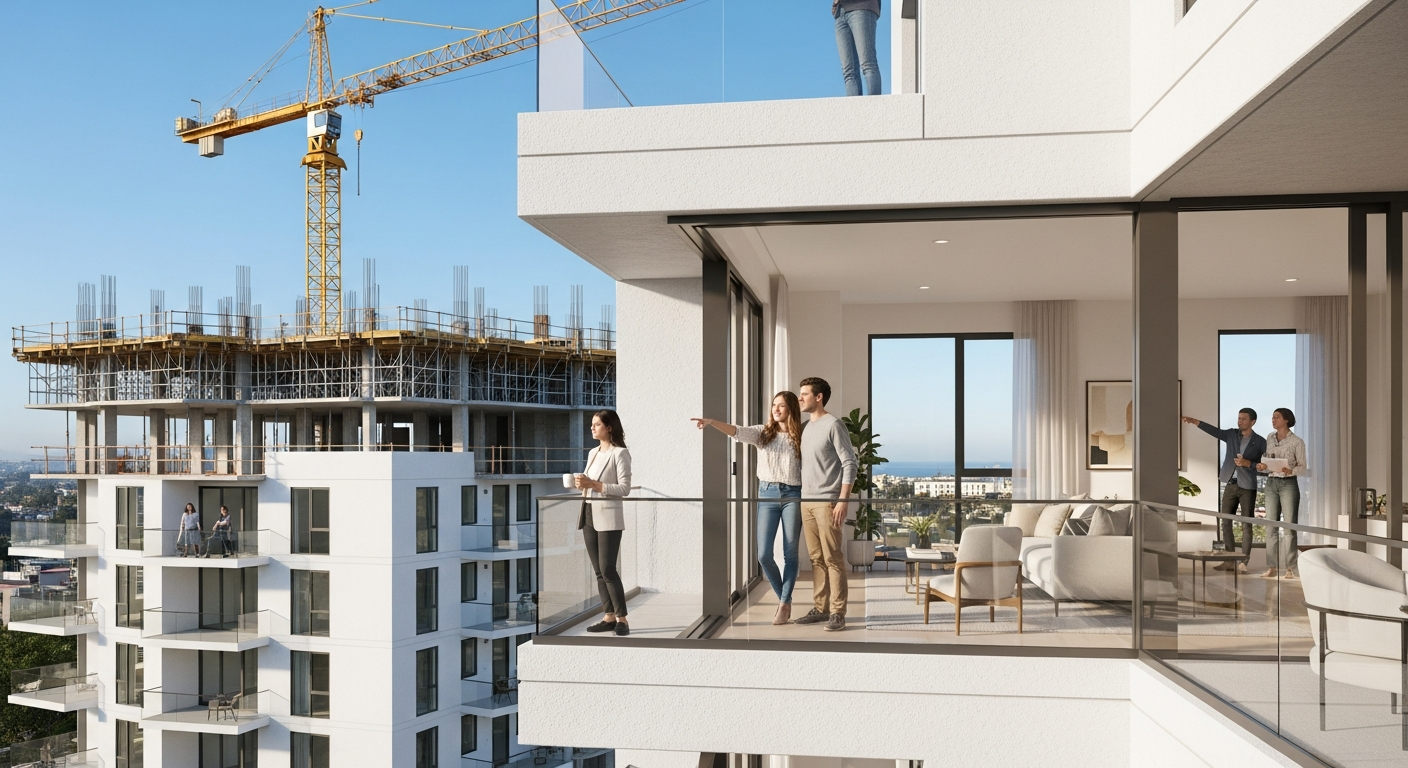
Why New Builds Are Booming in Spain
Spain's new build market has rebounded strongly since the post-2008 crash. Developers are building again — smarter, more energy-efficient, and with modern layouts that today's buyers actually want. For foreign buyers, new builds offer something resale properties often can't: certainty. Everything is new, everything is under warranty, and you know exactly what you're getting.
But buying new build in Spain works differently from most Northern European countries. The payment structure, the taxes, and the legal protections are all specific to Spain. Get it right and you'll have a hassle-free modern home. Get it wrong and you could lose money. Here's what you need to know.
Off-Plan vs Completed New Build
There are two ways to buy new build in Spain, and the difference matters.
Off-Plan (Sobre Plano)
You buy the property before it's built — sometimes before construction has even started. You choose from plans, a show home, or 3D renderings. The advantage: lower prices (typically 10-20% below the finished price), first pick of the best units, and time to arrange finances. The risk: construction delays, the developer going bankrupt, or the finished product not matching expectations.
Completed New Build (Obra Nueva Terminada)
The property is built and ready for handover. You can walk through the actual apartment or villa, see the finishes, check the views, and move in quickly. The price is higher than off-plan, but you eliminate construction risk entirely. Many developments sell a portion off-plan and the remaining units on completion.
Key to Quality
The memory of construction, the quality of the building specifications, is fixed in the building contract called memoria de calidades. This document specifies every detail: floor tiles, kitchen brand, window frames, insulation, bathroom fittings. Read it carefully. If the developer promises Porcelanosa tiles and Roca sanitaryware, it must be in this document — verbal promises mean nothing.
The Payment Schedule
This is where Spanish new builds differ most from other countries. You don't pay the full price upfront or on completion. The standard structure:
The 30/70 Split
- Reservation deposit: €3,000-10,000 to take the property off the market. Usually deducted from the purchase price.
- During construction (30%): You pay approximately 30% of the purchase price in staged payments during the construction period. This is typically split into monthly or quarterly instalments tied to construction milestones (foundations complete, structure up, roofing done).
- On completion (70%): The remaining 70% is paid when the property is finished and you sign the escritura (title deed) at the notary. This is when most buyers arrange their mortgage.
Example: A €250,000 new build apartment. You pay €6,000 reservation, then roughly €69,000 in staged payments over 18-24 months, then €175,000 on completion (which your mortgage covers).
Mortgage Timing
Most Spanish banks won't finalise a mortgage until the property has its licencia de primera ocupación (first occupancy licence). This means you can get a mortgage pre-approval during construction, but the actual mortgage is arranged in the final weeks before completion. Budget your finances accordingly — you need to fund the 30% from savings or other sources.
Bank Guarantee (Aval Bancario): Your Protection
This is the single most important legal protection when buying off-plan in Spain. Spanish law (Ley 38/1999, updated by Ley 20/2015) requires developers to guarantee all payments made during construction through either a bank guarantee (aval bancario) or an insurance policy (seguro de caución).
How It Works
- Every payment you make during construction must be deposited in a special account controlled by the bank or insurer
- If the developer fails to complete the project or deliver on time, the bank guarantee ensures you get all your money back — plus the legal interest
- The developer cannot use your money for other projects — it's ring-fenced
What to Check
- Demand the aval: For every payment you make, you should receive a bank guarantee certificate. No guarantee, no payment — this is non-negotiable.
- Check the issuer: The guarantee must come from a licensed Spanish bank or insurance company.
- Keep every document: Store all guarantee certificates safely. If anything goes wrong, these are your claim documents.
The bank guarantee system was strengthened after the 2008 crash, when thousands of buyers lost deposits to bankrupt developers. Today, it's a robust protection — but only if you insist on receiving the guarantees.
Taxes on New Build: IVA + AJD
New builds are taxed differently from resale properties. This is an important distinction.
Resale Properties
You pay ITP (Impuesto de Transmisiones Patrimoniales) — the transfer tax. This ranges from 6-10% depending on the autonomous community.
New Build Properties
Instead of ITP, you pay two taxes:
- IVA (VAT): 10% of the purchase price. This is a national rate, the same everywhere in Spain (except the Canary Islands, where IGIC of 6.5% applies instead).
- AJD (Actos Jurídicos Documentados): The stamp duty tax, which varies by region — typically 0.5% to 1.5% of the purchase price.
Total tax on new build: Approximately 11-11.5% in most regions. Compare this to resale, where ITP alone can be 10% in regions like Valencia or Catalonia. In some regions, new build ends up slightly more expensive tax-wise; in others, it's comparable or even cheaper.
Other Buying Costs
On top of taxes, budget for notary fees (€600-1,200), land registry fees (€400-700), and legal fees if you hire a lawyer (1-1.5% of the price, highly recommended). Total buying costs for a new build: approximately 13-14% on top of the purchase price.
The 10-Year Structural Warranty (Seguro Decenal)
Spanish law requires a 10-year insurance policy covering structural defects on all new build properties. This is called the seguro decenal, and it's one of the strongest buyer protections in Europe.
Three Levels of Warranty
- 1 year: The developer must fix any finishing defects — paint, tiles, doors, minor issues. This is your snagging period.
- 3 years: The developer is liable for defects affecting habitability — plumbing leaks, damp, faulty electrical systems, insulation failures.
- 10 years: The structural warranty covers the building's foundations, load-bearing walls, beams, and structural integrity. If the building has a structural problem within 10 years, the insurance pays for repair.
The seguro decenal is taken out by the developer but protects the buyer. It transfers automatically if you sell the property within the 10-year period. Make sure you receive a copy of the policy at completion.
The Snagging List (Lista de Repasos)
When your new build is ready and you're invited to inspect it before signing, you create a snagging list — a document recording every defect, no matter how small. In Spain this is called the lista de repasos or acta de defectos.
How to Do It Right
- Take your time: Don't rush the inspection. Budget at least 2-3 hours for an apartment, longer for a villa.
- Bring a checklist: Check every tap, every light switch, every door, every window. Open and close everything. Run all taps and check drainage. Test the air conditioning and heating.
- Look for: Cracked tiles, uneven grout, scratched glass, paint defects, doors that don't close properly, misaligned kitchen cupboards, leaking seals around windows.
- Document everything: Photograph every defect. Number them and mark them on a floor plan.
- Professional inspection: Consider hiring an independent building surveyor (perito) to inspect with you — cost is €300-500 and they'll catch things you'll miss.
- Submit in writing: Give the developer the signed lista de repasos. They must fix all items before you sign the escritura, or agree to a timeline for fixing them after completion.
You have the legal right to withhold signing until snagging items are resolved, but in practice many buyers sign and agree to a post-completion fix schedule. If you do this, get the commitment in writing with a specific deadline.
Energy Efficiency Certificates
New builds in Spain must comply with the latest CTE (Código Técnico de la Edificación) energy standards. This means:
- Energy rating: Most new builds achieve an A or B energy rating. Compare this to typical resale properties, which often rate E, F, or G. The difference in running costs is dramatic — up to 70% lower energy bills.
- Insulation: Modern thermal and acoustic insulation standards that older buildings simply don't have.
- Double or triple glazing: Standard in new builds, rare in resale properties built before 2006.
- Solar panels: New regulations increasingly require solar thermal panels for hot water, and some developments include photovoltaic panels.
- Aerothermic systems: Many new developments use aerothermal heat pumps (aerotermia) for heating, cooling, and hot water — extremely energy-efficient and increasingly standard.
The energy certificate is mandatory and must be provided before you sign. It rates the property from A (most efficient) to G (least efficient) and estimates annual energy consumption and CO2 emissions.
New Build vs Resale: Pros and Cons
Advantages of New Build
- Modern layout: Open-plan living, larger terraces, built-in wardrobes, pre-installed air conditioning, underground parking.
- Energy efficiency: Dramatically lower running costs compared to older properties.
- No renovation needed: Move in and live. No hidden surprises behind walls.
- Warranties: 1, 3, and 10-year legal protections against defects.
- Community facilities: New developments typically include pools, gardens, gyms, and co-working spaces designed for modern living.
- Accessibility: Built to current accessibility standards — lifts, wide doors, level access. Important for retirement planning.
Disadvantages of New Build
- Higher price per square metre: New builds typically cost 20-40% more than comparable resale properties in the same area.
- Location: New developments are often on the outskirts, not in established town centres where resale properties sit. You may need a car.
- Construction delays: Off-plan purchases can be delayed by 6-12 months or more. Life planning around a moving date becomes uncertain.
- Lack of character: If you want a traditional Spanish townhouse with thick stone walls and a courtyard, new builds won't satisfy.
- Unproven community: New developments have no track record of community management. The community of owners is new and untested.
- Surrounding area: New urbanisations may lack nearby shops, restaurants, and services for the first few years.
The Bottom Line
New builds make sense if you want a modern, low-maintenance, energy-efficient home and are willing to pay the premium. Resale makes sense if you want character, a central location, more space for your money, or an established neighbourhood. Many buyers visit Spain planning to buy resale and end up choosing new build once they see the quality difference — and vice versa.
Frequently Asked Questions
Off-Plan vs Completed New Build?
There are two ways to buy new build in Spain, and the difference matters. Off-Plan (Sobre Plano)
You buy the property before it's built — sometimes before construction has even started. You choose from plans, a show home, or 3D renderings. The advantage: lower prices (typically 10-20% below the finished price), first pick of the best units, and time to arrange finances. The risk: construction delays, the developer going bankrupt, or the finished product not matching expectations.
The Payment Schedule?
This is where Spanish new builds differ most from other countries. You don't pay the full price upfront or on completion. The standard structure: The 30/70 Split
Reservation deposit: €3,000-10,000 to take the property off the market. Usually deducted from the purchase price. During construction (30%): You pay approximately 30% of the purchase price in staged payments during the construction period. This is typically split into monthly or quarterly instalments tied to construction milestones (foundations complete, structure up, roofing done). On completion (70%): The remaining 70% is paid when the property is finished and you sign the escritura (title deed) at the notary. This is when most buyers arrange their mortgage.
Example: A €250,000 new build apartment. You pay €6,000 reservation, then roughly €69,000 in staged payments over 18-24 months, then €175,000 on completion (which your mortgage covers).
Bank Guarantee (Aval Bancario): Your Protection?
This is the single most important legal protection when buying off-plan in Spain. Spanish law (Ley 38/1999, updated by Ley 20/2015) requires developers to guarantee all payments made during construction through either a bank guarantee (aval bancario) or an insurance policy (seguro de caución). How It Works Every payment you make during construction must be deposited in a special account controlled by the bank or insurer If the developer fails to complete the project or deliver on time, the bank guarantee ensures you get all your money back — plus the legal interest The developer cannot use your money for other projects — it's ring-fenced What to Check Demand the aval: For every payment you make, you should receive a bank guarantee certificate. No guarantee, no payment — this is non-negotiable. Check the issuer: The guarantee must come from a licensed Spanish bank or insurance company. Keep every document: Store...
Taxes on New Build: IVA + AJD?
New builds are taxed differently from resale properties. This is an important distinction. Resale Properties You pay ITP (Impuesto de Transmisiones Patrimoniales) — the transfer tax. This ranges from 6-10% depending on the autonomous community.
The 10-Year Structural Warranty (Seguro Decenal)?
Spanish law requires a 10-year insurance policy covering structural defects on all new build properties. This is called the seguro decenal, and it's one of the strongest buyer protections in Europe. Three Levels of Warranty
1 year: The developer must fix any finishing defects — paint, tiles, doors, minor issues. This is your snagging period. 3 years: The developer is liable for defects affecting habitability — plumbing leaks, damp, faulty electrical systems, insulation failures. 10 years: The structural warranty covers the building's foundations, load-bearing walls, beams, and structural integrity. If the building has a structural problem within 10 years, the insurance pays for repair.
The seguro decenal is taken out by the developer but protects the buyer. It transfers automatically if you sell the property within the 10-year period. Make sure you receive a copy of the policy at completion.
Why Granfield Estate?
-
⚑
We live on the coast
Our team lives and works on the Costa Blanca. We know every neighbourhood, every street and the real prices — not from a catalogue, but from daily work on the ground.
-
⚖
In-house lawyer — 10+ years of experience
NIE, bank account, property check, contract, notary — legal support at every step. First consultation free.
-
🏠
Property management
Buying to rent? Our management company handles tenant search, maintenance and all questions.
-
🌐
We speak your language
English, Spanish, Russian, German, Finnish, Swedish and more. Licence RAICV 1663, member of Asivega.
Read also

How to Buy Property in Spain: Step-by-Step Guide 2026
05.06.2026
A complete step-by-step guide to buying property in Spain in 2026 — from getting your NIE number to signing at the notary. Costs, timelines, and pitfalls explained.

NIE Number in Spain: What It Is and How to Get One
06.06.2026
The NIE number is your essential ID for buying property, opening a bank account, and paying taxes in Spain. Here is exactly how to get one — in Spain or from abroad.

Mortgage in Spain for Foreigners: Complete Guide 2026
08.06.2026
Everything you need to know about getting a Spanish mortgage as a foreigner — LTV ratios, interest rates, required documents, best banks, and a step-by-step timeline.