


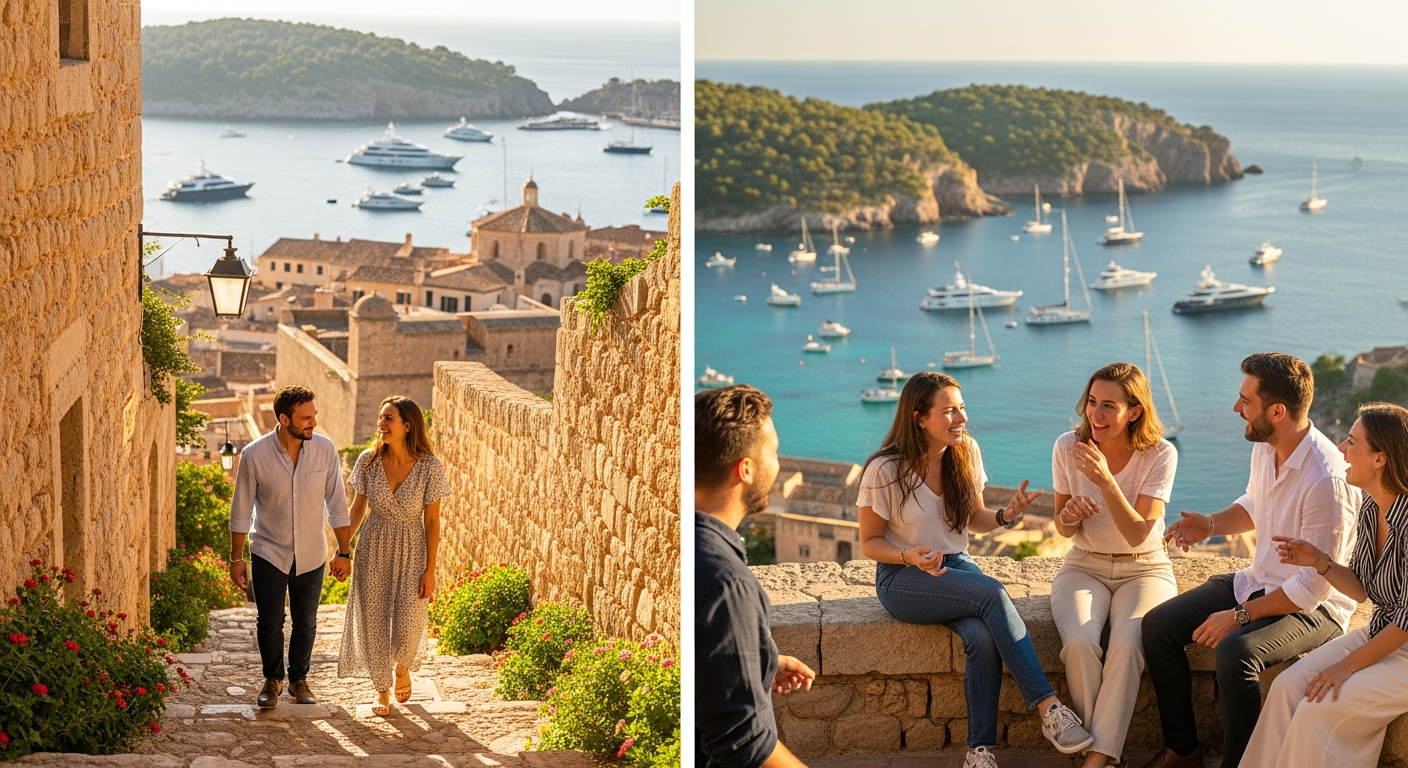
Ibiza: The Island Most People Do Not Really Know
Mention Ibiza and most people think of superclubs, DJs, and hedonistic summer nights. That reputation is not undeserved — the island's nightlife industry is genuinely world-famous and generates billions in revenue. But the Ibiza that people actually live in, year-round, is a remarkably different place from the one portrayed in party brochures and electronic music documentaries.
The real Ibiza is a Balearic island of just 572 square kilometres with a permanent population of approximately 155,000. It has a UNESCO World Heritage old town (Dalt Vila), a landscape of pine-covered hills and hidden coves, a thriving arts and wellness community, excellent international schools, and a property market that is among the most expensive and tightly regulated in Spain. For buyers considering Ibiza, understanding the gap between the party image and the residential reality is essential.
Dalt Vila: UNESCO Heritage at the Heart of the Island
Ibiza Town's old quarter, Dalt Vila, is one of the finest examples of a fortified Renaissance town in the Mediterranean. Enclosed within massive 16th-century walls built to defend against Ottoman raids, Dalt Vila rises dramatically from the harbour, its narrow cobblestone streets winding up to the cathedral at the summit. The entire complex — including the walls, the town within them, and the Phoenician archaeological site of Sa Caleta — was designated a UNESCO World Heritage Site in 1999.
For property buyers, Dalt Vila represents a unique opportunity to own a piece of genuine Mediterranean history. Properties within the walls range from small apartments in converted historic buildings to larger townhouses with spectacular views over the harbour and the sea. Prices are premium — expect to pay from 400,000 euros for a small apartment to well over 1,000,000 euros for a renovated townhouse — but the setting is incomparable. Living in Dalt Vila means stepping out of your front door onto ancient cobblestones, with the cathedral above you, the harbour below, and the island of Formentera visible across the water.
Beyond its historical significance, Dalt Vila is a living neighbourhood. It has restaurants, small galleries, boutique hotels, and a genuine residential community. The atmosphere changes with the seasons — lively and cosmopolitan in summer, quiet and intimate in winter — but it never feels abandoned.
The Year-Round Community: Not Just a Summer Island
One of the most important things for property buyers to understand is that Ibiza has a genuine year-round community. While the summer months (June to September) see the population more than double with tourists and seasonal workers, the off-season Ibiza is a tight-knit, characterful place with its own rhythm.
The permanent community includes a diverse mix of Spanish locals (many from families that have lived on the island for generations), long-established British, German, and Italian residents, a significant wellness and yoga community, artists and musicians, remote workers, and families who have chosen the island for its unique quality of life and excellent schooling options.
Winter in Ibiza is mild — temperatures rarely drop below 10 degrees Celsius, and sunny days are common even in January and February. The island's restaurants, cafes, and markets continue to operate year-round, though at a reduced pace. Santa Gertrudis, a village in the island's interior, has become the unofficial capital of year-round expat life, with its central square surrounded by excellent restaurants, galleries, and boutique shops that stay open throughout the winter.
The year-round community is also served by regular flight connections. Ibiza Airport has winter services to Madrid, Barcelona, Palma de Mallorca, and several European cities including London, Berlin, and Amsterdam, though frequencies are reduced compared to summer.
Family Life: Schools and Children
Ibiza has become increasingly attractive to families with children, driven largely by the quality of its international schools.
Morna International College
Morna International College is an IB World School in Santa Gertrudis offering the International Baccalaureate programme from early years through the Diploma Programme. The school has an excellent reputation, small class sizes, and a diverse student body. For many families, Morna is the single biggest reason for choosing Ibiza over other Balearic islands or mainland Spanish locations.
Other School Options
The island also has several Spanish public schools (colegios publicos), semi-private schools (concertados), and the French school Lycee Francais d'Ibiza. The variety of educational options is impressive for an island of this size.
Property Market: Expensive, Limited, and Tightly Regulated
Ibiza's property market is one of the most expensive in Spain outside central Madrid and Barcelona. Prices are driven by limited supply (the island is small and building regulations are strict), enormous demand (both for residential and tourist rental purposes), and the island's global brand recognition.
| Property Type | Price Range | Typical Locations |
|---|---|---|
| Apartments (2 bed) | €300,000 - €600,000 | Ibiza Town, Santa Eulalia, San Antonio |
| Townhouses (2-3 bed) | €400,000 - €800,000 | Ibiza Town, Dalt Vila, Jesus, Santa Gertrudis |
| Fincas / country houses | €600,000 - €2,500,000 | Interior villages, San Juan, San Carlos |
| Modern villas (3-5 bed) | €1,000,000 - €5,000,000+ | Roca Llisa, Can Furnet, Cala Conta area |
| Luxury seafront villas | €3,000,000 - €10,000,000+ | Es Cubells, Cala Jondal, Cap Martinet |
Key areas for buyers
- Ibiza Town (Eivissa): The capital and cultural heart. Dalt Vila, the marina district, Talamanca beach area, and the Botafoch peninsula offer urban and waterfront living. Best for buyers who want walkability, nightlife proximity, and cultural amenities
- Jesus: A village just outside Ibiza Town that has grown into a residential hub. Good restaurants, close to town and the airport, popular with families. More affordable than central Ibiza Town
- Santa Eulalia del Rio: The island's second town, on the eastern coast. A proper year-round town with a beautiful seafront promenade, Wednesday market, and family-friendly atmosphere. Calmer than Ibiza Town, with good local services
- Santa Gertrudis: The inland village that has become the heart of year-round expat life. Charming central square, excellent restaurants, galleries. Popular with families attending Morna International College. Properties in Santa Gertrudis command premium prices for the interior
- San Juan and the north: The most rural and traditional part of the island. Pine forests, secluded coves, and a bohemian atmosphere. Popular with artists, wellness practitioners, and those seeking tranquility. Fincas and country properties
- San Antonio and the west: Traditionally the party zone (especially the Sunset Strip), San Antonio is undergoing significant regeneration. New developments, improved waterfront, and lower entry prices than the east coast. Worth watching for value-oriented buyers
- Es Cubells, Cala Jondal, and the southwest: The ultra-luxury zone. Dramatic clifftop settings, exclusive restaurants (including the famous Blue Marlin), and the highest property prices on the island
Rental Restrictions: The Tourist Licence Moratorium
This is arguably the single most important factor for property buyers to understand, and one that many get wrong.
Ibiza (and the Balearic Islands generally) has implemented strict regulations on tourist rental properties (alquiler turistico / holiday lets). The key points are:
- Tourist licence moratorium: The Balearic government has imposed a moratorium on new tourist rental licences for apartments and houses in much of Ibiza. This means that if you buy a property without an existing tourist licence, you may not be able to legally rent it to tourists on a short-term basis
- Existing licences: Properties that already hold a valid tourist licence can continue to operate. These licences are transferable with the property upon sale, making licensed properties significantly more valuable than unlicensed equivalents
- Fines for illegal rentals: The Balearic government actively enforces rental regulations. Fines for operating an illegal tourist rental can reach 40,000 euros or more. Platforms like Airbnb are required to display licence numbers, and unlicensed listings are removed
- Long-term rentals: The restrictions apply to short-term tourist rentals. Long-term rentals (contracts of one year or more) are not affected and can be offered without a tourist licence
- Impact on investment: The moratorium has created a two-tier market. Properties with tourist licences trade at a significant premium. Buyers planning to generate rental income must verify the licence status before purchasing
Practical advice: If rental income is part of your investment case, insist on verifying the tourist licence with the Consell Insular d'Eivissa (island council) before committing. Do not rely on verbal assurances from sellers or agents. An independent lawyer should confirm the licence status as part of due diligence.
Seasonal vs Year-Round Living
Buying in Ibiza means choosing how you want to use the property, and this choice has practical implications.
Summer-only / seasonal use
Many buyers use their Ibiza property primarily during the summer season (May to October). This works well for holiday homes and properties near beach clubs and entertainment areas. However, seasonal properties face security considerations during the empty winter months, and running costs continue year-round regardless of occupancy.
Year-round living
Year-round residents need to consider factors that summer visitors can ignore: winter heating (Ibiza gets cool, not cold, but many older properties lack central heating), proximity to year-round services (schools, medical facilities, supermarkets that stay open), social infrastructure (the year-round community is concentrated in specific areas), and flight connections (winter schedules are reduced).
The best locations for year-round living are Ibiza Town, Jesus, Santa Eulalia, and Santa Gertrudis — places with established year-round communities and services. Remote rural fincas that feel magical in summer can feel isolated in winter when country roads are quiet and neighbours may have left for the mainland.
The shoulder seasons
Many Ibiza residents consider the shoulder seasons — April/May and October/November — the best time on the island. The weather is warm and sunny, the beaches are uncrowded, restaurant reservations are easy to get, and the island has a relaxed, convivial atmosphere that the intense summer season can overwhelm.
The Wellness and Creative Economy
Ibiza has become one of Europe's leading wellness destinations. Yoga retreats, holistic health centres, organic farms, and meditation spaces have proliferated across the island, particularly in the north and interior. This is not a passing trend — the wellness community has deep roots in Ibiza, dating back to the original hippie settlers of the 1960s and 1970s, and has evolved into a sophisticated and professional industry.
The creative economy is equally vibrant. Musicians, visual artists, fashion designers, writers, and digital creatives have established studios and businesses across the island. Events like Ibiza International Music Summit, art fairs, and design exhibitions contribute to a cultural scene that extends far beyond the club industry.
For property buyers, the wellness and creative economy means there is a genuine year-round demand for certain types of property — studio spaces, retreat venues, and homes in quiet rural settings that appeal to creative professionals.
Getting to Ibiza
Ibiza Airport (IBZ) is well connected, particularly during the summer season. Year-round services operate to Madrid (Iberia, Vueling), Barcelona (Vueling), and Palma de Mallorca (Air Europa). During summer, direct flights connect Ibiza to London, Manchester, Berlin, Amsterdam, Paris, Milan, Zurich, Stockholm, and many other European cities. Flight time from London is approximately 2.5 hours, from Madrid about 1 hour.
Inter-island ferries connect Ibiza to Formentera (30 minutes), Mallorca (approximately 3 hours), and mainland Valencia and Denia (regular services). The Denia ferry is particularly useful — it connects Ibiza to the northern Costa Blanca in approximately 2.5 hours.
Costs and Practicalities
Ibiza is more expensive than mainland Spain. Grocery prices are approximately 15-25% higher due to transport costs. Restaurant prices are comparable to or higher than Madrid and Barcelona. However, local markets, especially the Saturday market at Santa Gertrudis and the San Juan Sunday market, offer fresh local produce at more reasonable prices.
Water supply is a perennial issue on Ibiza. The island relies on a combination of desalination plants, wells, and imported water. Properties with their own well (pozo) or large cisterns (aljibe) have an advantage. New developments increasingly include water recycling and conservation systems.
Building regulations are strict. The Balearic Islands have some of Spain's most protective environmental and planning rules. New construction is limited, particularly near the coast and in protected areas. This restriction on supply is one of the factors supporting Ibiza's high property prices — there simply is not enough new stock to meet demand.
Investment Outlook
Ibiza's property market has shown consistent growth over the past decade, outperforming most Spanish regions. The fundamentals remain strong: an iconic global brand, severely constrained supply, growing year-round demand, and a diverse international buyer pool. The tourist licence moratorium, while frustrating for some buyers, actually supports property values by limiting the conversion of residential stock into tourist accommodation.
The main risks are regulatory — the Balearic government has shown willingness to impose new rules on property ownership and rental, and future regulations could affect returns. Water scarcity and environmental sustainability are also medium-term considerations that could influence planning decisions and building costs.
For buyers who understand the market's constraints and price their expectations accordingly, Ibiza offers a compelling combination of lifestyle and long-term value in one of the most desirable locations in the Mediterranean.
Is Ibiza Right for You?
Ibiza is right for you if you want a unique island lifestyle that combines natural beauty, cultural richness, and international community in a compact setting. It is not for you if you are seeking a budget property, maximum rental yield without restrictions, or a quiet mainland lifestyle. The island demands a certain commitment — to its pace, its prices, and its character — but for those who connect with it, there is no substitute.
Frequently Asked Questions
Dalt Vila: UNESCO Heritage at the Heart of the Island?
Ibiza Town's old quarter, Dalt Vila, is one of the finest examples of a fortified Renaissance town in the Mediterranean. Enclosed within massive 16th-century walls built to defend against Ottoman raids, Dalt Vila rises dramatically from the harbour, its narrow cobblestone streets winding up to the cathedral at the summit. The entire complex — including the walls, the town within them, and the Phoenician archaeological site of Sa Caleta — was designated a UNESCO World Heritage Site in 1999. For property buyers, Dalt Vila represents a unique opportunity to own a piece of genuine Mediterranean history. Properties within the walls range from small apartments in converted historic buildings to larger townhouses with spectacular views over the harbour and the sea. Prices are premium — expect to pay from 400,000 euros for a small apartment to well over 1,000,000 euros for a renovated townhouse — but the setting is incomparable. Living...
Family Life: Schools and Children?
Ibiza has become increasingly attractive to families with children, driven largely by the quality of its international schools. Morna International College Morna International College is an IB World School in Santa Gertrudis offering the International Baccalaureate programme from early years through the Diploma Programme. The school has an excellent reputation, small class sizes, and a diverse student body. For many families, Morna is the single biggest reason for choosing Ibiza over other Balearic islands or mainland Spanish locations.
Rental Restrictions: The Tourist Licence Moratorium?
This is arguably the single most important factor for property buyers to understand, and one that many get wrong. Ibiza (and the Balearic Islands generally) has implemented strict regulations on tourist rental properties (alquiler turistico / holiday lets). The key points are:
The Wellness and Creative Economy?
Ibiza has become one of Europe's leading wellness destinations. Yoga retreats, holistic health centres, organic farms, and meditation spaces have proliferated across the island, particularly in the north and interior. This is not a passing trend — the wellness community has deep roots in Ibiza, dating back to the original hippie settlers of the 1960s and 1970s, and has evolved into a sophisticated and professional industry. The creative economy is equally vibrant. Musicians, visual artists, fashion designers, writers, and digital creatives have established studios and businesses across the island. Events like Ibiza International Music Summit, art fairs, and design exhibitions contribute to a cultural scene that extends far beyond the club industry.
Costs and Practicalities?
Ibiza is more expensive than mainland Spain. Grocery prices are approximately 15-25% higher due to transport costs. Restaurant prices are comparable to or higher than Madrid and Barcelona. However, local markets, especially the Saturday market at Santa Gertrudis and the San Juan Sunday market, offer fresh local produce at more reasonable prices. Water supply is a perennial issue on Ibiza. The island relies on a combination of desalination plants, wells, and imported water. Properties with their own well (pozo) or large cisterns (aljibe) have an advantage. New developments increasingly include water recycling and conservation systems.
Why Granfield Estate?
-
⚑
Office on the coast — we live here
Our office is in La Mata, Torrevieja. We know every neighbourhood, every street and the real prices — not from a catalogue, but from daily work on the ground.
-
⚖
In-house lawyer — 10+ years of experience
NIE, bank account, property check, contract, notary — legal support at every step. First consultation free.
-
🏠
Property management
Buying to rent? Our management company handles tenant search, maintenance and all questions.
-
🌐
We speak your language
English, Spanish, Russian, German, Finnish, Swedish and more. Licence RAICV 1663, member of Asivega.
Granfield Estate · Av. Bélgica 1, C.C. Parquemar, La Mata, 03188 Torrevieja · +34 865 44 33 33
Read also

Benidorm: Investment and Rental Property
21.05.2026
Complete guide to property investment in Benidorm: 6-8% rental yields, area comparisons, updated prices and year-round rental potential.

Costa Blanca Property Guide 2026: Complete Buyer's Handbook
22.05.2026
Everything you need to know about buying property on Spain's Costa Blanca — from Dénia in the north to Torrevieja in the south, with real prices, honest area comparisons, and practical advice.

Costa del Sol Property Guide: Malaga to Gibraltar
23.05.2026
From Marbella luxury to Nerja charm — a complete guide to buying property on Spain's Costa del Sol, with prices, area comparisons, and investment insights.