


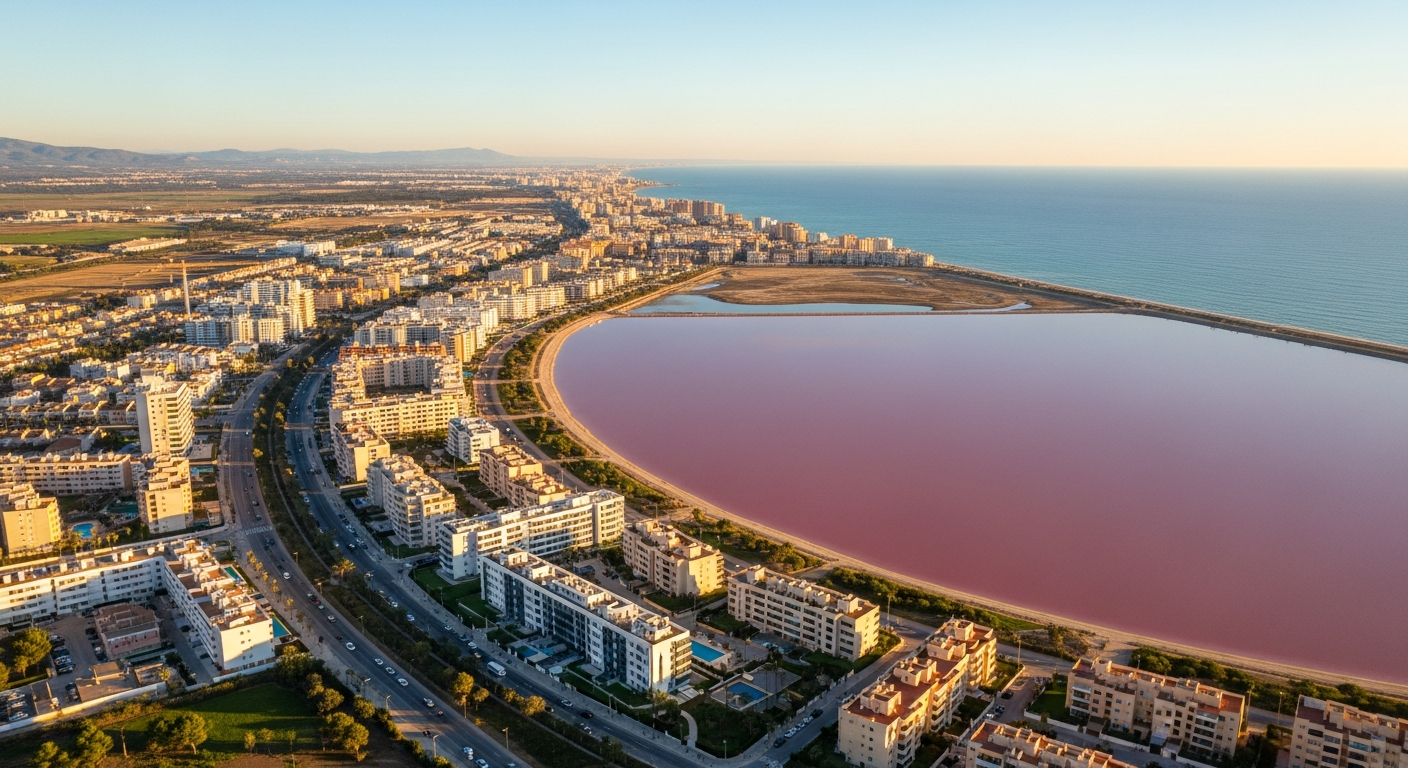
Why Torrevieja Keeps Attracting Investors
Torrevieja is the most talked-about property market on Spain's southern Costa Blanca. A city of roughly 85,000 registered residents — swelling to over 300,000 in summer — it sits between two salt lakes, faces the Mediterranean, and offers some of the lowest property prices on the Spanish coast. For investors, the question is not whether Torrevieja is cheap. It clearly is. The question is whether cheap translates into good value, sustainable rental income, and long-term capital growth. This analysis sets out to answer that question with data rather than estate-agent optimism.
Torrevieja has a polarising reputation. Some investors swear by it, pointing to 6–8% gross yields, a vast international tenant pool, and entry prices under €80,000. Others warn of oversupply, poor construction quality, and a holiday town that empties in winter. The truth, as always, sits somewhere in between — and depends entirely on what you buy, where you buy it, and how you manage it. This guide examines every factor that matters for making an informed decision in 2026.
Before we dive into the numbers, a note on methodology. The price data in this article draws on registered transaction prices from the Spanish Land Registry (Registro de la Propiedad), Idealista asking price indices, and real sale prices observed by local agents working in the Torrevieja and Orihuela Costa markets between 2015 and early 2026. Rental data comes from Airbnb/Booking.com scrapes, local rental agency reports, and real management company portfolios. No single data source is perfect, but triangulating multiple sources gives a reliable picture.
Price History: 2015–2026
Understanding where prices have been is essential for understanding where they might go. Torrevieja's property market has been on a remarkable journey over the past decade:
| Year | Avg. Price/m² (Torrevieja) | Year-on-Year Change | Spain National Avg./m² |
|---|---|---|---|
| 2015 | €780 | — | €1,460 |
| 2016 | €810 | +3.8% | €1,490 |
| 2017 | €870 | +7.4% | €1,530 |
| 2018 | €940 | +8.0% | €1,590 |
| 2019 | €1,010 | +7.4% | €1,650 |
| 2020 | €990 | −2.0% | €1,620 |
| 2021 | €1,060 | +7.1% | €1,690 |
| 2022 | €1,180 | +11.3% | €1,810 |
| 2023 | €1,290 | +9.3% | €1,920 |
| 2024 | €1,380 | +7.0% | €2,020 |
| 2025 | €1,460 | +5.8% | €2,100 |
| 2026 (Q1) | €1,520 | +4.1% (annualised) | €2,160 |
Key takeaways from this data:
- Total appreciation 2015–2026: approximately 95% over 11 years, or roughly 6.3% compound annual growth
- Torrevieja has outperformed the national average in percentage terms every year except 2020, largely because it started from a much lower base after the 2008 crash hit the Vega Baja region particularly hard
- Growth is decelerating: from double-digit increases in 2022–2023 to around 4–5% in early 2026 — a natural maturation of the recovery cycle
- Torrevieja remains 30% below the national average price per square metre, which provides a buffer against sharp corrections
- The 2020 COVID dip was shallow — only −2% — and recovered within a year, suggesting resilient underlying demand
Context matters: Torrevieja prices crashed roughly 55–60% between 2007 and 2014. The current price levels of €1,520/m² are still approximately 20–25% below the 2007 peak of around €1,900–2,000/m² in inflation-adjusted terms. This means there is arguably still headroom before we return to pre-crisis levels, though the market dynamics are fundamentally different now — construction is much slower, foreign buyer demographics have shifted, and rental regulation has increased.
Current Prices by Neighbourhood and Property Type
Torrevieja is not a single market. Prices vary enormously depending on the barrio and the type of property. Here is a detailed breakdown of what you can expect to pay in Q1 2026:
Torrevieja Centre (Casco Urbano)
- Studio/1-bed apartment (40–55m²): €55,000–€85,000
- 2-bed apartment (60–80m²): €80,000–€130,000
- 3-bed apartment (80–100m²): €110,000–€170,000
- Character: Urban, walkable, close to Mercado Municipal, Playa del Cura, and all services. Older buildings (1970s–1990s), many renovated. Strong long-term rental demand from Spanish workers and long-stay internationals.
Playa de los Locos / La Mata
- Studio/1-bed (40–55m²): €65,000–€100,000
- 2-bed apartment (55–75m²): €90,000–€140,000
- 2-bed with sea view: €130,000–€180,000
- Character: Beachfront zones with better-quality apartments, many from the 1990s–2000s. La Mata is quieter, more residential, and has one of the best natural beaches on the Costa Blanca. Higher tourist rental potential due to beach proximity.
Habaneras / Nueva Torrevieja
- 2-bed apartment (65–85m²): €95,000–€150,000
- 3-bed apartment (85–110m²): €130,000–€190,000
- Character: Commercial zone around the Habaneras shopping centre. Modern builds (2000s–2010s), good parking, close to the Aquopolis water park area. Popular with families. Slightly less tourist appeal but good long-term rental demand.
Torrevieja South / Punta Prima / Cabo Cervera
- 2-bed apartment (60–80m²): €100,000–€160,000
- 2-bed with community pool and sea view: €140,000–€200,000
- 3-bed penthouse: €180,000–€250,000
- Character: The upmarket end of Torrevieja, bordering Orihuela Costa. Better-quality urbanisations with community pools, gardens, and parking. Premium pricing but also premium rental rates. Cabo Cervera cliffs offer dramatic sea views.
Aguas Nuevas / El Chaparral / Los Balcones (outskirts)
- 2-bed bungalow/ground-floor apartment: €75,000–€120,000
- 3-bed townhouse: €110,000–€170,000
- Detached villa with pool: €200,000–€350,000
- Character: Residential urbanisations on Torrevieja's western and southern edges. Quieter, more car-dependent. Popular with retirees. Many with community pools. Los Balcones specifically is well-established with a commercial centre and strong international community.
Rental Yield Analysis: Short-Term Lets
Short-term rental is where Torrevieja's yield story gets interesting. With a valid tourist licence (licencia turística), a well-managed 2-bedroom apartment can generate gross yields of 6–8%. Here is the detailed breakdown:
Nightly Rates by Season (2-bed apartment with pool, mid-range quality)
- January–February: €35–€50/night
- March (pre-Easter): €40–€55/night
- Easter week (Semana Santa): €65–€85/night
- April–May: €50–€70/night
- June: €65–€85/night
- July–August: €85–€120/night
- September: €60–€80/night
- October: €45–€60/night
- November–December (pre-Christmas): €35–€50/night
- Christmas/New Year week: €55–€75/night
Occupancy Rates by Month (Torrevieja Average, Tourist Apartments)
| Month | Occupancy | Notes |
|---|---|---|
| January | 35% | Low season; some Scandinavian winter lets |
| February | 40% | Slight uptick from half-term holidays |
| March | 50% | Easter spike if it falls here; spring breakers |
| April | 60% | Easter and spring shoulder season |
| May | 65% | Warm weather starts; growing demand from Northern Europeans |
| June | 80% | Schools finishing; early summer rush |
| July | 95% | Peak season; near-full occupancy |
| August | 97% | Absolute peak; Spanish domestic holidays |
| September | 72% | Still warm; popular with retired couples |
| October | 50% | Shoulder season; warm sea temperature still attracts visitors |
| November | 35% | Low season begins; winter let enquiries start |
| December | 38% | Low except Christmas/New Year week |
Annual average occupancy: approximately 60%. Top-performing properties with excellent reviews, competitive pricing, and quick response times can achieve 65–70%. Poorly managed properties or those in less desirable locations might only hit 45–50%.
Projected Annual Income: Short-Term (2-bed apartment, purchase price €130,000)
- Gross rental income (based on weighted average nightly rate of €58 × 365 days × 60% occupancy): approximately €12,700
- Gross yield: 9.8% — but wait, this is before all costs
- Platform commissions (Booking.com 15% average): −€1,905
- Cleaning between guests (estimated 70 turnovers × €50): −€3,500
- Linen and consumables: −€600
- Management company (20% of net-of-commission income): −€2,160
- Community fees: −€1,200
- IBI (property tax): −€350
- Insurance: −€300
- Maintenance/repairs reserve: −€600
- Basura (waste tax): −€200
- Tourist licence renewal/compliance: −€100
- Total deductions: −€10,915
- Net income before income tax: €1,785
- Net yield before income tax: 1.4%
That number looks shockingly low. And it is accurate if you use full-service management at 20% and Booking.com at 15%. Here is how experienced investors improve it:
- Self-management (if locally based): saves the €2,160 management fee → net yield rises to 3.0%
- Direct bookings (own website, returning guests): saves 10–15% on commissions → net yield rises to 4.0–4.5%
- Airbnb instead of Booking.com: 3% host commission vs 15% → saves approximately €1,500 → net yield rises to 2.5% with management, 4.5% without
- Higher occupancy (70%+): increases gross income to approximately €14,800 → net yield with self-management can reach 5.5–6%
- Combination of above: self-managed, mix of Airbnb and direct bookings, 68% occupancy → realistic net yield of 5–6%
The honest conclusion: short-term rental in Torrevieja delivers 6–8% gross, but only 3–6% net depending on management model. If you are paying a full-service management company and relying entirely on Booking.com, expect closer to 2–3% net. If you are local, hands-on, and building direct bookings, 5–6% net is achievable.
Rental Yield Analysis: Long-Term Lets
Long-term rental offers simplicity, predictability, and zero tourist licence hassle. Monthly rents in Torrevieja for furnished apartments in 2026:
- Studio/1-bed centre: €400–€550/month
- 2-bed apartment centre: €550–€750/month
- 2-bed apartment beachfront zone: €650–€850/month
- 3-bed apartment: €700–€950/month
- 2-bed bungalow with pool: €600–€800/month
- 3-bed townhouse: €750–€1,000/month
- Detached villa with pool: €1,000–€1,500/month
Projected Annual Income: Long-Term (2-bed apartment, purchase price €130,000)
- Monthly rent: €650
- Gross annual rent (11 months — 1 month void): €7,150
- Gross yield: 5.5%
- Community fees: −€1,200
- IBI: −€350
- Insurance: −€300
- Maintenance reserve: −€400
- Basura: −€200
- Agent finder fee (amortised): −€250
- Total deductions: −€2,700
- Net income before tax: €4,450
- Net yield: 3.4%
Long-term is simpler but delivers lower returns. The real advantage is zero management headache and predictable cash flow. For overseas investors who cannot be hands-on, long-term rental often ends up delivering similar net returns to short-term once all short-term costs are honestly accounted for.
The Winter Rental Phenomenon: Scandinavian Snowbirds
One of Torrevieja's unique investment advantages is the winter rental market. Every October, thousands of Scandinavians — predominantly Swedish, Norwegian, and Finnish retirees — arrive for stays of 3–6 months. They are escaping Nordic winters where daylight drops to a few hours and temperatures plunge to −20°C. Torrevieja, with average January temperatures of 12–16°C and 6+ hours of daily sunshine, is their preferred antidote.
This is not a recent phenomenon. Torrevieja has had a substantial Scandinavian community since the 1970s. The Swedish-language newspaper Sol i Vinter has been published locally for decades. There are Scandinavian churches, clubs, food shops, and medical services. The word-of-mouth network is powerful — a satisfied winter tenant tells friends back in Gothenburg or Oslo, and next year you have a waiting list.
Winter rental rates (November–March, 5 months):
- 1-bed apartment: €500–€700/month (total €2,500–€3,500 for the season)
- 2-bed apartment with pool: €650–€900/month (total €3,250–€4,500)
- 2-bed bungalow: €700–€950/month (total €3,500–€4,750)
- 3-bed villa with pool: €1,000–€1,500/month (total €5,000–€7,500)
These rates are higher than standard long-term rents because winter tenants accept furnished, all-inclusive short-duration contracts. They pay on time (often the full season upfront), treat the property with care, and leave in spring ready for the tourist season. This is the ideal complementary market — winter lets cover 5 months of the low season, then summer tourist rentals cover June–September at premium rates. October and May act as bridge months.
Combined winter-let + summer-tourist model (2-bed apartment, €130,000 purchase):
- Winter let (Nov–Mar, 5 months): €750 × 5 = €3,750
- Summer tourist rental (Jun–Sep, 4 months): €75/night average × 120 days × 88% occupancy = €7,920
- Shoulder months (Apr–May, Oct): €55/night × 90 days × 55% occupancy = €2,723
- Total gross income: approximately €14,393
- Gross yield: 11.1%
Even after deducting all costs (management, cleaning, commissions, community fees, taxes — roughly €6,500–€8,000 depending on management model), this hybrid approach can deliver 4.5–6% net. It is the most profitable strategy for Torrevieja properties, but it requires either local presence or a very reliable management partner.
New Developments Pipeline
New construction in Torrevieja and the immediate surroundings has picked up significantly since 2022. Understanding the supply pipeline matters because new stock directly affects resale prices and rental competition:
- Torrevieja town itself: Limited new build activity within the municipal boundary. Most available land is already developed. A few small infill projects of 20–40 units are underway near Aguas Nuevas and the southern fringe, typically priced at €180,000–€280,000 for 2-bed apartments with communal pool.
- La Zenia / Orihuela Costa (bordering Torrevieja): The most active development zone. Multiple projects from promoters like TM Grupo, Habitat Inmobiliaria, and smaller local developers. Prices for new-build 2-bed apartments: €200,000–€320,000. These properties directly compete with Torrevieja resales for tourist rental guests.
- Guardamar del Segura: Several new developments near the beach and on the northern approach. 2-bed from €170,000. Lower-key competitor for the same buyer pool.
- Los Montesinos / San Miguel de Salinas (inland): Budget new-builds from €140,000–€200,000 for 2-bed with pool. These target permanent residents and retirees more than tourist rental investors.
The estimated new supply pipeline for the wider Torrevieja–Orihuela Costa area is approximately 800–1,200 new units per year for 2026–2028. This is modest compared to the pre-2008 boom (when 3,000–5,000 units per year were being built in this zone alone) but sufficient to keep downward pressure on price growth for mid-range properties. Premium locations — beachfront, sea views, top-floor penthouses — are largely insulated from new supply competition because there is no land left to build on.
Infrastructure Investments
Several infrastructure projects are enhancing Torrevieja's appeal and accessibility:
- Hospital de Torrevieja expansion: The regional government has approved funding for expanding the Hospital Universitario de Torrevieja, adding 120 beds and new specialist departments including an oncology wing. This is a significant quality-of-life improvement for a city whose hospital serves a wider population of 250,000+ across the Vega Baja comarca. For investors, healthcare quality is a key decision factor for retiree tenants.
- AP-7 motorway (now free): The tolls on the AP-7 between Alicante and Cartagena were removed in 2020. This dramatically improved access to Torrevieja — the drive from Alicante-Elche airport is now 40 minutes on a free motorway versus the old N-332 coast road. This single change has measurably increased buyer interest from outside the area.
- CV-95 and CV-905 road improvements: Ongoing widening and resurfacing of the main access roads from the AP-7 to Torrevieja and La Mata. These projects reduce congestion during summer peaks.
- Desalination plant upgrade: The Torrevieja desalination plant — one of Europe's largest — has been expanded, securing the city's water supply against drought risk. Water security is an increasingly important factor for property values in southeastern Spain.
- Paseo marítimo extension: The seafront promenade is being extended southward from Playa del Cura toward Cabo Cervera, with new pedestrian areas, cycling paths, and landscaping. Beachfront properties along this stretch should benefit from enhanced amenity value.
- Digital nomad infrastructure: Co-working spaces have opened in the centre, and fibre-optic internet coverage now reaches over 95% of the municipality. Torrevieja is increasingly positioning itself for the remote-worker market, which extends the rental season beyond traditional tourism.
Tourist Licence Situation in the Valencia Region
The Comunitat Valenciana's approach to tourist licences (licencia turística or VT — vivienda turística) is a critical factor for any short-term rental investor. Here is the current situation as of early 2026:
- New licences: The Valencian regional government introduced Decree 9/2024 (building on earlier Decree 92/2009) which tightened requirements for new tourist licences. New applications require first-occupation licences, energy efficiency certificates, and compliance with accessibility standards. Processing times have increased to 3–6 months.
- Existing licences: Properties with existing licences retain them, provided they remain active (minimum 30 days of advertised availability per year). Licences are attached to the property and transfer with sale — this is a significant factor. A 2-bed apartment with an active tourist licence is worth €10,000–€20,000 more than an identical one without.
- Urban vs rural: In Torrevieja (classified as urban), new licence applications are still being processed but the bar is higher. Properties must meet specific habitability standards, have a complaints book, display the licence number on all advertising, and maintain civil liability insurance.
- Community restrictions: Since 2024, community of owners (comunidades de propietarios) can vote to ban tourist apartments by a three-fifths majority. This has not happened widely in Torrevieja yet — most communities depend on tourist rental income — but it is a risk factor, particularly in smaller urbanisations where a few permanent residents could outvote absent owners.
- Enforcement: The Valencian authorities have increased inspections and fines for unlicensed tourist rentals. Fines range from €10,000 to €600,000 for serious violations. Operating without a licence in 2026 is significantly riskier than it was even two years ago.
Practical advice: If you are buying specifically for short-term rental, either buy a property that already has an active tourist licence, or confirm with a local gestoría that a new licence can be obtained before you complete the purchase. Do not assume you will get one — and budget €1,500–€3,000 for the application process including architect's certificate and administrative fees.
Comparison with Competing Destinations
Torrevieja does not exist in isolation. Investors should compare it against nearby alternatives:
| Factor | Torrevieja | Orihuela Costa | Guardamar | Los Alcázares (Murcia) |
|---|---|---|---|---|
| Avg. price/m² (2-bed) | €1,520 | €1,700 | €1,400 | €1,250 |
| Entry price (2-bed) | €80,000 | €95,000 | €75,000 | €65,000 |
| Gross yield (short-term) | 6–8% | 5–7% | 6–8% | 5–7% |
| Summer occupancy | 95% | 90% | 85% | 80% |
| Winter occupancy | 35–40% | 30–35% | 25–30% | 20–25% |
| Year-round services | Excellent | Good | Moderate | Limited |
| Beach quality | Good (La Mata excellent) | Excellent | Excellent | Good (Mar Menor lagoon) |
| New build supply | Low | High | Moderate | Low |
| International community | Very large | Large | Moderate | Small–Moderate |
| Airport distance | 40 min (ALC) | 35 min (ALC) | 45 min (ALC) | 25 min (RMU) |
| Tourist licence ease | Moderate | Moderate | Moderate | Easier (Murcia region) |
| DANA flood risk | Moderate | Moderate | Higher (river Segura) | Higher (Mar Menor issues) |
| Capital growth outlook | Moderate | Moderate–Good | Moderate | Moderate |
Torrevieja's advantages over competitors: Year-round services (supermarkets, medical, dining, entertainment never close), the largest international community providing reliable word-of-mouth tenant pipeline, the strongest winter rental market due to established Scandinavian networks, and good liquidity — properties sell faster in Torrevieja than in any other Vega Baja town because there are always buyers.
Where competitors win: Orihuela Costa offers newer stock and better beach urbanisations (Punta Prima, Mil Palmeras, Campoamor). Guardamar has arguably the best natural beach on the southern Costa Blanca and a more relaxed, less urbanised feel. Los Alcázares is significantly cheaper and sits in the Murcia region where tourist licence regulation is less restrictive — but the Mar Menor environmental crisis (algae blooms, ecosystem damage) has hurt its reputation and values.
Risk Factors
No honest investment analysis omits risks. Here are the factors that could negatively impact your Torrevieja investment:
1. Oversupply of Apartments
Torrevieja has a very high ratio of housing units to permanent residents — estimated at 2.5 dwellings per registered inhabitant, reflecting the huge second-home stock. In any given week, thousands of apartments are listed for sale or rent. This keeps a ceiling on prices and rents. It is almost impossible for Torrevieja to experience the supply shortages that drive dramatic price spikes in cities like Málaga or Valencia. Your property will always have direct competition from hundreds of similar units. The solution is differentiation: better furnishing, better photos, better reviews, faster response times.
2. DANA Flood Risk
The September 2024 DANA (Depresión Aislada en Niveles Altos — a cold-drop weather event) devastated parts of the Valencia region, with catastrophic flooding in towns like Paiporta, Catarroja, and across the Vega Baja. Torrevieja itself was less affected than inland areas, but some low-lying zones (particularly around the salt lakes and the Acequión channel area) experienced flooding. Climate scientists warn that DANA events are becoming more frequent and more intense due to Mediterranean warming.
Practical implications for investors:
- Avoid ground-floor properties in flood-mapped zones (check the PATRICOVA — Plan de Acción Territorial sobre Prevención del Riesgo de Inundación — maps)
- Properties above the second floor carry significantly less flood risk
- Insurance premiums have increased 15–25% for properties in the Vega Baja since 2024
- The Consorcio de Compensación de Seguros (government insurance pool) covers flood damage, but claims processing can take 6–12 months
- DANA risk is a valid reason to pay slightly more for an upper-floor apartment in a solid building rather than a ground-floor bungalow at a bargain price
3. Regulatory Tightening
The Valencia regional government has progressively tightened tourist rental regulation. Future measures could include caps on licence numbers per building or per neighbourhood, increased tax obligations, or mandatory minimum stay requirements. The political trend across Spain is toward more regulation, not less. Valencia city has already imposed a moratorium on new tourist licences in some barrios. Torrevieja has not followed suit yet, but it is not inconceivable.
4. Construction Quality
Many buildings in Torrevieja from the 1980s and 1990s were built quickly during boom periods with mediocre materials. Issues with damp, poor insulation, outdated electrical wiring, and inadequate plumbing are common in older blocks. Due diligence before purchase should include a building survey — budgeting €300–€500 for a surveyor. Derramas (special community levies for building repairs) can run to €3,000–€10,000+ per owner for major works like facade renovation or lift replacement.
5. Seasonality
Despite the winter rental market, Torrevieja remains a fundamentally seasonal destination. Six months of the year (November–April) generate relatively low rental income. This is not a problem if your financial model accounts for it, but investors who project 80% annual occupancy at summer rates will be severely disappointed.
6. Currency Risk (for non-Euro investors)
British, Scandinavian, and Polish investors are exposed to exchange rate fluctuations. The pound, krona, and złoty can move 10–15% against the euro in a single year. A 6% gross yield becomes a 6% loss if your home currency devalues sharply against the euro. There is no easy hedge for small investors.
Three Investment Scenarios
Let us model three concrete scenarios representing the most common Torrevieja investments. Each includes a full profit-and-loss projection over a 5-year hold period.
Scenario 1: €80,000 Studio Apartment — Torrevieja Centre
Property: 40m² studio, first floor, renovated, near Playa del Cura. No pool. Walking distance to everything.
Purchase costs:
- Purchase price: €80,000
- Transfer tax (ITP, 10% in Valencia): €8,000
- Notary, registro, gestoría: €2,200
- Total investment: €90,200
Annual income (long-term rental model):
- Monthly rent: €475
- Annual rent (11 months): €5,225
- Community fees: −€900
- IBI: −€250
- Insurance: −€220
- Maintenance: −€300
- Basura: −€180
- Net income: €3,375/year
- Net yield on total investment: 3.7%
5-year projection:
- Cumulative net rental income (5 years, with 2% annual rent increases): approximately €17,600
- Capital appreciation (3.5% annual growth estimate — conservative): €80,000 → €95,000 = €15,000 gain
- Selling costs (agency 3% + plusvalía + legal): approximately €4,500
- Total 5-year return: €17,600 + €15,000 − €4,500 = €28,100
- Return on total investment (€90,200): 31.2% total, or 5.6% annualised
Scenario 2: €150,000 Two-Bedroom Apartment — La Mata Beachfront Zone
Property: 70m², 2 bedrooms, community pool, 200m from beach. With active tourist licence. Third floor with partial sea view.
Purchase costs:
- Purchase price: €150,000
- Transfer tax (ITP, 10%): €15,000
- Notary, registro, gestoría: €3,000
- Furnishing upgrade: €3,000
- Total investment: €171,000
Annual income (hybrid winter-let + summer tourist model, self-managed):
- Winter let (Nov–Mar): €800 × 5 = €4,000
- Summer tourist (Jun–Sep, €80/night avg, 88% occupancy): €8,448
- Shoulder (Apr–May, Oct, €55/night, 55% occupancy): €2,723
- Gross income: €15,171
- Platform commissions (blended 8%): −€1,214
- Cleaning (65 turnovers × €50): −€3,250
- Linen/consumables: −€500
- Community fees: −€1,500
- IBI: −€400
- Insurance: −€320
- Maintenance: −€600
- Basura: −€200
- Tourist licence compliance: −€100
- Net income (self-managed): €7,087/year
- Net yield on total investment: 4.1%
5-year projection:
- Cumulative net rental income (5 years, 3% annual rental growth): approximately €37,600
- Capital appreciation (4% annual — beachfront premium): €150,000 → €182,500 = €32,500 gain
- Selling costs: approximately €7,500
- Total 5-year return: €37,600 + €32,500 − €7,500 = €62,600
- Return on total investment (€171,000): 36.6% total, or 6.4% annualised
Scenario 3: €250,000 Detached Villa with Private Pool — Los Balcones
Property: 120m² build on 250m² plot, 3 bedrooms, 2 bathrooms, private pool, off-street parking. Renovated with modern kitchen and bathrooms. In established urbanisation.
Purchase costs:
- Purchase price: €250,000
- Transfer tax (ITP, 10%): €25,000
- Notary, registro, gestoría: €4,000
- Pool certification and safety compliance: €800
- Total investment: €279,800
Annual income (tourist rental with winter lets, management company at 18%):
- Winter let (Nov–Mar): €1,200 × 5 = €6,000
- Summer tourist (Jun–Sep, €140/night avg, 85% occupancy): €14,280
- Shoulder (Apr–May, Oct, €90/night, 50% occupancy): €4,050
- Gross income: €24,330
- Management company (18% of gross): −€4,379
- Platform commissions (10% blended): −€2,433
- Cleaning (55 turnovers × €70): −€3,850
- Linen/consumables: −€700
- Pool maintenance: −€1,800
- Garden maintenance: −€1,200
- Community fees: −€600
- IBI: −€650
- Insurance: −€450
- Maintenance/repairs: −€1,200
- Basura: −€200
- Net income: €6,868/year
- Net yield on total investment: 2.5%
5-year projection:
- Cumulative net rental income (5 years, 3% growth): approximately €36,500
- Capital appreciation (3% annual — villas appreciate more slowly in this area): €250,000 → €289,800 = €39,800 gain
- Selling costs: approximately €11,000
- Total 5-year return: €36,500 + €39,800 − €11,000 = €65,300
- Return on total investment (€279,800): 23.3% total, or 4.3% annualised
Comparative summary:
| Scenario | Total Investment | Annual Net Income | Net Yield | 5-Year Total Return | 5-Year Annualised |
|---|---|---|---|---|---|
| €80K Studio (long-term) | €90,200 | €3,375 | 3.7% | 31.2% | 5.6% |
| €150K 2-Bed (hybrid, self-managed) | €171,000 | €7,087 | 4.1% | 36.6% | 6.4% |
| €250K Villa (tourist, managed) | €279,800 | €6,868 | 2.5% | 23.3% | 4.3% |
The 2-bedroom apartment with the hybrid winter-let/summer-tourist model delivers the best overall return. The studio wins on simplicity and lower capital requirement. The villa offers the worst yield (high running costs eat into margins) but appeals to investors who also want personal use — those summer weeks in your own pool villa have a lifestyle value that spreadsheets cannot capture.
Verdict and Recommendations by Buyer Type
So, is Torrevieja a good investment in 2026? The answer depends on who you are:
For the yield-focused investor (pure return, no personal use)
Verdict: Yes — with caveats. A 2-bedroom apartment in a beachfront zone with an existing tourist licence, purchased for €120,000–€160,000, self-managed or with a lean management company, can deliver 4–6% net yield plus 3–5% annual capital appreciation. That is a total return of 7–11% per year — competitive with most asset classes and significantly better than a savings account or government bonds. The caveat is that self-management (or at least active oversight of your management company) is essential. Passive, fully outsourced short-term rental in Torrevieja delivers disappointing net returns of 2–3%.
For the retiree seeking a winter base with rental income
Verdict: Excellent. Buy a 2-bed apartment or bungalow for €100,000–€170,000. Live in it for 5–6 months over winter (enjoying 300+ days of sunshine, low cost of living, and a massive international community). Rent it out for July–September on Airbnb at €70–€100/night. That summer income of €6,000–€9,000 covers most of your annual running costs. You get a free winter home and an asset that appreciates over time. This is the sweet spot of Torrevieja property ownership.
For the budget investor (under €100,000)
Verdict: Viable, but manage expectations. Studios and 1-bed apartments in the centre at €55,000–€85,000 generate 5–6% gross yield on long-term lets — respectable, but after costs, you are looking at 3–4% net. Capital appreciation is slower for these small units. The advantage is low entry cost and high liquidity — these properties sell quickly when you want to exit. Not a wealth-builder, but a steady performer that beats inflation.
For the lifestyle buyer who also wants an investment
Verdict: Good, if you are realistic. Buy the villa or the sea-view penthouse that makes your heart sing. Enjoy it for 6–8 weeks per year. Rent it the rest of the time. Accept that the net yield will be 2–3% after covering all costs and your own usage periods. Focus on capital appreciation (which historically runs 3–5% annually for premium properties) and the intangible value of having a Spanish bolthole. Do not pretend it is a high-yield investment — it is a lifestyle asset with a modest financial return.
For those who should look elsewhere
Avoid Torrevieja if: You want hands-free passive income with no management involvement (look at a REIT or a managed fund instead). You want high capital growth over rental yield (look at Málaga city, Valencia's Ruzafa, or Palma de Mallorca). You want a quiet, undiscovered village experience (Torrevieja is a busy, developed city — try inland Alicante or the Almería coast). You are risk-averse about climate events (consider northern Spain or the Canary Islands instead).
Final word
Torrevieja in 2026 is a mature, well-understood investment market. It will not make you rich quickly, but it will not blindside you either. The data supports it as a solid 5–8% total annual return proposition for an engaged investor buying in the right location at the right price. The fundamentals — low prices, high demand from multiple nationalities, year-round (if seasonal) rental potential, improving infrastructure, and constrained new supply within the town itself — remain sound. Buy wisely, manage actively, and Torrevieja will reward you. Buy carelessly and outsource everything, and you will wonder what all the fuss was about.
Frequently Asked Questions
Price History: 2015–2026?
Understanding where prices have been is essential for understanding where they might go. Torrevieja's property market has been on a remarkable journey over the past decade: YearAvg. Price/m² (Torrevieja)Year-on-Year ChangeSpain National Avg./m² 2015€780—€1,460 2016€810+3.8%€1,490 2017€870+7.4%€1,530 2018€940+8.0%€1,590 2019€1,010+7.4%€1,650 2020€990−2.0%€1,620 2021€1,060+7.1%€1,690 2022€1,180+11.3%€1,810 2023€1,290+9.3%€1,920 2024€1,380+7.0%€2,020 2025€1,460+5.8%€2,100 2026 (Q1)€1,520+4.1% (annualised)€2,160
Key takeaways from this data:
Rental Yield Analysis: Short-Term Lets?
Short-term rental is where Torrevieja's yield story gets interesting. With a valid tourist licence (licencia turística), a well-managed 2-bedroom apartment can generate gross yields of 6–8%. Here is the detailed breakdown: Nightly Rates by Season (2-bed apartment with pool, mid-range quality) January–February: €35–€50/night March (pre-Easter): €40–€55/night Easter week (Semana Santa): €65–€85/night April–May: €50–€70/night June: €65–€85/night July–August: €85–€120/night September: €60–€80/night October: €45–€60/night November–December (pre-Christmas): €35–€50/night Christmas/New Year week: €55–€75/night Occupancy Rates by Month (Torrevieja Average, Tourist Apartments) MonthOccupancyNotes January35%Low season; some Scandinavian winter lets February40%Slight uptick from half-term holidays March50%Easter spike if it falls here; spring breakers April60%Easter and spring shoulder season May65%Warm weather starts; growing demand from Northern Europeans June80%Schools finishing; early summer rush July95%Peak season; near-full occupancy August97%Absolute peak; Spanish domestic holidays September72%Still warm; popular with retired couples October50%Shoulder season; warm sea temperature still attracts visitors November35%Low season begins; winter let enquiries start December38%Low except Christmas/New Year week Annual...
The Winter Rental Phenomenon: Scandinavian Snowbirds?
One of Torrevieja's unique investment advantages is the winter rental market. Every October, thousands of Scandinavians — predominantly Swedish, Norwegian, and Finnish retirees — arrive for stays of 3–6 months. They are escaping Nordic winters where daylight drops to a few hours and temperatures plunge to −20°C. Torrevieja, with average January temperatures of 12–16°C and 6+ hours of daily sunshine, is their preferred antidote. This is not a recent phenomenon. Torrevieja has had a substantial Scandinavian community since the 1970s. The Swedish-language newspaper Sol i Vinter has been published locally for decades. There are Scandinavian churches, clubs, food shops, and medical services. The word-of-mouth network is powerful — a satisfied winter tenant tells friends back in Gothenburg or Oslo, and next year you have a waiting list.
Infrastructure Investments?
Several infrastructure projects are enhancing Torrevieja's appeal and accessibility: Hospital de Torrevieja expansion: The regional government has approved funding for expanding the Hospital Universitario de Torrevieja, adding 120 beds and new specialist departments including an oncology wing. This is a significant quality-of-life improvement for a city whose hospital serves a wider population of 250,000+ across the Vega Baja comarca. For investors, healthcare quality is a key decision factor for retiree tenants. AP-7 motorway (now free): The tolls on the AP-7 between Alicante and Cartagena were removed in 2020. This dramatically improved access to Torrevieja — the drive from Alicante-Elche airport is now 40 minutes on a free motorway versus the old N-332 coast road. This single change has measurably increased buyer interest from outside the area. CV-95 and CV-905 road improvements: Ongoing widening and resurfacing of the main access roads from the AP-7 to Torrevieja and La Mata. These projects...
Comparison with Competing Destinations?
Torrevieja does not exist in isolation. Investors should compare it against nearby alternatives: FactorTorreviejaOrihuela CostaGuardamarLos Alcázares (Murcia) Avg. price/m² (2-bed)€1,520€1,700€1,400€1,250 Entry price (2-bed)€80,000€95,000€75,000€65,000 Gross yield (short-term)6–8%5–7%6–8%5–7% Summer occupancy95%90%85%80% Winter occupancy35–40%30–35%25–30%20–25% Year-round servicesExcellentGoodModerateLimited Beach qualityGood (La Mata excellent)ExcellentExcellentGood (Mar Menor lagoon) New build supplyLowHighModerateLow International communityVery largeLargeModerateSmall–Moderate Airport distance40 min (ALC)35 min (ALC)45 min (ALC)25 min (RMU) Tourist licence easeModerateModerateModerateEasier (Murcia region) DANA flood riskModerateModerateHigher (river Segura)Higher (Mar Menor issues) Capital growth outlookModerateModerate–GoodModerateModerate
Torrevieja's advantages over competitors: Year-round services (supermarkets, medical, dining, entertainment never close), the largest international community providing reliable word-of-mouth tenant pipeline, the strongest winter rental market due to established Scandinavian networks, and good liquidity — properties sell faster in Torrevieja than in any other Vega Baja town because there are always buyers.
Why Granfield Estate?
-
⚑
Office on the coast — we live here
Our office is in La Mata, Torrevieja. We know every neighbourhood, every street and the real prices — not from a catalogue, but from daily work on the ground.
-
⚖
In-house lawyer — 10+ years of experience
NIE, bank account, property check, contract, notary — legal support at every step. First consultation free.
-
🏠
Property management
Buying to rent? Our management company handles tenant search, maintenance and all questions.
-
🌐
We speak your language
English, Spanish, Russian, German, Finnish, Swedish and more. Licence RAICV 1663, member of Asivega.
Granfield Estate · Av. Bélgica 1, C.C. Parquemar, La Mata, 03188 Torrevieja · +34 865 44 33 33
Read also

Rental Investment in Guardamar del Segura: Why the Short-Term Rental Ban Is Actually an Advantage
30.03.2026
Guardamar del Segura is one of the few Costa Blanca towns where the municipality does not issue short-term rental licences. For investors this means stable income without seasonal gaps, and for those buying to live — peace and permanent neighbours instead of noisy tourists.

Apartments and Penthouses in Los Alcázares: Investment Guide
16.04.2026
Los Alcázares is one of the most promising property investment destinations on the Mar Menor coast. Apartments from €90,000, penthouses with terraces from €200,000, seasonal rental yields of 6-9%. We break down property types, real running costs and the best areas.

Rent vs Buy in Spain: Which Makes More Sense in 2026?
13.06.2026
A data-driven analysis of price-to-rent ratios, purchase costs versus accumulated rent, Spanish rental regulations, and tax implications to help you decide whether to rent or buy in Spain.