


Why Nerja Is the Costa del Sol's Best-Kept Secret
Nerja is a coastal town of approximately 22,000 permanent residents located at the eastern end of the Costa del Sol, roughly 50 kilometres east of Málaga. While the western Costa del Sol — from Torremolinos through Fuengirola, Marbella, and down to Estepona — has experienced decades of intensive tourist development, Nerja has taken a fundamentally different path. Protected by the dramatic Sierra de Almijara mountains that rise directly behind the town and by geography that kept it relatively isolated until the coastal motorway arrived, Nerja has maintained the authentic Spanish character, human scale, and natural beauty that much of the western coast surrendered to high-rise development long ago.
This is a town where the old centre is still genuinely Spanish — whitewashed houses, narrow streets, small plazas with elderly locals chatting on benches, independent shops rather than international chains, and a pace of life that follows Mediterranean rhythms rather than tourist schedules. Walk through the streets behind the famous Balcón de Europa on a Tuesday morning in November and you will find a town living its own life, not performing for visitors. That authenticity is Nerja's greatest asset, and it is the primary reason a growing number of property buyers are choosing this quieter corner of the coast.
But Nerja is not a sleepy village. It has a vibrant cultural scene, excellent restaurants, a lively international community, and some of the most spectacular natural attractions on the entire Spanish Mediterranean — including the famous Caves of Nerja, the Balcón de Europa viewpoint, and the beautiful coves and beaches that punctuate its dramatic coastline. For buyers seeking a balance between authentic Spain and comfortable modern living, Nerja offers something that is increasingly difficult to find on the Costa del Sol.
The Balcón de Europa: Nerja's Iconic Heart
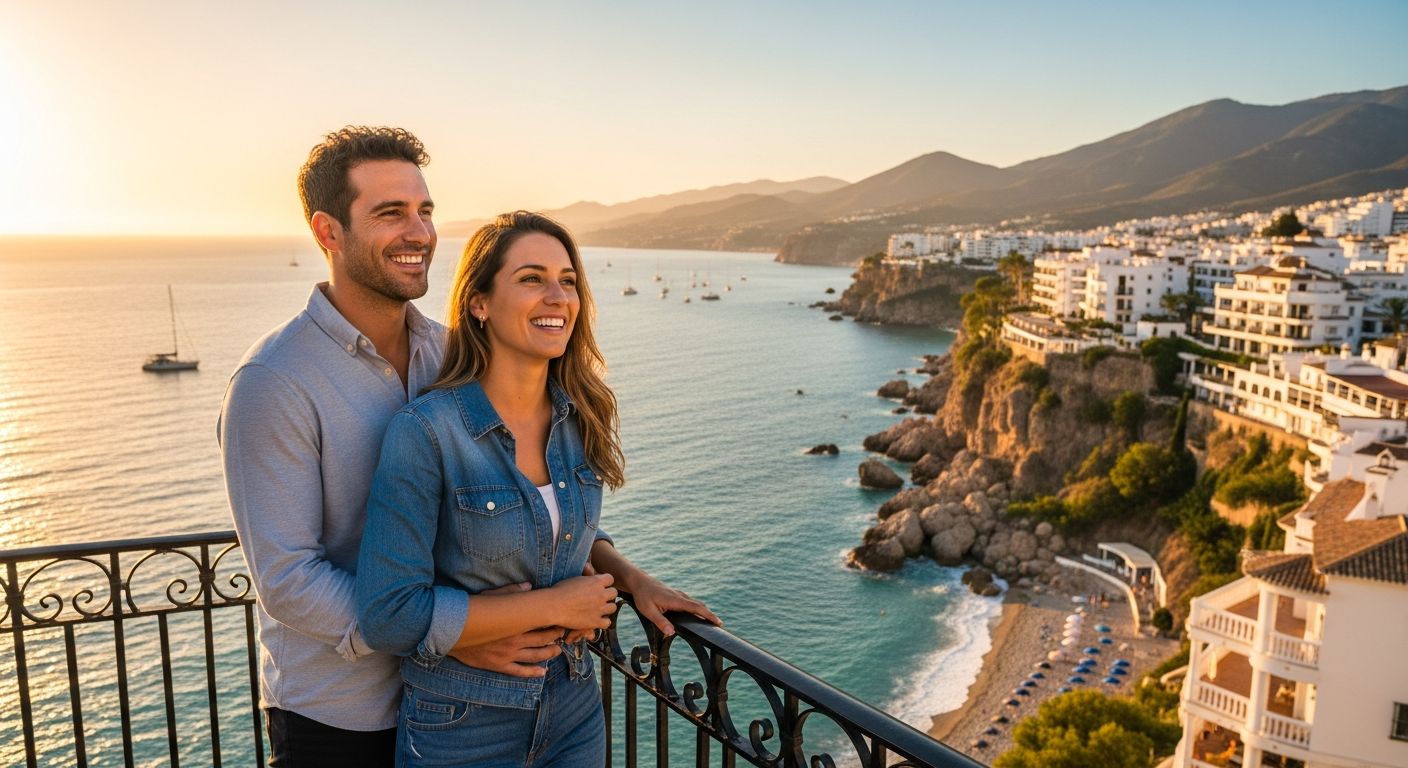
The Balcón de Europa is Nerja's most famous landmark and the emotional centre of the town. This dramatic promenade and viewpoint juts out into the Mediterranean from the end of the main street, offering panoramic views along the coastline in both directions — east towards the cliffs and coves of Maro, and west towards the sandy beaches of Torrecilla and El Playazo. On clear days, the coast of Africa is visible across the strait.
The site has a long history. Originally the location of a 9th-century Moorish fortress (the remains of which were destroyed in the 1812 earthquake), it was christened the "Balcón de Europa" by King Alfonso XII during a visit in 1885. According to local tradition, the king was so moved by the spectacular view that he declared it "the balcony of Europe" — and the name has endured.
Today, the Balcón de Europa is the social and commercial hub of Nerja. The broad promenade is flanked by restaurants, cafés, and ice cream parlours, and serves as the town's living room — a place where locals and visitors gather to watch the sunset, listen to street musicians, and enjoy the warm evenings. Below the balcony, small beaches and coves can be reached by stairs and paths, offering swimming spots that feel remarkably secluded despite being in the centre of town.
For property buyers, proximity to the Balcón de Europa is one of the key factors in property valuation. Apartments and townhouses in the old centre with views of or walking access to the balcony command premium prices, while properties in the surrounding streets offer the everyday convenience of being in the heart of Nerja's most vibrant area.
The Famous Caves of Nerja
The Cueva de Nerja (Caves of Nerja) is one of Spain's most visited natural attractions and one of the most important prehistoric sites in the western Mediterranean. Discovered accidentally in 1959 by five local boys who were out hunting bats, the cave system extends for almost five kilometres, though only about a third is open to the public. The accessible galleries contain enormous stalactites and stalagmites — including the world's largest known stalagmite column at 32 metres — along with prehistoric cave paintings dating back approximately 42,000 years, which are among the oldest known artistic expressions in human history.
The caves attract over half a million visitors annually and host a renowned annual music and dance festival in the natural amphitheatre of the Sala de la Cascada. The acoustics within the cave are extraordinary, and performances here — which have included international ballet companies, classical orchestras, and flamenco artists — are considered among the most atmospheric cultural events in Spain.
For residents, the caves are more than a tourist attraction. They are a source of civic pride and a reminder of the extraordinary geological and archaeological heritage that lies beneath the surface of daily life in Nerja. The caves complex also includes a museum, botanical gardens, and walking paths through the surrounding hills, offering pleasant recreational options year-round.
Beaches and Coastline
Nerja's coastline is arguably the most beautiful on the entire Costa del Sol. Unlike the long, flat sandy beaches of the western coast, Nerja's shore is characterised by dramatic cliffs, hidden coves, crystal-clear waters, and a mix of sandy and pebbly beaches that retain a wild, unspoiled character.
Burriana Beach
Burriana is Nerja's main beach and one of the most popular on the eastern Costa del Sol. A long crescent of sand backed by a promenade lined with restaurants and chiringuitos, Burriana has the infrastructure of a well-developed resort beach — lifeguards, sun lounger hire, water sports — while maintaining a more relaxed atmosphere than the mega-beaches further west. The famous Ayo's restaurant, where an elderly fisherman has been cooking giant paellas on the beach for decades, is a Nerja institution.
Playa de la Torrecilla
The nearest sandy beach to the town centre, Torrecilla sits just west of the Balcón de Europa. Smaller and more intimate than Burriana, it is popular with local families and provides easy access from the old town.
Playa del Salón and Playa de la Calahonda
Two small, atmospheric beaches directly below the Balcón de Europa, reached by staircases carved into the rock. These tiny coves offer some of the most picturesque swimming spots on the coast — crystal-clear water, dramatic cliff backdrops, and a sense of seclusion that belies their central location.
The Coves of Maro
East of Nerja, towards the village of Maro, a series of spectacular coves are accessible by foot or by kayak. The Acantilados de Maro-Cerro Gordo natural park protects this stretch of coastline, which includes hidden beaches, dramatic rock formations, waterfalls that cascade directly into the sea, and some of the best snorkelling and diving on the entire Mediterranean coast. These coves — including Cala del Pino, Playa de Maro, and Cala de la Granadella — are among the most photographed natural sites in Andalusia.
More Spanish Character, Less Development
One of Nerja's defining characteristics is how successfully it has resisted the high-rise development that transformed much of the Costa del Sol from the 1960s onwards. Building height restrictions, the protective influence of the surrounding natural park, and a local culture that values its traditional character have combined to keep Nerja at a human scale.
The old town remains a labyrinth of whitewashed buildings rarely exceeding three or four storeys, with narrow streets that are cool in summer and sheltered in winter. The main commercial street — Calle Pintada and its continuation — is lined with independent shops, local bakeries, traditional bars, and small family-run businesses rather than the chain stores and British pubs that dominate some parts of the western Costa del Sol.
This is not to say Nerja is isolated from the modern world. The town has excellent supermarkets (Mercadona, Lidl, Día), a good range of restaurants spanning Spanish traditional to international contemporary, healthcare facilities, banks, and all essential services. But these are integrated into a town that still feels and functions like an authentic Spanish community rather than a tourist resort.
For property buyers, particularly those from Northern Europe, this balance is enormously appealing. You can live a genuinely Spanish life — shopping at the daily market, having coffee in a local bar, getting to know your neighbours — while still having access to the comfort and convenience of modern infrastructure. It is the best of both worlds, and it is what draws buyers to Nerja rather than to the larger, more developed towns further west.
Frigiliana: Spain's Prettiest White Village
No guide to Nerja would be complete without discussing Frigiliana — the stunning white village that sits in the foothills of the Sierra de Almijara, just 6 kilometres inland from Nerja. Frigiliana has been voted one of Spain's prettiest villages multiple times and regularly appears in lists of the most beautiful villages in Europe.
The village is a visual masterpiece of Moorish-influenced architecture: steep, narrow streets paved with intricate pebble mosaics, whitewashed houses with terracotta roofs and cascading bougainvillea, shaded plazas with fountains, and panoramic views from every turn that sweep across the mountains down to the Mediterranean far below. The old quarter (Barrio Mudéjar) is one of the best-preserved examples of Moorish urban design in Andalusia, with ceramic plaques on the walls telling the history of the Moorish rebellion of 1569.
Frigiliana is not a museum — it is a living village of about 3,200 inhabitants with restaurants, shops, a small but growing international community, and a famous annual music and dance festival. The village is also known for its production of miel de caña (cane honey/molasses), made at the only remaining traditional sugar cane factory in Europe.
For property buyers, Frigiliana offers a rural mountain lifestyle with Nerja's beaches and services just minutes away. Village houses and apartments are available from €120,000, while renovated properties with views can reach €300,000-€500,000. The combination of Nerja's coast with Frigiliana's mountain beauty is one of the most compelling lifestyle packages in southern Spain.
Property Areas and Neighbourhoods
Old Town (Casco Antiguo)
The historic centre around the Balcón de Europa, with traditional whitewashed apartments, townhouses, and a handful of characterful renovated properties. Properties here offer atmosphere and walkability but tend to be older buildings with limited parking. Prices range from €150,000 for a modest apartment to €400,000+ for a renovated townhouse with views.
Parador / El Playazo Area
The area to the west of the old town, stretching towards El Playazo beach, includes the prestigious Parador hotel and a mix of apartment complexes, modern villas, and some of Nerja's most desirable residential addresses. Properties here benefit from beach proximity, sea views, and a quieter setting than the bustling centre.
Burriana Area
The residential area around Burriana beach includes a range of apartment buildings, some modern developments, and easy access to the beach and its restaurants. Popular with both permanent residents and holiday home buyers, with prices from €140,000 to €300,000 for apartments.
Capistrano Village
An established residential urbanisation on the hillside east of the centre, Capistrano offers apartments and villas with spectacular views over the coastline. Originally developed in the 1970s, many properties have been updated, and the urbanisation has its own shops, restaurants, and communal pools. A popular choice for international buyers.
San Juan de Capistrano / Eastern Heights
Hillside areas above the town with villas and detached houses offering panoramic sea and mountain views. These areas tend to be quieter and more spacious, with properties ranging from €300,000 to €700,000 depending on size, condition, and views.
Property Prices in 2026
| Property Type | Price Range | Typical Locations |
|---|---|---|
| Apartments (2 bed) | €140,000 - €280,000 | Burriana area, outskirts, older buildings |
| Apartments (2-3 bed, sea views) | €220,000 - €380,000 | Capistrano, Parador area, Old Town |
| Townhouses (2-3 bed) | €200,000 - €400,000 | Old Town, Burriana area |
| Villas (3-4 bed) | €300,000 - €700,000 | Eastern heights, hillside urbanisations |
| Frigiliana village houses | €120,000 - €350,000 | Frigiliana old quarter and surroundings |
Nerja's prices are generally competitive with the Costa del Sol average, though premium properties with exceptional views or locations can command significant prices. Compared to Marbella, prices are roughly 40-60% lower for equivalent quality. Compared to Fuengirola or Torremolinos, Nerja is similar or slightly higher due to limited supply and strong demand from buyers seeking its particular character.
The Eastern Costa del Sol Lifestyle
Living in Nerja is fundamentally different from living on the western Costa del Sol. The pace is slower, the landscape is more dramatic, and the Spanish character is more pronounced. This is not a criticism — it is simply a different proposition, and understanding the difference is essential for buyers making the right choice.
On the positive side: Nerja offers genuine immersion in Spanish life, spectacular natural beauty, a strong sense of community (both local and international), excellent food at reasonable prices, lower density and less traffic than western coast towns, and a quality of light and landscape that artists and photographers find irresistible.
On the practical side: Nerja is further from Málaga Airport (65 km / 45-55 minutes by car), has less commercial infrastructure than larger towns, has fewer English-speaking services than heavily touristic areas, and experiences more seasonal variation in activity — though it never truly shuts down thanks to its permanent resident population.
The town has an active international community, including British, German, Dutch, Scandinavian, and French residents. Social groups, cultural activities, language exchanges, and community events provide ample opportunities for newcomers to connect. Many international residents report that the smaller scale and Spanish character of Nerja encourages deeper integration than is typical in larger expat hubs.
Transport and Connectivity
- Málaga Airport (AGP): 65 km / 45-55 minutes via the A-7 and AP-7
- Málaga city: 50 km / 40 minutes
- Granada: 100 km / 1 hour 15 minutes (via dramatic mountain road)
- Almería: 160 km / 1 hour 40 minutes
- Bus service: Regular ALSA buses to Málaga (1 hour) and along the coast
- No train connection: Nerja does not have a rail link (plans have been discussed for decades but not realised)
The absence of a train connection is Nerja's main transport limitation. However, the A-7 coastal road is good, the AP-7 motorway extends to the area, and the bus service is reliable if not frequent. Many residents maintain a car, and the drive to Málaga Airport through the coastal mountains is one of the more scenic airport transfers in Spain.
Investment Outlook
Nerja's property market benefits from structural factors that support long-term value: limited land for new development (hemmed by mountains and natural park), building height restrictions that prevent densification, strong demand from quality-conscious international buyers, and a growing reputation as the authentic alternative to the overdeveloped western coast.
Holiday rental potential is strong — Nerja attracts a loyal visitor base that returns year after year, drawn by the natural beauty, Spanish character, and lower prices compared to resorts further west. The caves alone bring over 500,000 annual visitors, many of whom stay overnight in the town.
Price growth has been steady at 4-7% annually in recent years. The market is less volatile than Marbella's because it is driven more by lifestyle buyers than by speculation, and the limited supply of properties keeps the market from the boom-and-bust cycles that have affected more heavily developed areas.
Is Nerja Right for You?
Nerja is ideal for buyers who prioritise natural beauty, Spanish character, and a relaxed pace over convenience, nightlife, and metropolitan amenities. If you want a town that feels like the real Spain — with whitewashed streets, dramatic cliffs, hidden coves, and a community that knows your name — Nerja delivers this in a way that few places on the Costa del Sol still can.
Add the extraordinary bonus of Frigiliana just up the hill, the world-famous caves at your doorstep, and some of the most spectacular coastal scenery in the Mediterranean, and you have a destination that rewards residents with beauty and authenticity every single day. Nerja is not for everyone — buyers who need airports, shopping malls, and busy nightlife close at hand should look west. But for those who value what the western coast has lost, Nerja is where to find it.
Frequently Asked Questions
The Balcón de Europa: Nerja's Iconic Heart?
The Balcón de Europa is Nerja's most famous landmark and the emotional centre of the town. This dramatic promenade and viewpoint juts out into the Mediterranean from the end of the main street, offering panoramic views along the coastline in both directions — east towards the cliffs and coves of Maro, and west towards the sandy beaches of Torrecilla and El Playazo. On clear days, the coast of Africa is visible across the strait. The site has a long history. Originally the location of a 9th-century Moorish fortress (the remains of which were destroyed in the 1812 earthquake), it was christened the "Balcón de Europa" by King Alfonso XII during a visit in 1885. According to local tradition, the king was so moved by the spectacular view that he declared it "the balcony of Europe" — and the name has endured.
Beaches and Coastline?
Nerja's coastline is arguably the most beautiful on the entire Costa del Sol. Unlike the long, flat sandy beaches of the western coast, Nerja's shore is characterised by dramatic cliffs, hidden coves, crystal-clear waters, and a mix of sandy and pebbly beaches that retain a wild, unspoiled character. Burriana Beach Burriana is Nerja's main beach and one of the most popular on the eastern Costa del Sol. A long crescent of sand backed by a promenade lined with restaurants and chiringuitos, Burriana has the infrastructure of a well-developed resort beach — lifeguards, sun lounger hire, water sports — while maintaining a more relaxed atmosphere than the mega-beaches further west. The famous Ayo's restaurant, where an elderly fisherman has been cooking giant paellas on the beach for decades, is a Nerja institution.
Frigiliana: Spain's Prettiest White Village?
No guide to Nerja would be complete without discussing Frigiliana — the stunning white village that sits in the foothills of the Sierra de Almijara, just 6 kilometres inland from Nerja. Frigiliana has been voted one of Spain's prettiest villages multiple times and regularly appears in lists of the most beautiful villages in Europe. The village is a visual masterpiece of Moorish-influenced architecture: steep, narrow streets paved with intricate pebble mosaics, whitewashed houses with terracotta roofs and cascading bougainvillea, shaded plazas with fountains, and panoramic views from every turn that sweep across the mountains down to the Mediterranean far below. The old quarter (Barrio Mudéjar) is one of the best-preserved examples of Moorish urban design in Andalusia, with ceramic plaques on the walls telling the history of the Moorish rebellion of 1569.
Property Prices in 2026?
Property TypePrice RangeTypical Locations Apartments (2 bed)€140,000 - €280,000Burriana area, outskirts, older buildings Apartments (2-3 bed, sea views)€220,000 - €380,000Capistrano, Parador area, Old Town Townhouses (2-3 bed)€200,000 - €400,000Old Town, Burriana area Villas (3-4 bed)€300,000 - €700,000Eastern heights, hillside urbanisations Frigiliana village houses€120,000 - €350,000Frigiliana old quarter and surroundings
Nerja's prices are generally competitive with the Costa del Sol average, though premium properties with exceptional views or locations can command significant prices. Compared to Marbella, prices are roughly 40-60% lower for equivalent quality. Compared to Fuengirola or Torremolinos, Nerja is similar or slightly higher due to limited supply and strong demand from buyers seeking its particular character.
Transport and Connectivity?
Málaga Airport (AGP): 65 km / 45-55 minutes via the A-7 and AP-7 Málaga city: 50 km / 40 minutes Granada: 100 km / 1 hour 15 minutes (via dramatic mountain road) Almería: 160 km / 1 hour 40 minutes Bus service: Regular ALSA buses to Málaga (1 hour) and along the coast No train connection: Nerja does not have a rail link (plans have been discussed for decades but not realised)
The absence of a train connection is Nerja's main transport limitation. However, the A-7 coastal road is good, the AP-7 motorway extends to the area, and the bus service is reliable if not frequent. Many residents maintain a car, and the drive to Málaga Airport through the coastal mountains is one of the more scenic airport transfers in Spain.
Why Granfield Estate?
-
⚑
Office on the coast — we live here
Our office is in La Mata, Torrevieja. We know every neighbourhood, every street and the real prices — not from a catalogue, but from daily work on the ground.
-
⚖
In-house lawyer — 10+ years of experience
NIE, bank account, property check, contract, notary — legal support at every step. First consultation free.
-
🏠
Property management
Buying to rent? Our management company handles tenant search, maintenance and all questions.
-
🌐
We speak your language
English, Spanish, Russian, German, Finnish, Swedish and more. Licence RAICV 1663, member of Asivega.
Granfield Estate · Av. Bélgica 1, C.C. Parquemar, La Mata, 03188 Torrevieja · +34 865 44 33 33
Read also

Benidorm: Investment and Rental Property
21.05.2026
Complete guide to property investment in Benidorm: 6-8% rental yields, area comparisons, updated prices and year-round rental potential.

Costa Blanca Property Guide 2026: Complete Buyer's Handbook
22.05.2026
Everything you need to know about buying property on Spain's Costa Blanca — from Dénia in the north to Torrevieja in the south, with real prices, honest area comparisons, and practical advice.

Costa del Sol Property Guide: Malaga to Gibraltar
23.05.2026
From Marbella luxury to Nerja charm — a complete guide to buying property on Spain's Costa del Sol, with prices, area comparisons, and investment insights.