


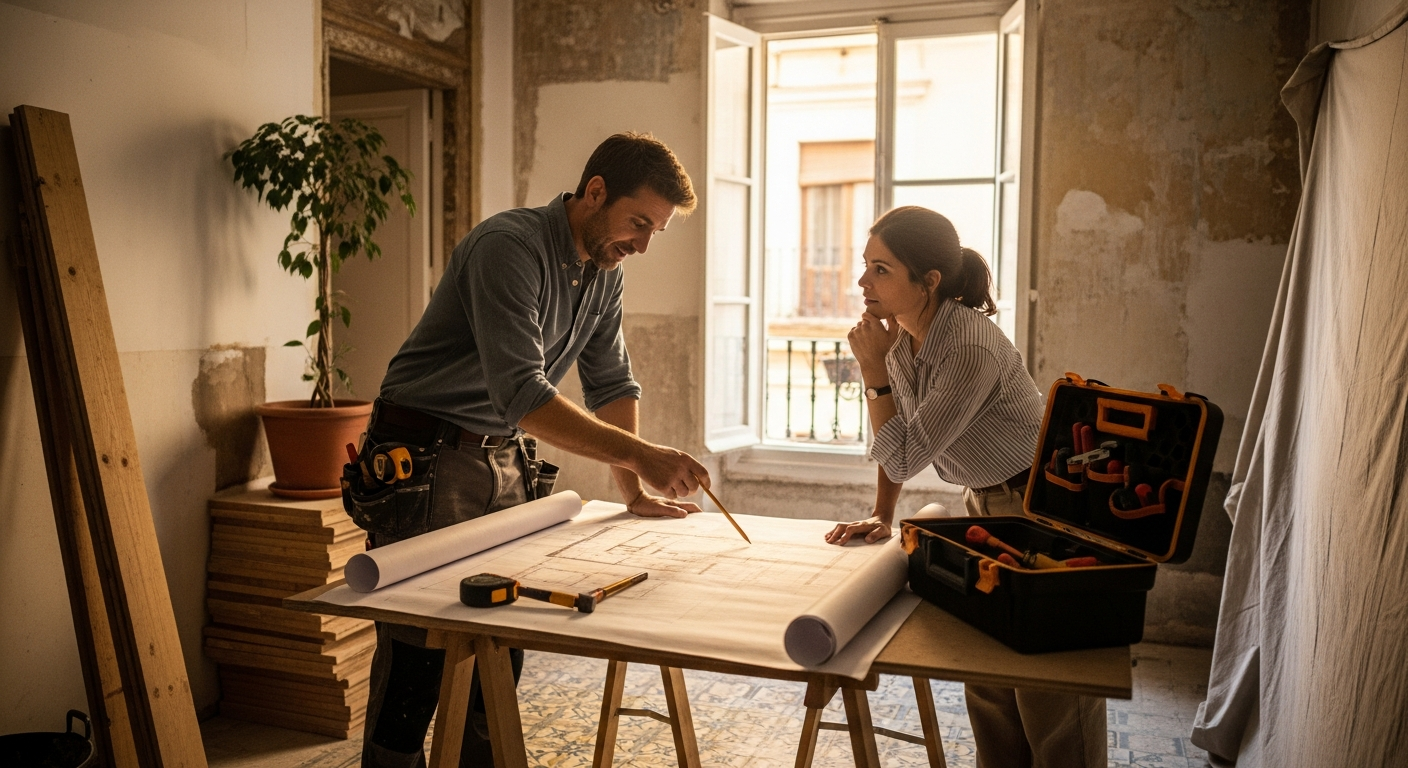
Why Renovate in Spain?
Spain offers some of the best renovation value in western Europe. Labour costs are significantly lower than in the UK, Germany, Scandinavia, or the Netherlands, yet the quality of skilled tradespeople — when you find the right ones — is excellent. Materials are affordable and widely available. And the sheer volume of older property stock means there is a deep, experienced renovation industry geared towards transforming dated apartments, tired townhouses, and crumbling fincas into beautiful modern homes.
Many foreign buyers in Spain deliberately seek out properties that need work. A two-bedroom apartment on the Costa Blanca that would sell for €120,000 in move-in condition might be available for €75,000-€85,000 if it needs a full renovation. Spend €25,000-€35,000 on a quality renovation and you have a property worth €120,000-€140,000 — with everything finished exactly to your taste. The same equation applies to townhouses, villas, and rural fincas, often with even wider margins.
But renovation in Spain is not without its challenges. Building permit processes are bureaucratic. Timelines are almost always longer than quoted. Cultural expectations around construction differ from what northern European or American buyers are accustomed to. And the potential for unpleasant surprises — hidden damp, asbestos, outdated electrics — is real in older Spanish properties. This guide covers every aspect of the renovation process, with honest costs and practical advice drawn from years of experience helping foreign property owners navigate the Spanish building world.
Renovation Levels: What Are You Getting Into?
Before you start getting quotes, it helps to understand the three broad levels of renovation and what each involves in terms of cost, time, and disruption.
Light Cosmetic Refresh: €5,000-€10,000
A light refresh covers the surface-level improvements that make a dated property feel clean and modern without touching the underlying structure or systems. This typically includes repainting throughout (walls and ceilings), replacing light fixtures and electrical outlets/switches with modern designs, updating bathroom fixtures (taps, showerhead, toilet seat, mirror, accessories), replacing interior door handles and hardware, and minor repairs such as fixing cracked tiles, regrouting, and patching plasterwork.
A light refresh is appropriate when the property has sound bones — the kitchen is functional, the bathroom layout works, the floors are acceptable, the electrics and plumbing are safe and up to code — but everything looks tired and outdated. This is also the level of renovation that makes sense for holiday rental properties where you want to present a clean, modern look without over-investing.
Timeline: 1-3 weeks for a standard apartment. You may not need any building permits for purely cosmetic work (more on permits below). A single painter and a handyman can handle most of this scope.
Medium Renovation: €15,000-€30,000
A medium renovation addresses the major functional spaces and surfaces without altering the structural layout. This typically includes a new kitchen (cabinets, worktops, appliances, tiling, plumbing, and electrical modifications), one or two new bathrooms (complete strip-out and refit with new sanitary ware, tiling, plumbing, and fixtures), new flooring throughout (removing old tiles and laying porcelain, ceramic, or laminate), new interior doors, a full repaint, updated electrical points (adding sockets, moving switches), and possibly new built-in wardrobes.
This is the sweet spot for most foreign buyers purchasing an older Spanish property. You keep the existing layout — which avoids the complexity and cost of structural work — but replace everything that matters for daily living comfort. A 1990s apartment with terracotta floor tiles, a cramped brown kitchen, and a pink bathroom becomes a contemporary, comfortable home.
Timeline: 6-12 weeks for a standard two- to three-bedroom apartment. You will need at least a licencia de obra menor (minor works licence) for this scope. You will need a builder (constructor) or small building firm, plus subcontracted specialists for plumbing, electrics, and possibly tiling.
Full Gut Renovation: €30,000-€60,000
A full gut renovation strips the property back to the bare walls (or even the bare structure) and rebuilds everything from scratch. This includes demolition of all non-structural internal walls, complete replanning of the interior layout, new partition walls, new electrical installation throughout (new wiring, new consumer unit, new distribution), new plumbing throughout (new pipes, new drainage connections), new kitchen and bathrooms in potentially new locations, new flooring on prepared substrates, new windows and exterior doors, new heating and cooling systems, and complete decoration throughout.
A gut renovation is necessary when the property has serious systemic issues — outdated aluminium wiring, lead or galvanised steel plumbing, layouts that do not work for modern living, or structural damp that requires treatment at the wall level. It is also the approach when you want to fundamentally reconfigure the space — opening up a closed kitchen to create an open-plan living area, combining two small bedrooms into one large one, or relocating bathrooms to better positions.
Timeline: 3-6 months for a standard apartment. Longer for a large villa or finca. You will almost certainly need a licencia de obra mayor (major works licence) and may need an architect (arquitecto) to prepare project plans, particularly if structural walls are being modified. We will cover permit types in detail below.
Cost Variables That Move the Numbers
The ranges above are realistic for standard properties in average Spanish locations. Several factors can push costs higher or lower. Location matters significantly: renovation in Barcelona, Madrid, Marbella, or Ibiza costs 20-40% more than in smaller towns along the Costa Blanca, Costa Cálida, or inland Andalusia. Labour costs track local living costs and demand. Property type also affects pricing: a ground-floor apartment with easy access for materials delivery costs less to renovate than a fourth-floor walk-up where everything must be carried up narrow stairs. Villas and fincas with large surface areas benefit from economies of scale on materials but often involve more complex work on roofing, exterior walls, and drainage. Material choices have an enormous impact: a basic porcelain floor tile costs €8-€15 per square metre, while a premium rectified large-format tile from Porcelanosa costs €40-€80 per square metre. The same applies to kitchen cabinets, worktops, sanitary ware, and every other finish. Finally, the condition of the existing property matters — hidden problems discovered during renovation can add 10-30% to the budget, which is why contingency planning is essential.
Building Permits: Licencia de Obra Mayor, Menor, and Comunicación Previa
The Spanish building permit system has three main categories, and understanding which applies to your renovation is essential. Working without the required permit is illegal, can result in fines, and — critically — can cause problems when you come to sell the property, because unpermitted work may not be reflected in the property registry or may be flagged during the buyer's due diligence.
Comunicación Previa (Prior Notification)
This is the simplest category, covering minor works that do not affect the building's structure, exterior appearance, or common elements. Painting, replacing fixtures, updating electrical outlets, replacing sanitary ware in existing positions, and like-for-like flooring replacement typically fall under comunicación previa. You file a notification with the town hall (ayuntamiento) describing the work, and you can begin after a waiting period — usually 15 days unless the ayuntamiento objects. No technical project is required. The fee is minimal, typically €50-€200 depending on the municipality.
Some municipalities have eliminated the comunicación previa category and require a licencia de obra menor even for very minor works. Others have expanded it to cover quite substantial interior renovations. There is no national standard — you must check with your specific ayuntamiento. This is where a local architect or aparejador (quantity surveyor/building engineer) earns their fee by knowing exactly what the local rules require.
Licencia de Obra Menor (Minor Works Licence)
This covers renovations that are more substantial than cosmetic changes but do not involve structural modifications. New kitchens, new bathrooms, new flooring throughout, replacing windows, updating the full electrical installation, replumbing, and internal reconfigurations that do not touch load-bearing walls typically require a licencia de obra menor. You submit an application to the ayuntamiento with a description of the works and, depending on the municipality, a basic technical report from an architect or aparejador. Processing time varies wildly: 2-6 weeks is typical, but some municipalities take 2-3 months. The licence fee is calculated as a percentage of the declared budget for the works, typically 2-4% plus administrative taxes (ICIO — Impuesto sobre Construcciones, Instalaciones y Obras). For a €25,000 renovation, expect to pay €500-€1,500 in permit fees and taxes.
Licencia de Obra Mayor (Major Works Licence)
This is required for any work that affects the building's structure, involves significant changes to the layout, modifies the exterior appearance, or changes the use of the property. Removing or modifying load-bearing walls, adding new rooms, changing the roofline, building extensions, adding a swimming pool, and converting commercial space to residential all require a licencia de obra mayor. You will need a full technical project prepared by a qualified architect (arquitecto), and the project must be approved by the ayuntamiento's urban planning department. The architect's project is then supervised during construction — either by the same architect or by an aparejador. Processing times are longer: 1-3 months is common, and complex projects in larger cities can take 6 months or more. Fees are higher, typically 3-5% of the declared budget, plus the architect's fees for preparing the project (which we cover below).
Working in a Community Building
If your property is in an apartment building or urbanisation with a community of owners (comunidad de propietarios), you need to check the community's statutes (estatutos) before starting any renovation. Most communities require you to notify the community administrator (administrador) before beginning works, and some require formal approval from the community for works that could affect common elements or cause significant disruption. At minimum, you will need to agree working hours — most communities restrict noisy works to weekday mornings and afternoons, prohibiting work on weekends and public holidays. Respect these rules scrupulously. Your neighbours will be living with the noise and dust of your renovation, and starting the relationship with a dispute is a poor foundation for community living.
Finding Builders: The Most Important Decision
The quality of your renovation depends more on the builder you choose than on any other single factor. A good builder with a modest budget will produce a better result than a bad builder with an unlimited budget. Finding reliable, competent builders in Spain takes effort, but the effort is repaid many times over.
How to Find Candidates
Personal recommendations are by far the most reliable source. Ask other foreign property owners in your area who they used and — equally important — who they would avoid. Real estate agents, particularly those who deal regularly with renovation properties, often know the best local builders. Your architect or aparejador, if you are using one, will have a network of builders they have worked with successfully. Online expat forums and local Facebook groups for foreign residents in your area are useful but should be treated as starting points for further investigation, not as endorsements.
Avoid builders who approach you unsolicited — particularly those who knock on your door or leave flyers. The best builders in Spain are busy and rarely need to advertise. They work through reputation and referral. A builder who is readily available to start next week in the middle of the busy season should raise a question: why are they not booked up?
Getting Quotes: Always Get Three
Request written quotes (presupuestos) from at least three builders for any significant renovation. A proper presupuesto should itemise every element of the work: demolition, materials (specifying brands and models), labour for each trade, waste removal, and IVA. Beware of single-line quotes ("kitchen renovation: €8,000") that do not break down what is included. These lead to disputes later when the builder claims that tiling behind the fridge, connecting the dishwasher, or installing under-cabinet lighting was not included in the price.
Compare quotes carefully. The cheapest quote is not necessarily the best value. Look at what is included and excluded. Check whether IVA is included or additional (a common source of confusion — a quote of €20,000 plus IVA at 10% means you actually pay €22,000). Verify that the quote includes waste removal (retirada de escombros), which can cost €500-€2,000 on a gut renovation. Ask specifically about electrical and plumbing certificates — your builder should provide a Boletín Eléctrico (electrical certificate) for any new or modified electrical installation, and equivalent certification for gas work.
Checking References
Before committing to any builder, ask for references from at least three previous clients, preferably foreign owners who have done similar work. Visit completed projects if possible. Look at the quality of finishing details — tile joints, paint edges, grouting, silicon sealing around baths and showers, alignment of electrical outlets. These details reveal a builder's standards more than anything else. Ask previous clients about timelines (did the builder finish on time or close to it?), communication (were problems discussed openly?), and final costs (did the final bill match the quote?).
Check that the builder is registered as autónomo or has a registered company (SL — Sociedad Limitada). Ask for their CIF (tax identification number). A builder who offers a significant discount for cash payment without IVA is telling you two things: they are evading tax, and they will provide no invoice or legal recourse if things go wrong. The 10% you save on IVA is not worth the total loss of legal protection.
Spanish Building Culture: What to Expect
Renovation in Spain follows cultural norms that differ from northern Europe, and understanding these differences will save you frustration and help you manage the project more effectively.
Timelines: Add 30-50%
Whatever timeline your builder quotes, add 30-50% as your realistic expectation. A quoted six-week renovation will likely take 8-9 weeks. A quoted three-month gut renovation will probably take 4-5 months. This is not necessarily dishonesty — it reflects the genuine unpredictability of renovation work, the complexity of coordinating multiple trades, the impact of weather on certain exterior works, and a cultural relationship with time that is simply different from German or Scandinavian precision.
Build this expectation into your planning from the start. If you need the property ready for summer rental bookings, start the renovation in January, not March. If you are relocating permanently, secure temporary accommodation for longer than the quoted renovation period. Do not book flights for a "handover weekend" based on the builder's optimistic completion date.
That said, there are things you can do to keep the project moving. Regular site visits (weekly at minimum) demonstrate that you are engaged and paying attention. Clear decisions made promptly — do not take three weeks to choose a tile colour — keep the workflow uninterrupted. And establishing a good personal relationship with your builder matters enormously in Spain. Construction here is still a relationship business.
Payment Stages: Protect Yourself
Never pay 100% upfront. This is the single most important financial rule of renovation in Spain. A common and reasonable payment structure is: 20-30% at the start (to cover initial materials and mobilisation), 30-40% at a defined midpoint (typically when demolition is complete and new installations begin), 20-30% on substantial completion, and 10% retained for 30-60 days after handover to cover any snagging items (repasos). This structure keeps the builder funded to continue work while ensuring you retain leverage to address quality issues before final payment.
Agree the payment schedule in writing before work begins, tied to specific milestones rather than dates. "30% when kitchen units are installed" is enforceable; "30% after four weeks" is not, because after four weeks the kitchen units might not have arrived yet. If a builder insists on more than 30% upfront or refuses to accept a retention, consider this a warning sign.
Communication and Decision-Making
If you do not speak Spanish, renovation becomes significantly more complex. Builders in Spain, particularly in smaller towns, rarely speak English. Even on the expatriate-heavy costas, the actual tradespeople doing the work — as opposed to the project manager or company owner — will almost certainly communicate in Spanish. You have several options: learn enough Spanish to discuss materials, colours, measurements, and timelines (this is valuable beyond the renovation); hire a bilingual project manager or architect who communicates with the builder on your behalf; or use a bilingual friend or translator for key meetings. WhatsApp is the universal communication tool on Spanish building sites. Photos exchanged via WhatsApp resolve more questions than any number of written specifications.
Materials: Where to Buy
Spain has an excellent range of building materials suppliers, from large national chains to specialist local suppliers. Where you buy affects both cost and quality, and understanding the landscape helps you make better decisions.
National Chains
Leroy Merlin: The French home improvement giant is Spain's largest DIY and renovation retailer. Stores are found in or near every significant city. The range is broad — from basic building materials to finished kitchens, bathrooms, flooring, paint, lighting, and garden products. Quality ranges from budget to mid-range. Leroy Merlin is excellent for comparing options, seeing physical samples, and getting a sense of price levels across different product categories. Their kitchen and bathroom planning service is competent and free. Prices are competitive for mid-range products.
Bricomart: Owned by the same parent group as Leroy Merlin, Bricomart focuses on professional and trade-scale purchasing. Products are sold in larger quantities at lower per-unit prices. If you are buying 100 square metres of floor tile, 50 bags of adhesive, and a pallet of plasterboard, Bricomart will be cheaper than Leroy Merlin. The stores are warehouse-format with less display polish but better trade pricing. This is where Spanish builders buy their materials, and if your builder is not buying here, ask why.
Porcelanosa: The Valencia-based premium tile and bathroom manufacturer is one of Spain's great success stories. Porcelanosa showrooms offer stunning high-end tiles, bathroom furniture, kitchen surfaces, and sanitary ware. Prices are premium — expect to pay 2-3 times the cost of equivalent products at Leroy Merlin — but the quality, design, and finish are exceptional. If your budget allows and you want a genuinely impressive finish, Porcelanosa products deliver. Their large-format tiles, in particular, transform a space. Visit a Porcelanosa showroom even if you ultimately buy elsewhere — it calibrates your eye for what is possible.
Local Suppliers
Almacenes de construcción (building supply warehouses): Every Spanish town of any size has one or more local building supply warehouses. These family-run businesses supply the local building trade with cement, sand, bricks, tiles, plumbing supplies, electrical materials, and everything else needed for construction. Prices are often the best available, particularly for basic materials. Your builder will have a preferred local almacén where they have an account and possibly a trade discount. Let them buy basic materials through their normal supply chain — they get better prices than you would as a retail customer, and the logistics of delivery to site are handled routinely.
For tiles specifically, the Castellón province in the Valencian Community is the heart of Spain's ceramic tile industry. If you are doing a large renovation and want premium tiles at factory prices, a trip to Castellón to visit manufacturer showrooms and outlets can save thousands of euros on a whole-house renovation. Brands like Porcelanosa, Vives, Aparici, and Tau have factory outlets with significant discounts on current and discontinued lines.
When You Need an Architect
Spanish law requires an architect (arquitecto) for any work that involves structural modifications — removing or modifying load-bearing walls, adding new structures, changing the roofline, building extensions, and similar works. For a licencia de obra mayor, the architect prepares the project (proyecto), submits it for approval, and supervises its execution. An aparejador (also called arquitecto técnico) handles the technical execution supervision and material quality control.
Architect fees in Spain are not regulated — they were deregulated years ago — so fees vary significantly. For a residential renovation project, expect to pay 5-10% of the construction budget for the architect's full service (design, project documentation, permit application, and construction supervision). On a €50,000 gut renovation, that means €2,500-€5,000 for the architect. Some architects charge fixed fees rather than percentages, which can be more economical for larger projects.
Even when an architect is not legally required, hiring one can be valuable for medium-to-large renovations. A good architect brings design expertise that maximises space, light, and functionality. They produce detailed plans and specifications that result in more accurate builder quotes and fewer disputes during construction. They supervise work quality on your behalf — particularly valuable if you are not permanently present. And they navigate the permit process efficiently because they do it routinely.
Finding a good architect follows the same principles as finding a good builder: personal recommendations, reviewing previous work, checking professional credentials (they should be registered with the Colegio de Arquitectos in their province), and assessing communication and cultural fit. For foreign owners, an architect who speaks your language or excellent English is extremely valuable — they become your interpreter not just of language but of the entire construction culture.
Energy Efficiency Upgrades: Spend Smart, Save Long-Term
If you are already renovating, incorporating energy efficiency improvements into the project is dramatically cheaper than retrofitting them later. Spain's climate makes certain upgrades particularly effective, and the return on investment can be compelling.
Windows and Doors
Replacing single-glazed aluminium windows — still common in Spanish properties built before 2000 — with modern double-glazed PVC or aluminium-with-thermal-break windows is one of the highest-impact upgrades you can make. Good windows reduce heat gain in summer (less air conditioning needed), reduce heat loss in winter (less heating needed), reduce external noise significantly, and eliminate the condensation and draughts that plague single-glazed properties.
Cost: €300-€800 per window depending on size, material, and glazing specification. A full apartment typically has 6-10 windows, so budget €3,000-€6,000 for a complete window replacement. The energy saving is typically €300-€600 per year in reduced heating and cooling costs, giving a payback period of 5-12 years. Beyond the financial return, the comfort improvement is immediate and dramatic — this is the upgrade that property owners consistently rate as making the biggest difference to their daily quality of life.
Insulation
Many older Spanish properties have zero wall insulation. In coastal areas, this was historically considered unnecessary because winters were mild. But mild is relative — uninsulated apartments in Alicante or Málaga can feel bitterly cold on January nights when exterior temperatures drop to 5-8°C and there is nothing between you and the outside but a single layer of brick and plaster. Adding insulation during a renovation is straightforward: interior wall insulation (trasdosado) using extruded polystyrene or mineral wool behind plasterboard costs €15-€30 per square metre and adds significant thermal comfort. Ceiling insulation is even cheaper at €10-€20 per square metre. For rooftop apartments and penthouses, roof insulation is essential — an uninsulated roof in southern Spain turns the top-floor apartment into an oven in summer.
Solar Panels
Spain averages 2,500-3,000 hours of sunshine per year, making solar panels an obvious investment. A domestic installation of 3-5 kW costs €4,000-€8,000 and typically pays for itself in 5-7 years through reduced electricity bills. After payback, you generate essentially free electricity for the remaining 20+ years of the system's life. If you are renovating a villa or a top-floor apartment with roof access (and community approval), integrating solar into the renovation project avoids the disruption and cost of a separate installation later. Many municipalities offer IBI (property tax) discounts of 25-50% for 3-5 years after solar installation, which accelerates the payback further.
Heat Pumps
Modern air-to-air heat pumps (essentially high-efficiency reversible air conditioning units) are the best heating and cooling solution for most Spanish properties. They deliver 3-4 units of heat for every unit of electricity consumed, making them far cheaper to run than direct electric heating. Aerothermal (air-to-water) heat pump systems for domestic hot water are also increasingly popular, reducing water heating costs by 60-70% compared to electric water heaters. An aerothermal hot water system costs €2,000-€4,000 installed and saves €200-€400 per year on electricity. Combined with solar panels, the running costs can approach zero.
The ROI Calculation
Energy efficiency upgrades are unusual in renovation because they pay for themselves. New windows, insulation, a heat pump, and solar panels on a typical three-bedroom property might cost €15,000-€25,000 combined. Annual energy savings of €1,500-€3,000 give a payback of 6-12 years. After payback, the savings continue for decades. Additionally, an energy-efficient property commands a higher sale price and — if you rent it — higher rental rates. The EPC (Energy Performance Certificate) rating improves visibly, which matters increasingly to both buyers and tenants. Spain is progressively tightening energy efficiency requirements, and properties with poor ratings may face restrictions or penalties in the future. Investing now future-proofs your property.
Common Renovation Surprises
Every experienced renovator in Spain has a story about an unpleasant discovery during demolition. Knowing what to look for — and budgeting for the unexpected — protects you from cost blowouts and dangerous situations.
Hidden Damp (Humedad)
Damp is the most common hidden problem in Spanish properties, particularly in ground-floor apartments, older townhouses, and properties in coastal areas. Types include rising damp (humedad por capilaridad) where moisture wicks up through the walls from the ground; penetrating damp from failed exterior waterproofing, cracked render, or damaged roof membranes; and condensation damp from inadequate ventilation in bathrooms and kitchens. Hidden damp is often concealed behind tiles, plaster, or fitted furniture. When you strip a bathroom or kitchen during renovation, you may discover mould growth, crumbling plaster, and even structural damage to the masonry behind.
Treatment costs vary enormously depending on the type and severity. A localised area of penetrating damp might cost €500-€2,000 to repair (fix the source, treat the affected wall, replaster). Rising damp requiring chemical injection treatment across an entire ground floor can cost €3,000-€8,000. The key is to identify and address the source, not just cover it up — a beautiful new bathroom tiled over a damp wall will fail within a few years.
Asbestos (Amianto)
Asbestos was widely used in Spanish construction from the 1960s through the 1990s. It was not banned in Spain until 2002 — later than many northern European countries. Common locations include fibre cement roofing sheets (uralita — the brand name is commonly used as a generic term), pipe insulation and lagging, floor tiles and adhesives (particularly vinyl tiles from the 1970s and 1980s), textured ceiling coatings, and some plasters and renders. If your property was built or significantly renovated between 1960 and 2002, there is a real possibility of encountering asbestos during demolition.
Spanish law requires that asbestos removal be carried out by a registered company (empresa inscrita en el RERA — Registro de Empresas con Riesgo de Amianto). Your builder cannot legally remove asbestos-containing materials. A specialist survey costs €200-€500, and removal costs depend on the quantity and type — from €1,000-€3,000 for a small amount of pipe lagging to €5,000-€15,000 for a full uralita roof replacement. Never attempt to handle, break, or dispose of suspected asbestos materials yourself. The health risks are severe and the legal penalties for improper disposal are significant.
Outdated Electrics
Spanish properties built before the 1990s frequently have electrical installations that would not meet current regulations. Common issues include aluminium wiring (which overheats at modern load levels), undersized cables for current appliance demands, insufficient earth (ground) protection, consumer units without modern RCD (diferencial) protection, and socket circuits that are daisy-chained without adequate ring main protection. Outdated electrics are both a safety hazard and a practical nuisance — they trip circuits, cannot handle modern appliance loads, and are a fire risk.
A complete electrical rewire of a two-bedroom apartment costs €3,000-€5,000 including a new consumer unit, proper earthing, RCD protection, and adequate circuits for modern living (dedicated circuits for kitchen, air conditioning, washing machine, and water heater). This is also when you add enough sockets — older Spanish apartments notoriously have far too few electrical outlets for modern life. A rewire during a gut renovation adds relatively little to the overall cost because the walls are already open. Retrofitting a rewire into a finished apartment is far more expensive and disruptive.
After any significant electrical work, your electrician must issue a Boletín Eléctrico (electrical installation certificate) confirming the installation meets current regulations. This certificate is required by your electricity supplier and may be requested by insurance companies. Insist on receiving it — it is not optional.
Plumbing Surprises
Older Spanish properties may have galvanised steel water pipes (which corrode internally, restricting flow and discolouring water), lead supply pipes (in very old properties — a health hazard), shared drainage stacks that are undersized for the number of units in the building, and polybutylene pipes (used in the 1980s-1990s, prone to sudden failure). A full replumb of a two-bedroom apartment costs €2,000-€4,000. As with electrics, doing this during a renovation when walls and floors are open is vastly cheaper than doing it as a standalone project later.
IVA on Renovation: 10% vs 21%
The IVA (VAT) rate on renovation work in Spain depends on the type of work and who is performing it. Understanding the rules can save you a significant amount of money.
Reduced rate of 10%: This applies to renovation and repair work on private dwellings (viviendas particulares) when the work is carried out by a builder or tradesperson and the materials are supplied as part of the service. The property must be your private dwelling (either primary or secondary residence) — not a commercial property. The materials included in the work must represent less than 40% of the total cost (in practice, this means labour-intensive work like plumbing, electrical installation, plastering, and painting qualifies for 10%). If materials exceed 40% of the total invoice, the entire invoice should technically be charged at 21%, though many builders structure their invoicing to maintain the 10% rate by separating materials and labour.
Standard rate of 21%: This applies to the purchase of materials that you buy yourself directly from a supplier (Leroy Merlin, Bricomart, Porcelanosa, or any other retailer). It also applies to renovation work on commercial properties and to any work where the materials component exceeds 40% of the total invoice value. Kitchen appliances purchased separately are always at 21%. Furniture and furnishings are always at 21%.
The practical implication: if your builder supplies and installs the bathroom tiles, the invoice for that work is at 10% IVA. If you buy the tiles yourself from Porcelanosa and the builder only charges for installation labour, you pay 21% IVA on the tiles and 10% on the labour. For high-value materials where you want a specific product, it can sometimes make sense to have the builder order them — even if they add a small margin — because the overall IVA saving at 10% outweighs the markup. Discuss this with your builder and calculate both scenarios.
Adding a Swimming Pool
A swimming pool is one of the most desirable features for both personal enjoyment and rental income in Spanish property. If your property does not have one, adding a pool during or alongside a renovation is a project that many foreign owners consider.
Permits
A swimming pool requires a licencia de obra mayor in virtually all Spanish municipalities. You will need plans prepared by a qualified professional (architect or engineer), which include the pool dimensions, construction details, safety features, drainage and water treatment systems, and compliance with local regulations on setbacks from boundaries. Some municipalities have specific pool regulations regarding minimum distances from neighbouring properties (typically 2-3 metres from boundaries), maximum depth, fencing and safety requirements (particularly if children are present), and water drainage and overflow management.
The permit process typically takes 1-3 months. Do not begin pool construction without the permit — unpermitted pools are a known enforcement target for Spanish building inspectors, and the consequences can include demolition orders, significant fines, and problems when selling the property.
Costs
A standard in-ground concrete pool of 8 x 4 metres costs €15,000-€25,000 installed, including excavation, reinforced concrete shell, waterproofing, tiling or liner, filtration system, pump, and basic surround. Factors that increase costs include: difficult access for excavation equipment (add €2,000-€5,000), rocky ground requiring pneumatic breaking (add €3,000-€8,000), infinity or overflow edge designs (add €5,000-€15,000), integrated spa/hot tub sections, and premium finishes like natural stone surrounds or glass mosaic tiling. A basic pool cover (essential for reducing evaporation and keeping the pool clean) costs €1,000-€3,000. A motorised safety cover costs €3,000-€8,000. Pool heating via heat pump costs €2,000-€5,000 installed and extends the swimming season from roughly May-October to March-November.
Ongoing Maintenance
A pool is not just a construction cost — it requires ongoing maintenance that you need to factor into your annual budget. Chemicals (chlorine or salt electrolysis), electricity for the pump and filtration, and periodic equipment maintenance cost €600-€1,500 per year for a standard pool that you maintain yourself. A professional pool maintenance service (common for holiday homes where the owner is not permanently present) costs €80-€150 per month, or roughly €1,000-€1,800 per year. Water refill costs vary depending on local water prices and evaporation rates (significant in southern Spain), but budget €200-€500 per year.
Salt water chlorination systems (cloración salina) have become the preferred option for many pool owners. The initial system costs €800-€2,000 more than a standard chlorine setup, but the ongoing chemical costs are lower and the water is gentler on skin and eyes. The salt cell needs replacing every 3-5 years at a cost of €300-€600.
Project Management: Keeping It on Track
Whether you manage the renovation yourself or hire a professional, certain practices keep projects on track and protect your investment.
Written contracts: Get everything in writing before work starts. The contract (contrato de obra) should specify the scope of work in detail, the total price (including whether IVA is included), the payment schedule tied to milestones, the start date and estimated completion date, the materials to be used (specific brands and models for visible finishes), responsibility for permits, insurance during construction, and provisions for changes and additional works.
Change management: Changes during a renovation are almost inevitable. You will see something that does not look right, have a better idea, or discover a hidden problem that requires a different approach. Every change should be agreed in writing with a clear cost implication before the work is carried out. Verbal agreements on site lead to disputes at final billing. A simple WhatsApp message confirming "we agreed to add two extra sockets in the kitchen for an additional €120 including IVA" creates a record that both parties can reference.
Regular site visits: Visit the site at least weekly, ideally at a regular scheduled time so the builder knows you are coming. Take photographs at every visit — they document progress, quality, and any issues. A photo diary of the entire renovation is invaluable for resolving disputes, for insurance purposes, and (not least) for the personal satisfaction of seeing the transformation documented.
Snagging (repasos): At the end of the renovation, walk through the entire property systematically and compile a written list of defects, unfinished items, and quality issues. This snag list (lista de repasos) should be agreed with the builder, and the items should be resolved before you release the final retention payment. Common snag items include paint touch-ups needed after other trades have finished, silicon sealant that needs redoing, doors that do not close properly, electrical fittings that are not straight, and grout lines that are uneven. A thorough snagging process is the difference between a good renovation and a great one.
Final Advice
Renovation in Spain is a rewarding process that transforms a tired property into a beautiful home tailored to your taste. The costs are favourable by European standards, the climate means you can enjoy the results year-round, and the value uplift from a well-executed renovation is substantial. But success requires preparation, realistic expectations, and careful management.
Budget a contingency of 15-20% above your builder's quote for unexpected discoveries and changes. Start the permit process early — it always takes longer than you expect. Choose your builder on quality and references, not price alone. Make decisions promptly to keep the project moving. Invest in energy efficiency while the walls are open — it is the cheapest time to do it and the returns are compelling. And above all, build a good relationship with your builder and tradespeople. Spanish construction professionals take pride in their work, and a relationship built on mutual respect produces the best results.
The property you renovate today will serve you for decades. The investment of time, money, and attention during the renovation period pays dividends in comfort, value, and satisfaction for years to come.
Frequently Asked Questions
Renovation Levels: What Are You Getting Into?
Before you start getting quotes, it helps to understand the three broad levels of renovation and what each involves in terms of cost, time, and disruption. Light Cosmetic Refresh: €5,000-€10,000 A light refresh covers the surface-level improvements that make a dated property feel clean and modern without touching the underlying structure or systems. This typically includes repainting throughout (walls and ceilings), replacing light fixtures and electrical outlets/switches with modern designs, updating bathroom fixtures (taps, showerhead, toilet seat, mirror, accessories), replacing interior door handles and hardware, and minor repairs such as fixing cracked tiles, regrouting, and patching plasterwork.
Finding Builders: The Most Important Decision?
The quality of your renovation depends more on the builder you choose than on any other single factor. A good builder with a modest budget will produce a better result than a bad builder with an unlimited budget. Finding reliable, competent builders in Spain takes effort, but the effort is repaid many times over. How to Find Candidates Personal recommendations are by far the most reliable source. Ask other foreign property owners in your area who they used and — equally important — who they would avoid. Real estate agents, particularly those who deal regularly with renovation properties, often know the best local builders. Your architect or aparejador, if you are using one, will have a network of builders they have worked with successfully. Online expat forums and local Facebook groups for foreign residents in your area are useful but should be treated as starting points for further investigation, not...
Materials: Where to Buy?
Spain has an excellent range of building materials suppliers, from large national chains to specialist local suppliers. Where you buy affects both cost and quality, and understanding the landscape helps you make better decisions. National Chains Leroy Merlin: The French home improvement giant is Spain's largest DIY and renovation retailer. Stores are found in or near every significant city. The range is broad — from basic building materials to finished kitchens, bathrooms, flooring, paint, lighting, and garden products. Quality ranges from budget to mid-range. Leroy Merlin is excellent for comparing options, seeing physical samples, and getting a sense of price levels across different product categories. Their kitchen and bathroom planning service is competent and free. Prices are competitive for mid-range products.
Energy Efficiency Upgrades: Spend Smart, Save Long-Term?
If you are already renovating, incorporating energy efficiency improvements into the project is dramatically cheaper than retrofitting them later. Spain's climate makes certain upgrades particularly effective, and the return on investment can be compelling. Windows and Doors Replacing single-glazed aluminium windows — still common in Spanish properties built before 2000 — with modern double-glazed PVC or aluminium-with-thermal-break windows is one of the highest-impact upgrades you can make. Good windows reduce heat gain in summer (less air conditioning needed), reduce heat loss in winter (less heating needed), reduce external noise significantly, and eliminate the condensation and draughts that plague single-glazed properties.
IVA on Renovation: 10% vs 21%?
The IVA (VAT) rate on renovation work in Spain depends on the type of work and who is performing it. Understanding the rules can save you a significant amount of money. Reduced rate of 10%: This applies to renovation and repair work on private dwellings (viviendas particulares) when the work is carried out by a builder or tradesperson and the materials are supplied as part of the service. The property must be your private dwelling (either primary or secondary residence) — not a commercial property. The materials included in the work must represent less than 40% of the total cost (in practice, this means labour-intensive work like plumbing, electrical installation, plastering, and painting qualifies for 10%). If materials exceed 40% of the total invoice, the entire invoice should technically be charged at 21%, though many builders structure their invoicing to maintain the 10% rate by separating materials and labour.
Why Granfield Estate?
-
⚑
Office on the coast — we live here
Our office is in La Mata, Torrevieja. We know every neighbourhood, every street and the real prices — not from a catalogue, but from daily work on the ground.
-
⚖
In-house lawyer — 10+ years of experience
NIE, bank account, property check, contract, notary — legal support at every step. First consultation free.
-
🏠
Property management
Buying to rent? Our management company handles tenant search, maintenance and all questions.
-
🌐
We speak your language
English, Spanish, Russian, German, Finnish, Swedish and more. Licence RAICV 1663, member of Asivega.
Granfield Estate · Av. Bélgica 1, C.C. Parquemar, La Mata, 03188 Torrevieja · +34 865 44 33 33
Read also

How to Buy Property in Spain: Step-by-Step Guide 2026
05.06.2026
A complete step-by-step guide to buying property in Spain in 2026 — from getting your NIE number to signing at the notary. Costs, timelines, and pitfalls explained.

NIE Number in Spain: What It Is and How to Get One
06.06.2026
The NIE number is your essential ID for buying property, opening a bank account, and paying taxes in Spain. Here is exactly how to get one — in Spain or from abroad.

Mortgage in Spain for Foreigners: Complete Guide 2026
08.06.2026
Everything you need to know about getting a Spanish mortgage as a foreigner — LTV ratios, interest rates, required documents, best banks, and a step-by-step timeline.