


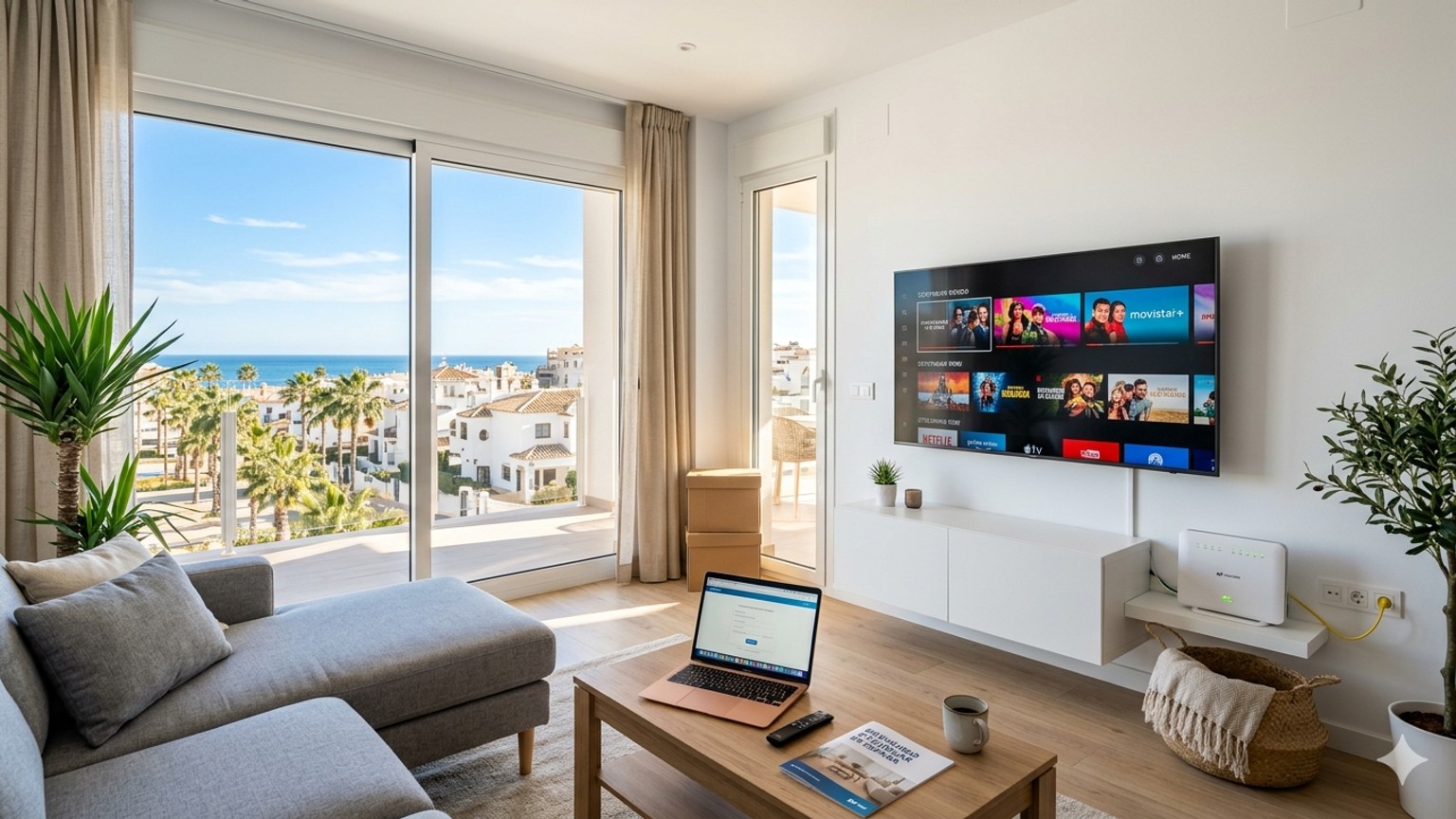
Spain's Internet Infrastructure: Better Than You Might Expect
If you are moving to Spain and worried about internet quality, here is some good news: Spain has one of the best fiber optic networks in Europe. The country invested heavily in FTTH (Fiber to the Home) infrastructure, and by 2026, fiber coverage reaches over 95% of the urban population. In cities like Madrid, Barcelona, Valencia, Alicante, and Malaga, gigabit fiber is standard and affordable.
That said, there are important exceptions. If you are buying a property in an urbanizacion (a residential development outside city centres, common on the Costa Blanca and Costa del Sol), fiber availability can be hit or miss. Some urbanizaciones built in the 2000s were never connected to fiber infrastructure, and you may be limited to ADSL (up to 20 Mbps) or 4G/5G wireless solutions. Always check fiber availability at your specific address before purchasing a property — your estate agent or the provider's website can confirm this.
Typical fiber speeds in Spain range from 300 Mbps to 1 Gbps symmetric (same upload and download speed). Even the cheapest fiber plans start at 300 Mbps, which is more than enough for streaming, video calls, and working from home. Spain's fiber infrastructure consistently ranks among the top 5 in the EU.
Major Internet Providers Compared
Spain has a competitive telecommunications market with several major providers and a growing number of budget operators. Here is a detailed comparison to help you choose:
Movistar (Telefonica)
Spain's largest and oldest telecom provider. Movistar has the widest fiber coverage, especially in rural and semi-rural areas. If fiber is available anywhere in your area, Movistar likely has it. They offer reliable service and good technical support, but at a premium price. Fiber-only plans start around €45-55/month for 600 Mbps, and convergent packages (fiber + mobile) run €55-70/month. Customer service is available in Spanish, with limited English support. Contract terms are typically 12 months with early termination fees.
Orange
The second-largest provider, Orange offers excellent value with good coverage in urban and suburban areas. Their fiber plans start at €35-45/month for 500 Mbps, and convergent packages with mobile are €40-55/month. Orange has invested in their own fiber network and also uses Movistar's infrastructure in some areas. Customer service quality is generally good, with some English-speaking support available. Contract terms are usually 12 months.
Vodafone Spain
Vodafone offers competitive packages with good service quality. Fiber plans start at €35-45/month for 500 Mbps. Their convergent packages (fiber + mobile) are priced at €45-60/month. Vodafone has decent English-language support, which makes them popular with expats. They use a mix of their own fiber network and Movistar's infrastructure. Standard 12-month contracts apply.
Digi
Digi is the disruptor in the Spanish market. This Romanian-origin provider has been expanding aggressively since 2019 and is now extremely popular with expats and budget-conscious consumers. Their fiber plans are remarkably cheap: €20-30/month for 300-1000 Mbps. Mobile plans with generous data start at just €3-10/month. The catch? Coverage is not as widespread as the big three — check their coverage map at dfrente.es. Customer service can be inconsistent, and wait times for installation may be longer. No contract commitment required for most plans, which is a major advantage.
MasMovil / Yoigo
MasMovil Group (which includes brands Yoigo, PepePhone, and Llamaya) offers solid mid-range options. Fiber plans range from €25-35/month for 300-600 Mbps. They use a combination of their own fiber and Movistar/Orange infrastructure. Good value for money with straightforward pricing. Some brands under the group (like PepePhone) are known for excellent customer service.
Provider Comparison Table
| Provider | Fiber Price/month | Speeds | Coverage | English Support | Contract |
|---|---|---|---|---|---|
| Movistar | €45-55 | 300-1000 Mbps | Best (urban + rural) | Limited | 12 months |
| Orange | €35-45 | 500-1000 Mbps | Very good | Some | 12 months |
| Vodafone | €35-45 | 500-1000 Mbps | Good | Good | 12 months |
| Digi | €20-30 | 300-1000 Mbps | Growing (urban) | Limited | No contract |
| MasMovil/Yoigo | €25-35 | 300-600 Mbps | Good | Limited | Varies |
The Installation Process: What to Expect
Setting up internet in Spain is straightforward but requires some preparation. Here is what you need and what to expect:
Documents Required
- NIE number (Numero de Identidad de Extranjero) — this is essential. You cannot sign a telecom contract without it.
- Spanish bank account — all providers require direct debit (domiciliacion bancaria). Credit card payment is not standard.
- Proof of address — your rental contract, property deed, or a recent utility bill.
- Passport or EU ID card
Step-by-Step Process
- Check coverage at your address on the provider's website or by calling them.
- Choose your plan — you can sign up online, by phone, or in a physical store. For expats, visiting a store is often easiest as staff can help with paperwork.
- Schedule a technician visit — if fiber is available but not yet connected to your property, a technician needs to install the fiber terminal (ONT) and router. This typically takes 1-2 hours.
- Wait for activation — expect 3-10 business days from signing the contract to having working internet. In busy periods or remote areas, it can take up to 2-3 weeks.
What If There Is No Fiber at Your Address?
If you discover that fiber is not available at your property (common in some urbanizaciones and rural areas), you have several alternatives:
- ADSL — if a phone line exists, you can get ADSL (up to 20 Mbps). Slow by modern standards, but workable for basic browsing and email.
- 4G/5G Home Router — Movistar, Orange, and Vodafone all offer fixed wireless solutions using the mobile network. Speeds of 30-300 Mbps depending on coverage. Typically €30-50/month.
- Starlink — available in Spain since 2022. Speeds of 50-200 Mbps with low latency. Costs approximately €40/month plus a one-time hardware fee of around €350. Excellent option for truly rural properties.
- Local WiMAX providers — in some coastal areas, local companies offer wireless broadband. Quality varies significantly.
Mobile Phone Plans in Spain
Getting a Spanish mobile number is one of the first things you should do when moving to Spain. You will need it for bank accounts, medical appointments, deliveries, and two-factor authentication for Spanish services.
Prepaid vs Contract
Prepaid (prepago) is ideal when you first arrive. You can buy a SIM card at any phone store, supermarket, or the provider's shop. You will need your passport or NIE. Top up as needed, no commitment. Good for the first few months while you settle in.
Contract (contrato) offers better value long-term. You will need a NIE and Spanish bank account. Most contracts are rolling monthly with no lock-in period for mobile-only plans. Convergent packages (fiber + mobile) may have 12-month commitments.
Best Mobile Options by Category
Premium providers (best coverage, 5G, roaming deals):
- Movistar — €15-30/month for 15-100 GB data
- Vodafone — €15-30/month, good international roaming options
- Orange — €15-25/month, strong 5G rollout
Budget providers (lower prices, great for international calls):
- Digi — €3-15/month for 5-50 GB, excellent international call rates, very popular with expats
- Lycamobile — €10-20/month, specializes in international calls, prepaid-friendly
- Lebara — €10-20/month, good international bundles, prepaid available
- Llamaya (MasMovil) — €8-20/month, competitive data packages
eSIM Options
Most modern smartphones support eSIM, and all major Spanish providers (Movistar, Orange, Vodafone) now offer eSIM activation. This lets you keep your home country physical SIM while adding a Spanish number digitally. Digi also supports eSIM. For short stays, international eSIM providers like Airalo or Holafly offer temporary Spanish data plans.
Watching TV from Your Home Country
This is perhaps the single most common question expats ask after moving to Spain: "How do I watch TV from home?" Whether it is the BBC, German public television, Dutch channels, or Scandinavian streaming, there are several solutions.
Spanish Free-to-Air TV (TDT)
Spain's digital terrestrial television (TDT — Television Digital Terrestre) is free and includes around 30 national channels plus regional channels. To receive TDT, you need a compatible TV (all modern TVs are) and a standard antenna — most apartments and houses already have one. Channels include La 1, La 2, Antena 3, Cuatro, Telecinco, La Sexta, and various 24-hour news, sports, and entertainment channels. All content is in Spanish, which makes TDT excellent for language learning.
Streaming Services
All major streaming platforms are available in Spain:
- Netflix Spain — €5.49-17.99/month, library differs from other countries but includes Spanish originals
- HBO Max — €5.99-13.99/month, strong film and series catalogue
- Amazon Prime Video — included with Amazon Prime (€4.99/month or €49.99/year)
- Disney+ — €5.99-11.99/month
- DAZN — sports streaming including La Liga football, from €9.99/month
- Movistar+ — Movistar's own platform with sports, series, and films (included in many fiber packages or from €10/month standalone)
Note that when you access Netflix, Amazon, or Disney+ from Spain, you will see the Spanish content library, which differs from your home country's. Some shows available in your home country may not be available in Spain and vice versa.
VPN for Home Country TV
A VPN (Virtual Private Network) allows you to connect to a server in your home country, making streaming services think you are there. This lets you access:
- BBC iPlayer (UK) — connect to a UK server
- SVT Play, TV4 Play (Sweden) — connect to a Swedish server
- NRK TV (Norway) — connect to a Norwegian server
- Yle Areena (Finland) — connect to a Finnish server
- ARD Mediathek, ZDF Mediathek (Germany) — connect to a German server
- NPO Start (Netherlands) — connect to a Dutch server
- France.tv (France) — connect to a French server
Popular VPN services that work well in Spain include NordVPN (from €3-5/month), ExpressVPN (from €6-8/month), and Surfshark (from €2-4/month). Choose a VPN with servers in your home country and good speeds for streaming. Most offer apps for Smart TVs, Fire Stick, and mobile devices.
Important: While using a VPN is legal in Spain, it may violate the terms of service of some streaming platforms. Services like Netflix are increasingly detecting and blocking VPN connections. This is a personal choice and risk assessment.
Satellite TV
Satellite remains a reliable option for watching home country channels, especially free-to-air broadcasts:
- Astra 19.2°E — carries German channels (ARD, ZDF, RTL, ProSieben, Sat.1), Dutch channels (NPO 1/2/3, RTL), and Austrian/Swiss channels. Many are broadcast unencrypted (free-to-air).
- Hotbird 13°E — carries Polish channels (TVP, Polsat, TVN), Italian channels (RAI, Mediaset), and various other European broadcasters.
- Astra 28.2°E — carries UK channels (BBC, ITV, Channel 4). Most are encrypted and require a UK-registered Sky or Freesat card.
A satellite dish (60-80 cm for most of Spain), an LNB, and a satellite receiver are all you need. Installation by a local technician costs €150-300. Many urbanizaciones already have communal satellite dishes.
IPTV Services
IPTV (Internet Protocol Television) services that offer live TV channels from multiple countries exist in Spain. These range from legitimate paid services to unlicensed streams. We mention them for awareness — if you choose this route, research the legality and reliability of any specific service carefully. Quality varies enormously, and unlicensed services can disappear without notice.
Smart TV Apps and Streaming Devices
A simple and effective approach is to use a streaming device with your Spanish internet connection:
- Amazon Fire TV Stick (€35-60) — install VPN apps, streaming apps from home country, and Spanish apps
- Google Chromecast (€30-70) — cast from your phone or tablet
- Apple TV (€169+) — premium option with excellent app ecosystem
- Xiaomi Mi Box (€60-80) — good budget Android TV option
These devices let you install your home country's streaming apps and combine them with a VPN for geo-restricted content.
Internet in Rural Areas and Urbanizaciones
If you have purchased a villa or townhouse in an urbanizacion outside the main towns, internet connectivity deserves special attention. This is one of the most common frustrations for new property owners on the Costa Blanca and Costa del Sol.
The Urbanizacion Problem
Many residential developments, especially those built between 1990 and 2010, were wired only for telephone (ADSL) and never received fiber upgrades. The telecoms invest in areas with high population density, and spread-out urbanizaciones with seasonal occupancy are low priority. You may find that an apartment in the town centre has 1 Gbps fiber, while a villa 3 kilometres away is stuck with 8 Mbps ADSL.
Solutions for Low-Coverage Areas
4G/5G Home Routers: The most common solution. Movistar, Orange, and Vodafone offer dedicated home routers that use the 4G or 5G mobile network. You get a router with an external antenna, and speeds typically range from 30-150 Mbps. Monthly costs are €30-50. Coverage depends on proximity to a mobile tower. Before committing, test 4G signal strength at your property with your phone.
Starlink: Elon Musk's satellite internet has been available in Spain since 2022 and is a game-changer for rural properties. The service costs approximately €40/month with a one-time hardware purchase of around €350 (for the standard kit). Speeds range from 50-200 Mbps with latency of 20-40ms — good enough for streaming and video calls. The dish is self-installing and needs a clear view of the sky. Starlink is the best option if you are in a truly rural area with poor mobile coverage.
Local Wireless ISPs: In areas like the Costa Blanca, several local companies provide wireless internet using directional antennas. They are usually small operations that know the area well and can provide solutions where the big providers cannot. Search for "internet rural [your area]" to find local options. Speeds and reliability vary.
Costa Blanca Specific Tips
The Costa Blanca, from Denia in the north to Pilar de la Horadada in the south, is one of Europe's most popular expat destinations. Here are area-specific internet and TV tips:
Torrevieja and Orihuela Costa
Fiber coverage in Torrevieja town centre is excellent — all major providers are available. In Orihuela Costa urbanizaciones (La Zenia, Playa Flamenca, Cabo Roig, Villamartin, Los Dolses), coverage is mixed. The newer developments and main roads usually have fiber, but older urbanizaciones on the outskirts may not. Digi has been expanding rapidly in this area and offers the best value if available. Check coverage at your specific address.
Benidorm and Northern Costa Blanca
Benidorm has excellent fiber coverage across the town. Surrounding areas like Albir, Altea, Calpe, and Javea have good coverage in town centres with gaps in rural and hillside properties. In mountainous areas, 4G routers or Starlink are common solutions.
Common Issues
- Shared community connections: Some urbanizaciones have a communal internet connection shared among residents. This is generally slow and unreliable — getting your own individual connection is strongly recommended.
- Seasonal slowdowns: In tourist areas, internet speeds can drop during summer months when the population triples. Fiber connections are less affected than wireless solutions.
- Power cuts: Brief power interruptions are more common in rural areas and urbanizaciones. Consider a UPS (uninterruptible power supply) for your router if you work from home — available from €30-50 at any electronics store.
Setting Up a Landline Phone
The traditional landline phone is increasingly unnecessary in Spain. Most people, including Spanish residents, rely entirely on mobile phones. However, if you want a landline:
- Included with fiber: Most fiber packages include a landline number at no extra cost. You just plug a phone into the router.
- VoIP services: If you want to keep a phone number from your home country, services like Skype (€3-7/month for a number) or Wise (formerly TransferWise) offer virtual phone numbers. Family and friends can call a local number in your home country and it rings on your phone in Spain.
- WhatsApp and video calls: In practice, most international communication happens via WhatsApp, FaceTime, or similar apps over your internet connection at no cost.
Monthly Cost Summary
Here is a realistic monthly budget for internet, mobile, and TV in Spain:
| Service | Budget Option | Mid-Range | Premium |
|---|---|---|---|
| Fiber Internet | €20-25 (Digi) | €35-40 (Orange) | €50-55 (Movistar) |
| Mobile Plan | €5-10 (Digi) | €15-20 (Orange) | €25-30 (Movistar) |
| VPN Service | €3-4 | €5-6 | €8-10 |
| Streaming (1-2 services) | €6-10 | €12-20 | €25-35 |
| Total Monthly | €34-49 | €67-86 | €108-130 |
Convergent packages (fiber + mobile from the same provider) typically save €10-15/month compared to buying services separately. Digi's combined fiber + mobile from €25/month is the most budget-friendly option in the market.
Practical Tips for a Smooth Setup
- Get your NIE first — you cannot sign any telecom contract without it. Apply as soon as possible after arriving.
- Open a bank account early — you need it for the direct debit. Some banks can open an account with just a passport, before you have NIE.
- Visit a physical store — especially if your Spanish is limited. Staff in tourist areas often speak English, German, or other languages.
- Check fiber at your address before buying property — if you work remotely, this can be a deal-breaker. Visit the provider websites and enter the exact address.
- Start with prepaid mobile — get a SIM the day you arrive, switch to contract later once you have NIE and bank account.
- Ask neighbours — existing residents in your urbanizacion know exactly which providers work well in your specific area. This is the most reliable information you can get.
- Consider a convergent package — bundling fiber + mobile with one provider saves money and simplifies billing.
- Keep a VPN subscription — even a basic one is invaluable for accessing home country content, online banking that blocks foreign IPs, and general privacy.
Setting up internet and TV in Spain is simpler and cheaper than in many northern European countries. The key is choosing the right provider for your specific location and needs. Once connected, you will find that Spain's modern infrastructure supports everything from remote work to streaming your favourite shows from home — all while enjoying the Spanish sunshine outside your window.
Why Granfield Estate?
-
⚑
We live on the coast
Our team lives and works on the Costa Blanca. We know every neighbourhood, every street and the real prices — not from a catalogue, but from daily work on the ground.
-
⚖
In-house lawyer — 10+ years of experience
NIE, bank account, property check, contract, notary — legal support at every step. First consultation free.
-
🏠
Property management
Buying to rent? Our management company handles tenant search, maintenance and all questions.
-
🌐
We speak your language
English, Spanish, Russian, German, Finnish, Swedish and more. Licence RAICV 1663, member of Asivega.
Read also

Cost of Living in Spain 2026: Monthly Budget Breakdown
10.06.2026
What it really costs to live in Spain in 2026. Complete monthly budget breakdown for a couple: from €1,500 to €2,500 per month, comfortable but not luxury.

Healthcare in Spain for Foreigners: Complete Guide
12.06.2026
Spain has one of Europe's best healthcare systems. How to access public and private healthcare as a foreigner — EHIC, SIP card, convenio especial, and private insurance explained.

10 Best Beaches on Costa Blanca (and Property Nearby)
17.06.2026
From the golden dunes of Guardamar to the hidden cove of Granadella — the 10 best beaches on Costa Blanca, with Blue Flag status, crowd levels, facilities, and property prices within walking distance.