


Mar Menor: Europe's Largest Saltwater Lagoon and Water Sports Paradise
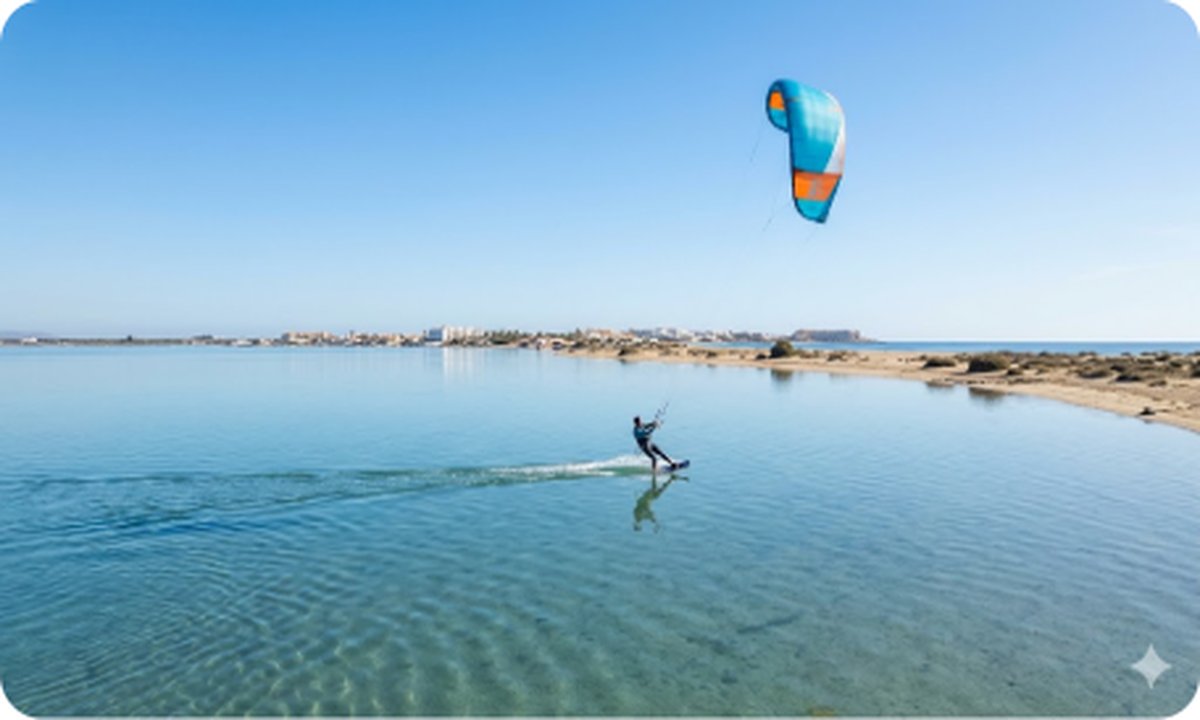
Most people who visit the Murcia coast for the first time expect a typical Mediterranean beach experience — waves, salt spray, deep blue water stretching to the horizon. Then they see Mar Menor, and their plans change. A vast inland lagoon with water so shallow you can wade hundreds of metres from shore, so warm it feels like a natural pool, and so calm that a child can paddle safely while adults kitesurf nearby.
Mar Menor is not a lake. It is a saltwater lagoon connected to the Mediterranean through several narrow channels, separated by La Manga — a 22 km sandbar that is itself one of the most distinctive geographical features on the Spanish coast. The lagoon covers 170 km², making it the largest body of saltwater enclosed by land in Europe. Its maximum depth is 7 metres, with most areas between 1 and 4 metres deep.
For the towns along its shores — Los Alcázares, San Pedro del Pinatar, San Javier, Cartagena — Mar Menor is both an economic engine and a way of life. This guide explores what makes the lagoon unique, the water sports that draw thousands of visitors each year, the Mediterranean beaches just minutes away, and what the climate looks like month by month.
What Makes Mar Menor Unique
Geology and formation
Mar Menor formed through a geological process spanning millions of years. La Manga — the narrow sandbar separating the lagoon from the Mediterranean — is the result of sediment accumulation driven by coastal currents. The sandbar is just 100–1,200 metres wide at various points along its 22 km length, with the Mediterranean on one side and the lagoon on the other. Several channels (golas) allow limited water exchange between the two bodies.
The lagoon sits in a natural depression on the Campo de Cartagena plain. Its shoreline stretches over 70 km, touching five municipalities. The seabed is predominantly sandy with patches of seagrass, and the shallow depth means sunlight reaches the bottom everywhere — supporting a unique ecosystem that differs markedly from the open Mediterranean.
Water properties: salinity and temperature
Mar Menor's salinity is higher than the Mediterranean — typically 42–47 parts per thousand compared to the Mediterranean's 36–38. This elevated salinity, combined with the shallow depth and enclosed nature, produces several distinctive effects:
- Higher water temperature: The lagoon absorbs heat faster and retains it longer. Summer surface temperatures reach 28–30°C (compared to 24–26°C in the Mediterranean). Even in winter, Mar Menor rarely drops below 12°C, while the open sea falls to 14–15°C.
- Greater buoyancy: The higher salt content makes floating easier — swimmers notice the difference immediately, especially those accustomed to freshwater lakes or the Atlantic.
- Therapeutic properties: For centuries, the mud and mineral-rich waters of Mar Menor have been used for therapeutic purposes. The mud baths at Lo Pagán remain popular today, though medical claims should be approached with appropriate scepticism.
Calm waters: why it matters
The near-complete absence of waves is Mar Menor's most important practical feature. La Manga blocks ocean swell from entering the lagoon. Local wind can create small ripples — 20–30 cm at most — but nothing resembling Mediterranean surf conditions. This makes the lagoon:
- Exceptionally safe for children and inexperienced swimmers
- Ideal for learning water sports (no current, no waves to fight)
- Perfect for anchoring small boats without the swell and surge of open water
- Accessible to elderly residents who want to swim regularly without fear of undertow
Water Sports on Mar Menor
The combination of consistent wind, shallow water, warm temperatures, and zero waves creates conditions that are difficult to replicate anywhere in Europe. Mar Menor has become a magnet for water sports enthusiasts ranging from absolute beginners to professional competitors.
Kitesurfing and windsurfing
Mar Menor is widely regarded as one of the best kitesurfing spots in Europe — and not just for experienced riders. The shallow water (you can stand up almost everywhere) means that falls are gentle, equipment recovery is simple, and beginners gain confidence quickly. The learning curve here is significantly shorter than at ocean spots where deep water and waves add complexity.
Wind conditions follow a reliable pattern: thermal winds (the Lebeche and the Levante) blow from the south and southeast most afternoons from April through October, typically 12–25 knots. Morning sessions tend to be calmer, making them suitable for lessons and freestyle practice. The peak kitesurfing season runs June through September, but April–May and October also offer excellent conditions with fewer crowds.
The main kitesurfing zone is the stretch between Los Alcázares and Los Narejos, where the water is consistently shallow for 300–500 metres from shore. Several schools operate along this stretch, offering equipment rental and courses in English, Spanish, German, and other languages.
Windsurfing follows similar conditions but tends to concentrate around La Manga and Santiago de la Ribera, where channel effects can create slightly stronger, more directional winds.
Sailing and dinghy racing
The flat water and predictable thermal winds make Mar Menor a natural venue for sailing training and competition. The Real Club de Regatas de Santiago de la Ribera, Club Náutico Los Alcázares, and Club Náutico Lo Pagán all offer sailing programmes, from introductory dinghy courses to competitive racing.
Classes commonly seen on the lagoon include Optimist (children), Laser, 420, and catamaran (Hobie Cat). The Spanish national sailing championships in several youth categories are regularly held on Mar Menor. International events, including European and world championship qualifiers, also use the lagoon — a testament to the quality of its sailing conditions.
For leisure sailors, the lack of tidal variation (Mar Menor has virtually no tide) and the predictability of the wind make planning straightforward. You can anchor anywhere the depth allows and swim off the boat in calm, warm water — something that ocean sailors rarely get to do.
Stand-up paddleboarding (SUP) and kayaking
The flat water and scenic shoreline make Mar Menor one of the most enjoyable places in Spain for stand-up paddleboarding. Early morning sessions — before the thermal wind picks up — offer glass-flat conditions and views of the sunrise over La Manga. Sunset paddles are equally popular.
SUP and kayak rental is available at multiple points along the shore in Los Alcázares, Santiago de la Ribera, and Lo Pagán. Guided tours explore the islands (Isla Perdiguera, Isla del Barón, Isla del Ciervo) scattered across the lagoon — these uninhabited volcanic islets are reachable by paddle in 30–60 minutes from the nearest shore, offering a genuine sense of exploration.
For fitness-oriented paddlers, the annual Mar Menor SUP race draws participants from across Spain and Europe. The course typically runs 12–15 km, with the flat water allowing competitive speeds rarely achievable in open-water events.
Scuba diving and snorkelling
While Mar Menor's shallow depth limits scuba diving within the lagoon itself, the Mediterranean side of La Manga offers some of the best diving in southeastern Spain. The Cabo de Palos – Islas Hormigas Marine Reserve, located at the southern tip of La Manga, is a protected underwater area with rich marine life, including groupers, barracuda, eagle rays, and extensive Posidonia seagrass meadows.
Visibility in the reserve frequently exceeds 20 metres. Several dive centres in La Manga and Cabo de Palos offer PADI and SSI courses, guided dives for certified divers, and snorkelling excursions. The combination of lagoon-side living and world-class diving just 15–20 minutes away is one of Mar Menor's underappreciated advantages.
Jet ski and motorised water sports
Jet ski rental is available at designated zones along the Mar Menor coast, with operators in Los Alcázares and La Manga. Speed restrictions apply within the lagoon to protect bathers and wildlife — motorised craft must stay within marked channels near populated beaches. Open stretches further from shore allow more freedom. Parasailing and wakeboarding are also available through licensed operators, primarily during the summer months.
The Mediterranean Side: Beaches Beyond the Lagoon
Living on Mar Menor does not mean giving up the Mediterranean. The open sea is never more than a few kilometres away, and some of southeastern Spain's most impressive beaches line the other side of La Manga and the coast south towards Cartagena.
La Manga del Mar Menor
The sandbar itself has Mediterranean beaches on its eastern side — long, narrow strips of sand facing the open sea. These beaches offer waves, stronger currents, and a different swimming experience from the lagoon. The northern section of La Manga (near the Tomás Maestre marina) tends to be less crowded than the southern end. Access from Los Alcázares takes about 15 minutes by car.
Cabo de Palos
This fishing village at the southern tip of La Manga has a distinctive lighthouse and a series of rocky coves with exceptionally clear water. The seafood restaurants here are considered among the best on the Murcia coast — the caldero (a local rice dish cooked with fish stock) is the signature dish. Cabo de Palos is 25 minutes from Los Alcázares and makes an excellent day trip.
Calblanque Regional Park
One of the most pristine coastal areas in Spain, Calblanque is a protected natural park with undeveloped beaches, dune systems, and salt flats. No hotels, no chiringuitos, no urbanisations — just sand, clear water, and native vegetation. Vehicle access is restricted in summer (shuttle bus from the car park), which keeps crowds manageable. The beaches face the open Mediterranean and offer a stark contrast to the calm lagoon. Calblanque is about 30 minutes from Los Alcázares.
Environmental Recovery: The Lagoon's Recent History
Any honest guide to Mar Menor must address the environmental challenges that have affected the lagoon in recent years. Between 2016 and 2021, Mar Menor experienced several episodes of ecological crisis — mass fish die-offs, algal blooms, and reduced water quality caused primarily by agricultural nutrient runoff from the Campo de Cartagena.
The situation has prompted significant legislative action. In 2022, Mar Menor became the first ecosystem in Europe to be granted legal personhood — a symbolic but important step that gives the lagoon standing in court. The Spanish government and the Murcia regional government have invested in reducing nutrient inputs through buffer zones, wetland restoration, and stricter regulation of agricultural practices in the catchment area.
As of 2026, water quality has improved measurably. Seagrass meadows — a key indicator of lagoon health — are recovering in several areas. Fish populations have stabilised. However, the recovery is ongoing and not yet complete. Prospective buyers and visitors should be aware of this context while also recognising the substantial progress being made.
The environmental regulations have had an indirect positive effect on property values: they limit new construction near the shoreline, which constrains housing supply and supports price stability for existing properties.
Climate Data: Month by Month
The table below summarises average conditions throughout the year, based on meteorological data from the Campo de Cartagena weather stations and Mar Menor water temperature monitoring.
| Month | Air Temp (°C) | Water Temp (°C) | Sunshine (hrs/day) | Rain (mm) | Wind Notes |
|---|---|---|---|---|---|
| January | 8–16 | 12–14 | 6 | 25 | Variable, calm days common |
| February | 9–17 | 12–14 | 7 | 25 | Occasional westerly gusts |
| March | 10–19 | 14–16 | 7 | 25 | Thermals begin, light Lebeche |
| April | 13–22 | 16–18 | 8 | 25 | Reliable afternoon thermals start |
| May | 16–26 | 19–22 | 9 | 20 | Good kite/windsurf conditions |
| June | 20–30 | 23–26 | 10 | 10 | Consistent thermals, 12–20 kn |
| July | 23–33 | 27–30 | 11 | 3 | Strong thermals, peak season |
| August | 24–34 | 28–31 | 10 | 5 | Strong thermals, peak season |
| September | 21–30 | 25–28 | 8 | 30 | Thermals weaken, DANA risk |
| October | 17–25 | 21–24 | 7 | 45 | Variable, occasional storms |
| November | 12–20 | 17–19 | 6 | 35 | Calmer, cool mornings |
| December | 9–17 | 14–16 | 6 | 25 | Variable, calm days common |
The DANA phenomenon (Depresión Aislada en Niveles Altos) — known internationally as a cold drop — can bring intense rainfall in September and October. These events are short-lived (typically 1–3 days) but can cause localised flooding. They are a normal part of the southeastern Spanish climate and do not reflect year-round conditions.
Living by the Lagoon: Property Options
Mar Menor has four main residential towns along its western shore, each with a distinct character:
Los Alcázares — The most popular base for water sports enthusiasts and the town with the most established international community. Compact, walkable, with direct beach access and a well-maintained promenade. Property ranges from affordable apartments (from €90,000) to seafront penthouses and villas. Read our detailed guide: buying property in Los Alcázares.
Santiago de la Ribera — Slightly more upscale, with a long promenade, sailing clubs, and a quieter atmosphere. Popular with Spanish families from Murcia city who use properties as second homes. Good restaurants and a weekly market.
Lo Pagán — Known for its mud baths and therapeutic traditions. More laid-back and less touristy. Property prices are among the lowest on the Mar Menor shore, making it an entry point for budget-conscious buyers.
San Pedro del Pinatar — The northernmost town on the lagoon, with a large salt flat nature reserve (Las Salinas) attracting flamingos and other birdlife. A genuine working town with a fishing port, less dependent on tourism than its neighbours.
All four towns are connected by the RM-12 coastal road, and the entire stretch from San Pedro del Pinatar to Los Alcázares takes about 15 minutes to drive. The Región de Murcia International Airport (Corvera) is equidistant from all of them — roughly 20–25 minutes.
Browse available properties across the Mar Menor area on our website: properties in Los Alcázares. Granfield Estate can help you identify the right town and neighbourhood based on your lifestyle preferences, budget, and whether you plan to use the property for personal residence, rental investment, or both.
Frequently Asked Questions
Is Mar Menor safe to swim in?
Yes. Following the environmental challenges of 2016–2021, water quality in Mar Menor has improved significantly. Regional authorities conduct regular water quality testing at all public beaches, and results are published weekly during the bathing season (June–September). As of 2026, the vast majority of Mar Menor beaches meet EU bathing water standards. The shallow depth and absence of currents make it exceptionally safe for swimmers of all ages and abilities. However, like any natural water body, conditions can vary — check local signage and municipal announcements before swimming.
When is the best time for water sports on Mar Menor?
The optimal window for wind-dependent sports (kitesurfing, windsurfing, sailing) is May through September, when thermal winds blow reliably most afternoons at 12–25 knots. June and July typically offer the strongest and most consistent winds. For SUP, kayaking, and other non-wind-dependent activities, the season extends from April through November — early mornings in spring and autumn provide the flattest water and most pleasant temperatures. Even winter has usable days, though water temperatures (12–14°C) require a wetsuit.
Are there schools for beginners?
Yes, multiple schools operate along the Mar Menor shore, concentrated in Los Alcázares and Santiago de la Ribera. Most offer courses in English and Spanish, with some also teaching in German, French, and other languages. Kitesurfing courses typically run 8–12 hours over 2–3 days (€200–€350). Sailing courses are offered through the local yacht clubs. SUP and kayak rental includes basic instruction and is available by the hour (€10–€20/hour). Equipment quality is generally high, and instructors hold recognised certifications (IKO for kite, RYA or national equivalents for sailing).
What is the water temperature in Mar Menor throughout the year?
Mar Menor water temperatures range from 12°C in January–February to 28–31°C in July–August. The lagoon warms up faster than the Mediterranean in spring (reaching 20°C by mid-May, compared to late June for the open sea) and cools down more slowly in autumn (still 21–24°C in October). For comfortable swimming without a wetsuit, the season runs from late May through mid-October. The warmest months (July–August) can feel almost bath-like, with surface temperatures occasionally exceeding 30°C in shallow nearshore areas.
Why Granfield Estate?
-
⚑
We live on the coast
Our team lives and works on the Costa Blanca. We know every neighbourhood, every street and the real prices — not from a catalogue, but from daily work on the ground.
-
⚖
In-house lawyer — 10+ years of experience
NIE, bank account, property check, contract, notary — legal support at every step. First consultation free.
-
🏠
Property management
Buying to rent? Our management company handles tenant search, maintenance and all questions.
-
🌐
We speak your language
English, Spanish, Russian, German, Finnish, Swedish and more. Licence RAICV 1663, member of Asivega.
Read also

What to Bring from Alicante
07.03.2026
Olive oil, jamón and wine are the obvious choices — but far from the only ones. We've gathered gift ideas from Alicante for every budget and suitcase size. Discover where to find unique souvenirs with authentic Spanish character without overpaying in tourist traps.

Ski resorts in Spain
17.03.2026
Spain isn't just beaches. The country has dozens of ski resorts with a mild climate and reasonable prices. Sierra Nevada, Baqueira-Beret, Formigal — we review the best slopes, the skiing season, and what sets Spanish skiing apart from the Alps. A pleasant discovery for winter sports enthusiasts.

Holidays in Alicante: tourist reviews
04.04.2026
200 km of beaches, a 9th-century castle, the mosaic Explanada, and a constant holiday atmosphere — Alicante wins you over from the very first visit. Year-round mild weather, an international airport, and one of Spain's best universities. We share tourist impressions and explain why people keep coming back.