


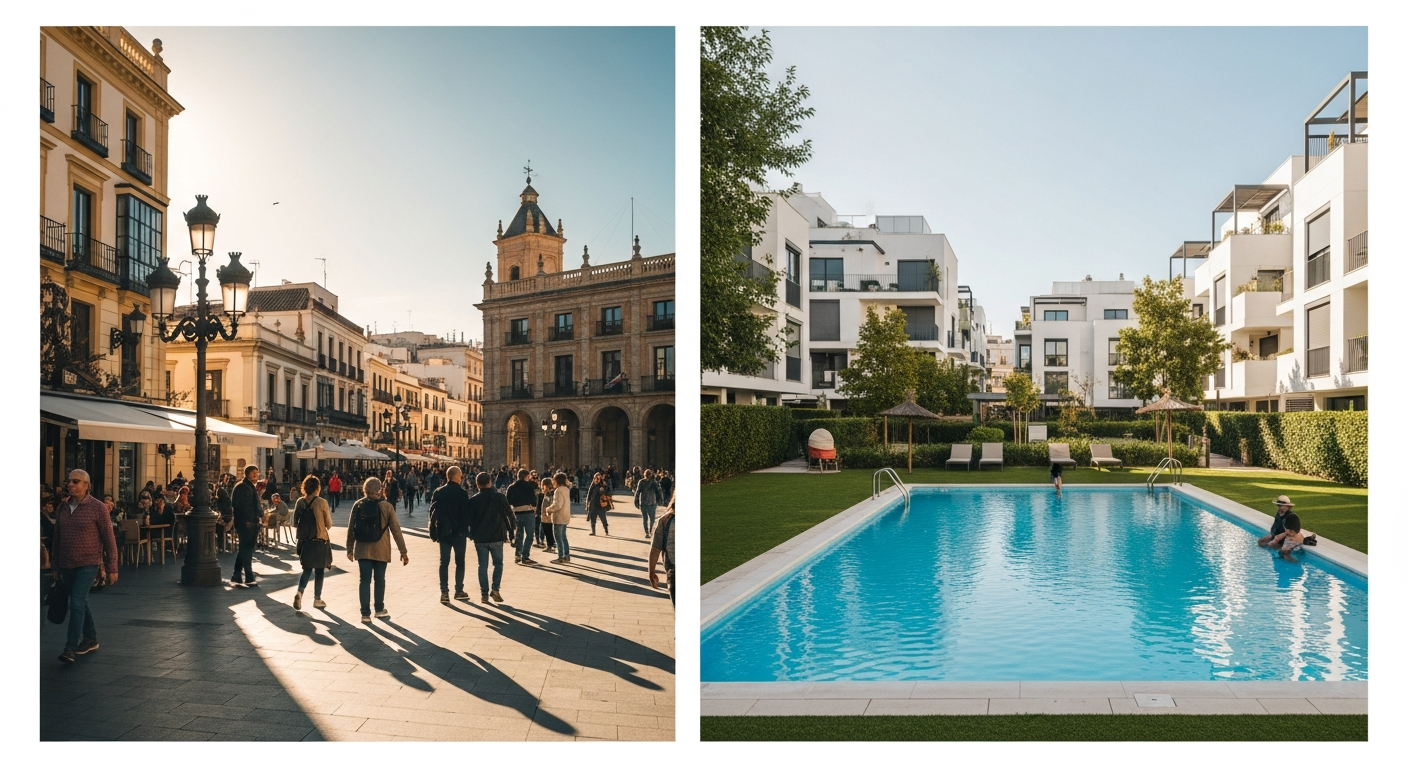
Two Worlds 15 Minutes Apart
Torrevieja and Orihuela Costa are separated by just a 15-minute drive, yet they deliver fundamentally different living experiences. Torrevieja is an authentic Spanish city — 80,000 registered residents (over 100,000 actual), with a municipal market, hospital, courts, and a full urban life. Orihuela Costa is a collection of tourist and residential urbanisations built between the 1980s and 2000s, with no defined town centre but spectacular beaches and a quiet, sun-and-golf lifestyle.
If you are considering buying property on the southern Costa Blanca, this is probably the biggest decision you will face: city life or urbanisation life? This guide compares both areas point by point.
Price Comparison by Property Type
| Property type | Torrevieja | Orihuela Costa |
|---|---|---|
| 1-bed apartment | €55,000–85,000 | €65,000–95,000 |
| 2-bed apartment | €75,000–130,000 | €90,000–160,000 |
| 3-bed apartment | €100,000–180,000 | €130,000–220,000 |
| Townhouse / Bungalow | €110,000–200,000 | €120,000–250,000 |
| Detached villa | €200,000–450,000 | €180,000–600,000 |
| New build (2-3 bed) | €180,000–300,000 | €200,000–380,000 |
Torrevieja is cheaper across the board, particularly for central apartments and properties in La Mata. Orihuela Costa has a wider price range — budget options in Playa Flamenca and Punta Prima sit alongside premium properties in Las Colinas Golf and Campoamor.
Beaches: Quantity vs Quality
Torrevieja has several urban beaches: Playa del Cura (the main one — central, packed in summer), Playa de Los Locos (quieter, popular with locals), Playa de Los Náufragos (Blue Flag), and the long sandy stretches of La Mata to the north. They are well-equipped with showers, lifeguards, and chiringuitos, but July and August bring serious overcrowding.
Orihuela Costa has some of the finest beaches in Alicante province. Playa Flamenca, Cala Capitán, Cala Bosque, Punta Prima, Cabo Roig, and Campoamor offer crystal-clear cove beaches with far less crowding than Torrevieja's urban strands. La Zenia beach is a regional standout. For beach quality, Orihuela Costa wins decisively.
Shopping, Restaurants, and Nightlife
Torrevieja delivers a full commercial offering: the Municipal Market (one of the largest in Spain), Carrefour, Mercadona, Lidl, independent shops throughout the centre, and the Habaneras shopping centre. Dining ranges from cheap tapas in the old town to seafood restaurants at the port. Nightlife is lively, especially in summer — bars and clubs line the promenade and the pub district.
Orihuela Costa has open-air commercial centres: La Zenia Boulevard (the largest shopping centre in Alicante province), the Cabo Roig Strip, and smaller retail zones in each urbanisation. Restaurants are plentiful but skew towards expatriate tastes — British, Scandinavian, and Central European cuisines sit alongside Spanish restaurants. Nightlife centres on the Cabo Roig Strip and is considerably quieter than Torrevieja.
Do You Need a Car?
Torrevieja: Not necessarily. The centre is walkable, with supermarkets, doctors, pharmacies, banks, and beaches all on foot. There is a local bus service and connections to Alicante and the airport. Many residents live comfortably without a car, especially in the centre and La Mata.
Orihuela Costa: Essentially yes. The urbanisations are spread out, pavements are often missing or poorly maintained, and distances between services are significant. A limited bus service (Costa Azul) exists but is not sufficient to replace a car. Without one, you rely on taxis or the goodwill of neighbours.
Winter Life
Torrevieja stays alive in winter. Bars and restaurants remain open, the market runs as normal, there are cultural events at the auditorium and theatre, and the large community of foreign residents — especially Scandinavians, British, and Eastern Europeans — maintains an active social life. The seafront is busy on any sunny January afternoon.
Orihuela Costa empties significantly in winter. Many urbanisations become half-deserted, several restaurants and shops close from November to March, and the sense of isolation can be noticeable. Urbanisations with more permanent residents (Punta Prima, Playa Flamenca) hold up better than the more tourist-oriented ones (Campoamor, Dehesa de Campoamor).
Rental Yield Comparison
| Rental type | Torrevieja (gross) | Orihuela Costa (gross) |
|---|---|---|
| Tourist / holiday let | 6–8% | 5–7% |
| Long-term rental | 5–7% | 4–6% |
| Hybrid (10+2 months) | 6–8% | 5–7% |
Torrevieja edges ahead on yields thanks to lower purchase prices and stronger long-term rental demand (there is a local job market). Orihuela Costa relies more heavily on holiday lets, which can generate high income in July and August but suffer from low winter occupancy. That seasonal dip is the weak point for annual yield calculations.
Who Should Buy Where?
Retirees without a car: Torrevieja, without question. Everything is walkable, the hospital is close, and social life is active year-round. Central Torrevieja or La Mata are ideal.
Retirees with a car seeking peace and quiet: Orihuela Costa. Better environmental quality, urbanisations with pools, less noise, magnificent beaches. Punta Prima and Cabo Roig are excellent choices.
Families with children: Depends on priorities. Torrevieja has more schools (state, semi-private, and international), extracurricular activities, and urban life. Orihuela Costa has safer, quieter urbanisations but fewer educational and social services.
Rental investors: Torrevieja for long-term rental (higher demand, lower prices, better yield). Orihuela Costa for premium tourist lets if the property is near the beach or in a golf area.
Digital nomads: Torrevieja. You need cafés, coworking options, reliable fibre optic, and walkable social life. Orihuela Costa can feel isolated if you work from home without a car.
Infrastructure and Services
Healthcare: Torrevieja has the Hospital Universitario de Torrevieja and multiple health centres. Orihuela Costa relies on the Aguamarina health centre and, for emergencies, Torrevieja Hospital or Hospital Vega Baja in Orihuela (30 minutes away).
Transport: Alicante-Elche airport is 35 minutes from Torrevieja and 25 minutes from northern Orihuela Costa urbanisations. Murcia-Corvera airport is about 30 minutes from both areas. Torrevieja has better bus connections, though neither area has a train station.
Bureaucracy: Torrevieja has a foreigners' office, national police (for NIE and registration), notaries, land registry, and all administrative services. In Orihuela Costa, most paperwork requires a trip to Orihuela city (25 minutes) or Torrevieja.
Final Verdict
| Criterion | Winner |
|---|---|
| Purchase price | Torrevieja |
| Beach quality | Orihuela Costa |
| Nightlife and entertainment | Torrevieja |
| Peace and quiet | Orihuela Costa |
| Car-free living | Torrevieja |
| Winter life | Torrevieja |
| Rental yield | Torrevieja (long-term) / Orihuela Costa (premium tourist) |
| Healthcare access | Torrevieja |
| Urban quality | Orihuela Costa |
There is no universal answer. Torrevieja is better for those who want city life, car-free independence, full services, and stable rental income. Orihuela Costa is better for those who prioritise quality of life, beaches, tranquillity, and have a car. Both areas are excellent property investments on the southern Costa Blanca — the key is choosing the one that fits your lifestyle.
Frequently Asked Questions
Price Comparison by Property Type?
Property typeTorreviejaOrihuela Costa 1-bed apartment€55,000–85,000€65,000–95,000 2-bed apartment€75,000–130,000€90,000–160,000 3-bed apartment€100,000–180,000€130,000–220,000 Townhouse / Bungalow€110,000–200,000€120,000–250,000 Detached villa€200,000–450,000€180,000–600,000 New build (2-3 bed)€180,000–300,000€200,000–380,000
Torrevieja is cheaper across the board, particularly for central apartments and properties in La Mata. Orihuela Costa has a wider price range — budget options in Playa Flamenca and Punta Prima sit alongside premium properties in Las Colinas Golf and Campoamor.
Beaches: Quantity vs Quality?
Torrevieja has several urban beaches: Playa del Cura (the main one — central, packed in summer), Playa de Los Locos (quieter, popular with locals), Playa de Los Náufragos (Blue Flag), and the long sandy stretches of La Mata to the north. They are well-equipped with showers, lifeguards, and chiringuitos, but July and August bring serious overcrowding. Orihuela Costa has some of the finest beaches in Alicante province. Playa Flamenca, Cala Capitán, Cala Bosque, Punta Prima, Cabo Roig, and Campoamor offer crystal-clear cove beaches with far less crowding than Torrevieja's urban strands. La Zenia beach is a regional standout. For beach quality, Orihuela Costa wins decisively.
Shopping, Restaurants, and Nightlife?
Torrevieja delivers a full commercial offering: the Municipal Market (one of the largest in Spain), Carrefour, Mercadona, Lidl, independent shops throughout the centre, and the Habaneras shopping centre. Dining ranges from cheap tapas in the old town to seafood restaurants at the port. Nightlife is lively, especially in summer — bars and clubs line the promenade and the pub district. Orihuela Costa has open-air commercial centres: La Zenia Boulevard (the largest shopping centre in Alicante province), the Cabo Roig Strip, and smaller retail zones in each urbanisation. Restaurants are plentiful but skew towards expatriate tastes — British, Scandinavian, and Central European cuisines sit alongside Spanish restaurants. Nightlife centres on the Cabo Roig Strip and is considerably quieter than Torrevieja.
Do You Need a Car?
Torrevieja: Not necessarily. The centre is walkable, with supermarkets, doctors, pharmacies, banks, and beaches all on foot. There is a local bus service and connections to Alicante and the airport. Many residents live comfortably without a car, especially in the centre and La Mata. Orihuela Costa: Essentially yes. The urbanisations are spread out, pavements are often missing or poorly maintained, and distances between services are significant. A limited bus service (Costa Azul) exists but is not sufficient to replace a car. Without one, you rely on taxis or the goodwill of neighbours.
Winter Life?
Torrevieja stays alive in winter. Bars and restaurants remain open, the market runs as normal, there are cultural events at the auditorium and theatre, and the large community of foreign residents — especially Scandinavians, British, and Eastern Europeans — maintains an active social life. The seafront is busy on any sunny January afternoon. Orihuela Costa empties significantly in winter. Many urbanisations become half-deserted, several restaurants and shops close from November to March, and the sense of isolation can be noticeable. Urbanisations with more permanent residents (Punta Prima, Playa Flamenca) hold up better than the more tourist-oriented ones (Campoamor, Dehesa de Campoamor).
Why Granfield Estate?
-
⚑
Office on the coast — we live here
Our office is in La Mata, Torrevieja. We know every neighbourhood, every street and the real prices — not from a catalogue, but from daily work on the ground.
-
⚖
In-house lawyer — 10+ years of experience
NIE, bank account, property check, contract, notary — legal support at every step. First consultation free.
-
🏠
Property management
Buying to rent? Our management company handles tenant search, maintenance and all questions.
-
🌐
We speak your language
English, Spanish, Russian, German, Finnish, Swedish and more. Licence RAICV 1663, member of Asivega.
Granfield Estate · Av. Bélgica 1, C.C. Parquemar, La Mata, 03188 Torrevieja · +34 865 44 33 33
Read also

Benidorm: Investment and Rental Property
21.05.2026
Complete guide to property investment in Benidorm: 6-8% rental yields, area comparisons, updated prices and year-round rental potential.

Costa Blanca Property Guide 2026: Complete Buyer's Handbook
22.05.2026
Everything you need to know about buying property on Spain's Costa Blanca — from Dénia in the north to Torrevieja in the south, with real prices, honest area comparisons, and practical advice.

Costa del Sol Property Guide: Malaga to Gibraltar
23.05.2026
From Marbella luxury to Nerja charm — a complete guide to buying property on Spain's Costa del Sol, with prices, area comparisons, and investment insights.