


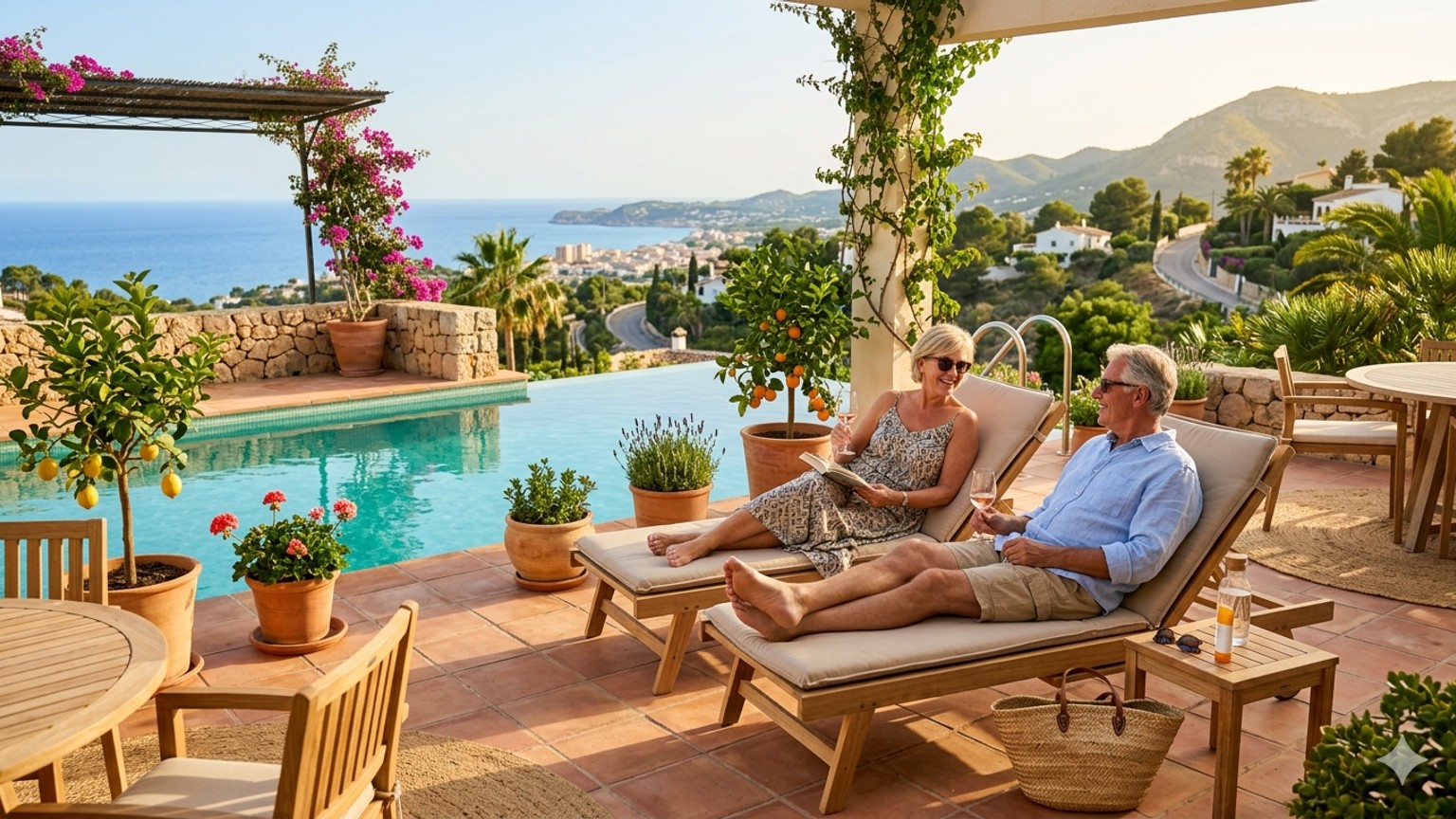
Why So Many Belgians Choose Spain
An estimated 50,000–60,000 Belgian citizens live permanently or semi-permanently in Spain, making it by far the most popular emigration destination for Belgians. The reasons are compelling: over 300 days of sunshine per year, dramatically lower living costs, affordable real estate, a relaxed pace of life, and — perhaps most importantly — a vast, well-established Belgian community that makes the transition remarkably smooth.
Belgium is a country of two main linguistic communities, and each has developed distinct preferences when it comes to settling in Spain. Flemish (Dutch-speaking) Belgians overwhelmingly favour the Costa Blanca — especially the southern stretch around Torrevieja, Orihuela Costa, Guardamar del Segura, and Rojales — where the Dutch-speaking community is enormous. Walloon (French-speaking) Belgians and Bruxellois tend to gravitate toward the Costa del Sol (Málaga, Fuengirola, Marbella) and the Canary Islands, where the international and francophone atmosphere feels more natural. This dual pattern is one of the most distinctive features of Belgian emigration to Spain, and this guide covers the essentials for citizens from both communities.
EU Free Movement — Your Fundamental Right
As a Belgian (and therefore EU) citizen, you have the absolute right to live, work, and reside in Spain without a visa or work permit. This is one of the core freedoms guaranteed by the European Union. The only obligation is to register within three months of arrival. There are three key registrations to complete:
Step 1: NIE Number
The NIE (Número de Identidad de Extranjero) is your Spanish foreign identification number. You need it for virtually everything: opening a bank account, buying property, signing a rental contract, connecting utilities, filing taxes, and even purchasing a car. Apply at the Oficina de Extranjería or local police station. You will need:
- Passport or Belgian identity card
- Completed form EX-15
- Tasa 790 código 012 (approximately €12, payable at a Spanish bank)
- Cita previa (online appointment — book well in advance as slots fill quickly)
Step 2: Empadronamiento
Visit the Ayuntamiento (town hall) of your place of residence and register on the municipal population register. You will need your passport or ID card plus a rental contract or property deed. The empadronamiento is one of the most important documents in Spain — it unlocks access to public healthcare, school enrolment, and municipal services. Without it, you cannot access many essential services.
Step 3: Green Certificate (Certificado de Registro de Ciudadano de la UE)
This certificate proves your right to reside in Spain as an EU citizen. Apply at the Oficina de Extranjería. Requirements include proof of financial means (employment contract, pension income, or savings of approximately €6,000) and health insurance coverage. The certificate is permanent and has no expiry date.
Belgian Tax Obligations (FOD Financiën / SPF Finances)
Belgian tax law is notoriously complex, and emigration adds another layer of complication. Getting this wrong can have consequences that follow you for years, so it is essential to handle the tax side carefully.
Deregistration from the Population Register
When leaving Belgium permanently, you must deregister from your municipality's population register (bevolkingsregister / registre de la population). You will then be registered with the Belgian consulate in Spain. This step is critical: as long as you remain registered in a Belgian municipality, you are presumed to be a Belgian tax resident and are taxable on your worldwide income.
Tax Residency — When Are You "Gone" from Belgium?
Belgium determines tax residency based on factual circumstances, not just administrative formalities. The key criteria are:
- Domicile: where is your actual place of residence?
- Siège de fortune (seat of wealth): from where do you manage your financial assets?
- Legal presumption: registration in the population register (rebuttable)
- Family situation: where does your spouse or partner live?
Important: even after deregistering from the population register, the FOD Financiën / SPF Finances can argue that you remain a Belgian tax resident if your "centre of vital interests" stays in Belgium — for example, if you maintain a company in Belgium or manage your investments from there. Ensure that your genuine centre of life shifts to Spain.
Belgium-Spain Double Taxation Treaty
Belgium and Spain have a comprehensive treaty to prevent double taxation. The general principle is that you pay taxes in the country where you are a tax resident (Spain, if you live there). However, there are important exceptions:
- Belgian property income: income from Belgian real estate is taxed in Belgium (but Belgium applies exemption with progressivity reserve)
- Legal pension: taxed in the country of residence (Spain) — this is often more favourable than Belgian taxation
- Supplementary pension (groepsverzekering / assurance groupe): may be partially taxed in Belgium upon payout
- Government pensions: taxed exclusively in Belgium
Pension — RVP/SFP and Supplementary Pensions
Legal Pension
Your Belgian legal pension (via the Rijksdienst voor Pensioenen / Service fédéral des Pensions) is paid worldwide, regardless of where you live. You do not need to notify the pension service of your move — they will continue paying. However, you must send an annual life certificate (levensbewijs / certificat de vie). Your Spanish bank can typically certify this document.
Under the Belgium-Spain double taxation treaty, the legal pension is taxed in the country of residence — that is Spain. You will pay Spanish income tax (IRPF) on your pension, not Belgian tax. The Spanish rate is often lower than the Belgian rate, resulting in a tax advantage for many retirees.
Supplementary Pension (Second Pillar)
If you built up a group insurance (groepsverzekering / assurance groupe), IPT/EIP, or VAPZ/PLCI through your employer, the rules become more complex. Capital payouts in Belgium are typically subject to a liberating withholding tax of 10% or 16.5%, depending on the timing. If you are already a Spanish tax resident at the time of payout, Spain may also levy tax on this capital. Always consult a specialised tax adviser who understands both the Belgian and Spanish systems.
Healthcare — From Mutualité to the Spanish System
Transitioning from the Belgian Mutualité
In Belgium, you are accustomed to the mutualité system (CM, Solidaris, Helan, Partenamut, Mutualité Libre, etc.). When emigrating permanently to Spain, you will terminate your Belgian health insurance membership. However, do not cancel until your Spanish coverage is fully in place.
The S1 Form — Crucial for Pensioners
As a pensioner, you can apply for form S1 (formerly E121) from the RIZIV/INAMI or your mutualité before leaving Belgium. This form certifies that Belgium will continue to fund your healthcare, entitling you to the Spanish public healthcare system (seguridad social) on the same terms as Spanish nationals. Register the S1 with the Spanish INSS (Instituto Nacional de la Seguridad Social) to receive your tarjeta sanitaria (health card).
Healthcare Options in Spain
- Pensioners with S1: full access to the Spanish public healthcare system, funded by Belgium. This is the most cost-effective option — no additional premiums required.
- Employees in Spain: you join the Spanish social security system through your employer, with contributions deducted from your salary.
- Self-employed (autónomo): you register as autónomo and pay social contributions yourself (minimum €230/month in 2026).
- Non-workers without pension: private health insurance is required. Popular options include Sanitas, Adeslas, and Asisa — from €50–150/month depending on age.
The Spanish public healthcare system is of good quality, with modern hospitals and well-trained doctors. However, waiting times for specialists can be longer than in Belgium. Many Belgians in Spain take out supplementary private insurance for faster access to specialist consultations while retaining their public coverage. Spanish pharmacies (farmacias) are well-stocked, and many medications that require prescriptions in Belgium are available over the counter at lower prices.
Buying Property as a Belgian
There are no restrictions on EU citizens purchasing property in Spain. However, the process differs significantly from what you are accustomed to in Belgium.
The Purchase Process
- Get your NIE — mandatory for any real estate transaction
- Open a Spanish bank account — needed for payment
- Find a property — through an estate agent, online platforms, or your network
- Reservation contract — a deposit of €3,000–6,000 to take the property off the market
- Arras contract — signed with a 10% deposit. If the buyer withdraws, they lose the deposit; if the seller withdraws, they repay double
- Escritura — the notarial deed at the Spanish notary. You pay the remaining balance and receive the keys
Additional Costs: 10–13%
- ITP (transfer tax): 6–10% depending on the region (10% in Comunidad Valenciana)
- Notary fees: €600–1,200
- Registro de la Propiedad: €400–700
- Lawyer: 1–1.5% (always hire an independent lawyer!)
Critical Difference from Belgium
In Belgium, the notary is an independent party who protects both buyer and seller, verifies all charges and liens, and ensures the transaction is legally sound. In Spain, the notary is merely a public official who drafts the deed — they do not check whether there are outstanding debts on the property, whether building permits are in order, or whether the seller is the legitimate owner. This is why hiring an independent Spanish lawyer is absolutely essential. Do not economise on this.
Belgian Communities in Spain
Costa Blanca — The Flemish Heartland
The southern Costa Blanca (Costa Blanca Sur) is by far the most popular region for Flemish Belgians. The concentration is highest in:
- Torrevieja: thousands of Flemish residents, Flemish associations, Dutch-speaking shops and restaurants
- Orihuela Costa (Playa Flamenca, La Zenia, Villamartín): massive Belgian and Dutch community in residential urbanisations
- Guardamar del Segura: a quieter alternative with beautiful dunes and pine forests
- Rojales / Ciudad Quesada: popular with retirees, active community life
- San Miguel de Salinas, Los Montesinos: smaller towns with a strong Belgian presence
The Flemish community here is so large that you could live for years without speaking Spanish — though this is strongly discouraged. Learning the language opens doors and enriches your experience enormously.
Costa del Sol — Popular with Walloons
The Málaga region (Fuengirola, Benalmádena, Marbella) attracts many French-speaking Belgians. The atmosphere is more cosmopolitan, with a mix of British, Scandinavian, French, and Belgian residents. French-speaking professional services are available, and the Lycée Français offers schooling in French in several cities.
Canary Islands
Tenerife and Gran Canaria have a growing Belgian community. The year-round spring-like climate (20–26°C) without extreme summer heat makes the islands especially popular with those who want to avoid the scorching continental summers on the Spanish mainland.
Flights from Belgium
Flight connections between Belgium and Spain are excellent:
- Brussels Airport (Zaventem): daily flights to Alicante, Málaga, Barcelona, and Madrid with Brussels Airlines, Ryanair, Vueling, and Transavia
- Charleroi (Brussels South): the Ryanair hub — extremely affordable flights to Alicante (2h20), Málaga, Valencia, Murcia, and Tenerife. Return tickets from €30–80 when booked early
- Antwerp Airport: seasonal flights to Alicante and Málaga with TUI fly
The flight from Brussels to Alicante takes just 2 hours and 20 minutes. Most Belgians in Spain fly home 4–8 times per year for family visits. With Charleroi as a base, annual travel costs can be kept remarkably low — often under €500 for six return trips.
Cost of Living: Belgium vs Spain
The cost-of-living advantage of Spain over Belgium is substantial:
- Rent: two-bedroom flat in Torrevieja: €450–700/month (vs €800–1,200 in Brussels or Antwerp)
- Groceries: 25–35% cheaper than Belgium. Fresh vegetables, fruit, fish, and meat from local markets are particularly good value
- Dining out: menú del día (three-course lunch with drink) for €10–14. In Belgium, a comparable meal costs €20–30
- Energy: minimal heating costs in southern Spain (you barely heat at all), but summer air conditioning costs €50–100/month
- Healthcare: free with S1 form. Private insurance: €50–150/month
- Council tax (IBI): €200–600/year (vs significantly higher onroerende voorheffing / précompte immobilier in Belgium)
A retired couple with a Belgian pension of €2,500–3,000/month can live very comfortably in Spain, covering rent, groceries, a car, leisure activities, and regular flights back to Belgium. The biggest savings come from housing (40–50% cheaper), groceries (25–35% cheaper), and dining out (50–60% cheaper).
Banking — The Euro Advantage
A major advantage for Belgian expatriates: both countries use the euro. There is zero currency conversion risk and no exchange fees — a significant benefit compared to British or Scandinavian expats who lose 1–3% on every transfer.
Keep Your Belgian Account
Maintain your Belgian bank account (KBC, BNP Paribas Fortis, Belfius, ING) for pension payments, any Belgian rental income, and payments in Belgium. Most Belgian banks allow non-resident clients to keep their accounts, though conditions may change over time.
Open a Spanish Account
Open a Spanish account with Sabadell, CaixaBank, BBVA, or Bankinter for rent, utilities, and daily expenses. You will need your NIE, passport, and proof of address in Spain.
Transfers Between Belgium and Spain
SEPA transfers are free or nearly free (maximum €0.20 per transaction). Set up a monthly standing order from your Belgian account to your Spanish account. Services like Wise or Revolut are unnecessary since there is no currency conversion involved — though they can serve as a useful backup for managing multiple accounts.
Schools for Families with Children
There are no official Belgian schools in Spain (unlike the Lycée Français network). Options for Belgian families include:
- Spanish public schools (colegio público): free, good quality — children learn Spanish rapidly. Ideal for younger children up to age 10–12 who adapt easily
- International schools: English-language curriculum (British School, American School). Fees: €4,000–12,000/year. Available in Torrevieja, Alicante, Málaga, Madrid, and Barcelona
- Private Spanish schools (colegio concertado/privado): €200–600/month, often with multilingual programmes
For Belgian diploma recognition: children returning to Belgium can have their qualifications validated through the Vlaamse Examencommissie (Flemish community) or the equivalence service of the Fédération Wallonie-Bruxelles (French community). Distance learning through Belgian institutions is also possible.
Car and Driving Licence
Your Belgian driving licence is valid in Spain as an EU licence — no exchange is required. However, if you bring your car from Belgium, you must re-register it in Spain (matriculación) within 60 days of establishing residency. This involves a technical inspection (ITV), payment of registration tax (IEDMT), and new Spanish number plates. Many Belgians choose to sell their Belgian car and buy a second-hand vehicle in Spain — this is often simpler and cheaper.
Traffic rules in Spain are similar to Belgium but with some differences: 50 km/h in built-up areas (or 30 km/h in many city centres), 90 km/h outside urban areas, and 120 km/h on motorways. Speeding fines are substantial. Always carry your driving licence, vehicle registration document, and insurance certificate.
Daily Life — What to Expect
Life in Spain differs from Belgium in many ways. The daily rhythm is different: lunch is the main meal (2–4 PM), dinner is late (9–10 PM), and many shops close between 2 and 5 PM for siesta. Supermarkets like Mercadona, Lidl, and Aldi are widespread and offer excellent quality at sharp prices. Local markets (mercados) are a treasure trove of fresh produce at low prices.
Social life revolves around the bar — not in the Belgian sense of a pub, but rather a meeting place where you have morning coffee, enjoy a lunchtime menú del día, and share an evening glass of wine. Belgians who make the effort to learn Spanish discover a warmth and hospitality that enriches daily life enormously.
The climate is the biggest difference. On the Costa Blanca, expect an average of 320 sunny days per year, temperatures of 10–16°C in winter and 28–35°C in summer. Rain is rare but can be heavy (gota fría in autumn). The low humidity makes the heat far more bearable than in Belgium.
Language and Integration
Many Belgians on the Costa Blanca function in Dutch or English. However, anyone who truly wants to integrate should learn Spanish. For French-speaking Belgians, Spanish is relatively easy given the shared Latin roots and similar grammar. For Flemish Belgians, the language gap is larger, but the massive Dutch-speaking community on the Costa Blanca eases the transition considerably. Language courses are available at local schools, the Escuela Oficial de Idiomas (free government schools), and through private tutors. Online platforms such as Preply and italki are popular alternatives (€15–25/hour).
Moving Checklist
Before leaving Belgium
- Deregister from your municipal population register
- Register with the Belgian consulate in Spain
- Inform FOD Financiën / SPF Finances of your emigration
- Apply for S1 form (pensioners) from RIZIV/INAMI or your mutualité
- Verify pension payments with RVP/SFP
- Cancel or adjust Belgian insurance policies (car, home, liability)
- Book cita previa for NIE in Spain
- Belgian driving licence — valid in Spain as EU licence, no exchange needed
First weeks in Spain
- Get your NIE number
- Register at town hall (empadronamiento)
- Open a Spanish bank account
- Apply for green certificate (EU registration)
- Register S1 form with INSS
- Get a Spanish phone number
- Set up utilities in your name (water, electricity, internet)
First year
- File Spanish tax return (Modelo 100) — deadline June
- Apply for certificado digital for online government services
- Send life certificate to RVP/SFP
- File a final Belgian tax return (for the year of departure)
- Learn Spanish — it is the best investment you can make
Why Granfield Estate?
-
⚑
Office on the coast — we live here
Our office is in La Mata, Torrevieja. We know every neighbourhood, every street and the real prices — not from a catalogue, but from daily work on the ground.
-
⚖
In-house lawyer — 10+ years of experience
NIE, bank account, property check, contract, notary — legal support at every step. First consultation free.
-
🏠
Property management
Buying to rent? Our management company handles tenant search, maintenance and all questions.
-
🌐
We speak your language
English, Spanish, Russian, German, Finnish, Swedish and more. Licence RAICV 1663, member of Asivega.
Granfield Estate · Av. Bélgica 1, C.C. Parquemar, La Mata, 03188 Torrevieja · +34 865 44 33 33
Read also

Residency and Visa Options in Spain 2026: The Complete Guide
11.06.2026
Every route to legal residency in Spain — from EU free movement to the digital nomad and non-lucrative visas, plus what the 2025 Golden Visa abolition means for buyers. Requirements, costs, and timelines for 2026.

How to Move to Spain from Sweden: Complete Guide 2026
20.06.2026
Everything you need to know about moving from Sweden to Spain — EU registration, tax obligations, pension transfers, healthcare, Swedish communities on Costa Blanca, and a full moving checklist.

How to Move to Spain from Germany: The Complete Guide
21.06.2026
Everything German residents need to know about relocating to Spain — from Abmeldung and tax treaties to pensions, health insurance, and finding the right community.