


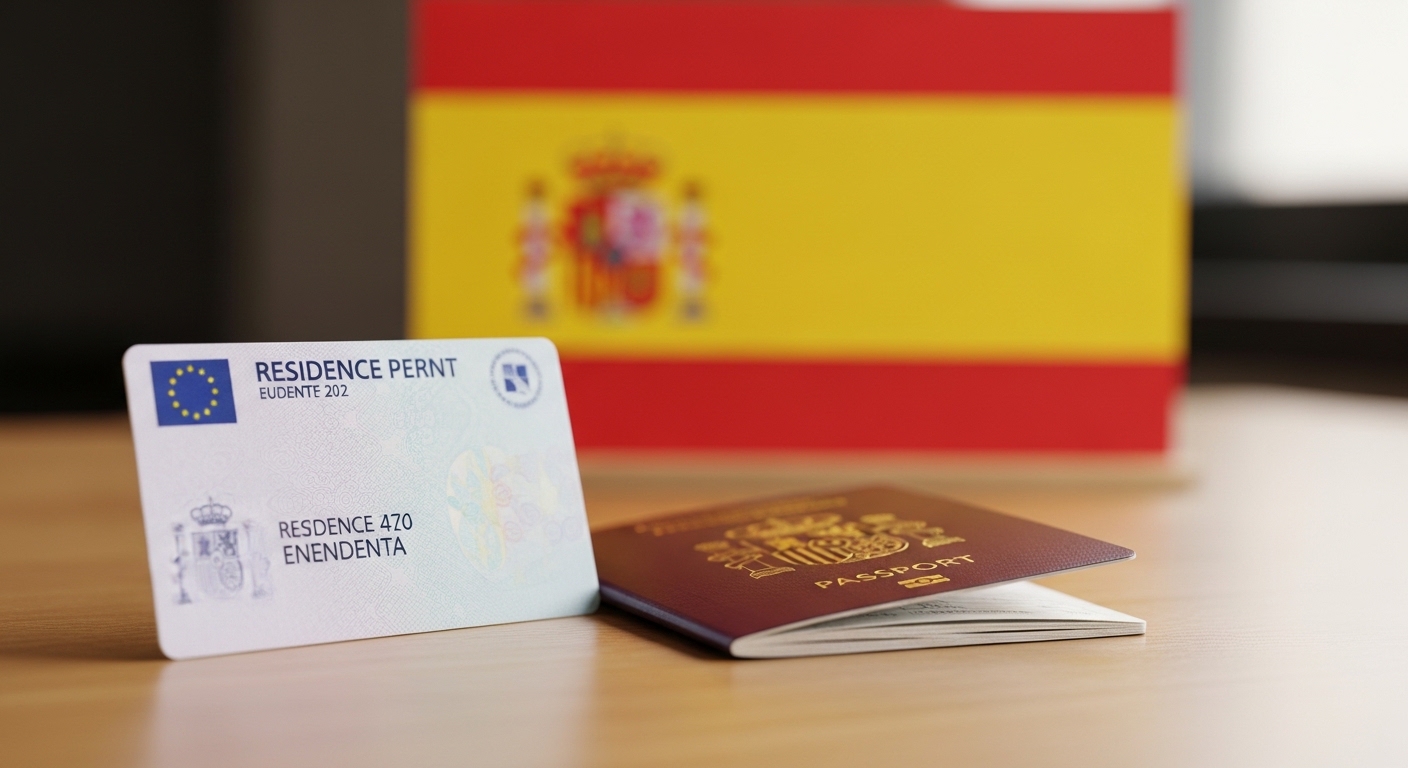
Moving to Spain: Your Legal Options
You've found the property. You've fallen in love with the lifestyle. Now the practical question: how do you actually live in Spain legally? The answer depends entirely on one thing — your passport.
Spain's residency system is a patchwork of EU regulations, national visa programmes, and bilateral agreements. The good news: there are more routes into Spain than almost any other European country. The digital nomad visa launched in 2023, EU citizens have near-automatic rights, and there are well-trodden paths for retirees and remote workers alike. One door has closed, though: the Golden Visa was abolished in April 2025, so buying property alone no longer brings residency. The bad news: Spanish bureaucracy remains legendarily slow, and the rules change often.
This guide covers every major pathway as of early 2026. Whether you're an EU citizen who just needs to register, a remote worker eyeing the digital nomad visa, or a buyer wondering what replaced the Golden Visa — here's exactly what you need to know.
EU/EEA Citizens: Free Movement Rights
If you hold a passport from any EU or EEA country (plus Switzerland), moving to Spain is straightforward. You have the right to live and work in Spain without any visa. But "straightforward" doesn't mean "no paperwork."
The First 3 Months
You can stay in Spain for up to 90 days with just your passport or national ID card. No registration required. You're essentially a tourist with the right to stay longer.
After 3 Months: The Green Certificate
If you plan to stay beyond 90 days, you must register at the Oficina de Extranjería or a designated police station. You'll receive the Certificado de Registro de Ciudadano de la Unión — commonly called the "green certificate" or "green card" (it's actually a green-printed A4 paper with your NIE number).
Requirements:
- Valid passport or national ID
- Proof you won't be a burden on the Spanish state — one of: an employment contract, proof of self-employment, sufficient financial means (no fixed amount, but ~€6,000 in savings is typical), or enrolment in an educational institution
- Health insurance — either public (through employment) or private comprehensive cover
- EX-18 form completed
- Appointment (cita previa) — these can be difficult to get; book early
Cost: ~€12 (Tasa 790, código 012). The certificate is permanent — it doesn't expire.
Timeline: Same day, if your paperwork is in order. The certificate is issued on the spot.
Permanent Residency for EU Citizens
After 5 continuous years of legal residence, EU citizens can apply for a permanent residency certificate. This is largely symbolic (your rights don't change much), but it provides extra security and simplifies some administrative processes.
Non-EU Citizens: Visa Required
If you're from outside the EU/EEA, you need a visa before you can live in Spain. You cannot enter on a tourist visa (or visa-free entry) and then switch to a residence permit from within Spain — you must apply at the Spanish consulate in your home country (or country of legal residence).
Here are the main visa categories:
The Digital Nomad Visa (Visado para Teletrabajo Internacional)
Launched in January 2023 under Spain's Startup Law (Ley de Startups), this is Spain's newest and most popular visa for remote workers. It allows non-EU citizens to live in Spain while working remotely for companies or clients outside Spain.
Requirements
- Employment: You must work remotely for a company established outside Spain, or be a freelancer with clients predominantly (at least 80%) outside Spain
- Income: Minimum €2,520/month (200% of the Spanish minimum wage, adjusted annually). If applying for dependents, add 75% of the minimum wage per additional family member
- Professional experience: At least 3 months of the current employment relationship, or proof of at least 1 year of professional experience in your field if freelance
- Company viability: The employer/client company must have been operating for at least 1 year
- Clean criminal record from countries you've lived in during the last 5 years
- Health insurance: Comprehensive private insurance valid in Spain
- No prior illegal residence in Spain
Duration and Renewal
The initial visa is granted for up to 1 year (applied for at the consulate). Once in Spain, you can apply for a residence permit valid for up to 3 years, renewable for another 2 years. After 5 years total, you can apply for permanent residency.
The Beckham Law: Tax Benefits
Digital nomad visa holders can opt into the "Beckham Law" (Régimen Fiscal Especial para Trabajadores Desplazados) — originally created for footballer David Beckham when he moved to Real Madrid. Under this regime:
- You're taxed as a non-resident for up to 6 years
- Flat 24% income tax rate on Spanish-source income up to €600,000 (vs. progressive rates up to 47%)
- Foreign income (except employment income) is generally not taxed in Spain
- No wealth tax on assets outside Spain
- No obligation to declare worldwide assets (Modelo 720)
This is a significant advantage and one of the main reasons Spain's digital nomad visa is so attractive compared to similar programmes in Portugal, Greece, or Croatia.
Application Process
Apply at the Spanish consulate in your country of residence. Processing time is typically 20–45 working days. Once approved, you must enter Spain within 1 year and apply for your TIE card within 30 days of arrival.
The Golden Visa (Visado de Inversor) — Abolished in 2025
For over a decade, Spain's Golden Visa was the headline route for property investors: invest €500,000 or more in Spanish real estate and receive residency for the whole family, with no minimum stay requirement. Introduced in 2013 under Ley 14/2013, it became one of Europe's most established investor visa programmes — and one of the main reasons international buyers chose Spain over its neighbours.
That era is over. The Golden Visa was abolished on April 3, 2025, when Ley Orgánica 1/2025 came into force. Spain no longer accepts new investor residency applications under any of the former routes — not the €500,000 real estate investment, not the €1 million in company shares or bank deposits, and not the €2 million in government bonds. The government framed the decision around housing affordability, arguing that investor demand was pushing up prices in the most sought-after areas.
What this means in practice:
- No new applications: there is no way to apply for a Spanish Golden Visa in 2026, through property or any other investment.
- Existing holders keep their status: investors who obtained their residencia de inversor before the programme closed retain their permits and can continue to renew them under the previous conditions.
- Buying property no longer grants residency: a €500,000 purchase — or any purchase — does not by itself entitle you to a residence permit.
If you were counting on the Golden Visa, the practical alternatives in 2026 are the digital nomad visa (covered above) and the non-lucrative visa (covered below). Neither requires an investment, and owning a home in Spain still helps your application in practical ways — as proof of accommodation and of genuine ties to the country. You can buy property in Spain freely regardless of residency status; the purchase simply no longer comes with a visa attached.
Non-Lucrative Visa (Visado de Residencia No Lucrativa)
The "retirement visa" — though you don't need to be retired. This visa is for people who want to live in Spain without working. You must prove you have sufficient passive income or savings to support yourself.
Requirements
- Income: Approximately €2,400/month (400% of the IPREM indicator, adjusted annually) for the main applicant, plus ~€600/month per dependent. Alternatively, equivalent savings (approximately €28,800 for one year)
- No work: You cannot work in Spain on this visa — no employment, no freelancing, no business activity. Income must come from pensions, investments, rental income from outside Spain, savings, etc.
- Health insurance: Comprehensive private insurance with no copays, valid in Spain, from an insurer authorised to operate in Spain
- Clean criminal record
- Medical certificate confirming no serious contagious diseases
Duration
Initial visa: 1 year. Renewable for 2-year periods. After 5 years, you can apply for permanent residency — at which point the work restriction lifts. After 10 years, citizenship.
Important: The non-lucrative visa requires you to actually live in Spain. You cannot spend more than 6 months outside Spain per year, or your residency can be revoked.
Other Visa Types
Student Visa (Visado de Estudios)
For those enrolled in a Spanish educational institution. Not a direct path to residency, but can be converted to a work permit after completing studies. Time spent on a student visa counts partially (not fully) toward the 10-year citizenship requirement.
Work Visa (Visado de Trabajo)
Requires a job offer from a Spanish employer. The employer must demonstrate they couldn't fill the position with an EU citizen (labour market test). In practice, this is difficult unless you work in a high-demand sector (tech, healthcare, engineering). The employer handles much of the paperwork.
Entrepreneur Visa (Visado de Emprendedor)
Under the same Startup Law as the digital nomad visa. For non-EU citizens who want to start an innovative business in Spain. Requires a favourable report from ENISA (a public business agency) on your business plan. Capital requirements are modest, but the approval process is more complex than other routes.
Family Reunification (Reagrupación Familiar)
If a family member is already legally resident in Spain, they can apply to bring you over. The sponsoring relative must demonstrate sufficient income and adequate housing.
The TIE Card (Tarjeta de Identidad de Extranjero)
The TIE is Spain's physical residence card for non-EU citizens. Regardless of which visa you obtain, once you arrive in Spain you must apply for your TIE within 30 days. It's a credit-card-sized document with your photo, NIE number, and the type/duration of your residence permit.
Process:
- Book a cita previa at the Oficina de Extranjería
- Submit your passport, visa, EX-17 form, photos, proof of address, and tax payment (Tasa 790, código 012, approximately €16)
- Fingerprints are taken at the appointment
- Card is typically ready for collection in 20–40 days
The TIE is essential. It's your primary ID document in Spain — you'll need it for opening bank accounts, signing contracts, accessing healthcare, and countless daily transactions. Guard it carefully.
Empadronamiento: Town Hall Registration
One of the first things you should do after arriving — regardless of your nationality or visa type — is register on the padrón municipal at your local town hall (ayuntamiento). This is called empadronamiento.
Why it matters:
- Required for accessing public healthcare
- Needed for enrolling children in public schools
- Required to vote in local elections (EU citizens)
- Proof of residence for many administrative processes
- Determines which municipality provides you with public services
- Essential for the path to permanent residency and citizenship — it establishes your official start date of residence
Requirements: Passport or ID, proof of address (rental contract, property deed, or a letter from the property owner), and the registration form from the town hall. It's free and usually processed on the spot.
You can empadronarse even without a residence permit — the padrón is a municipal census, not an immigration register. Town halls are legally obligated to register anyone living in their municipality, regardless of immigration status.
Path to Permanent Residency and Citizenship
Permanent Residency (5 Years)
After 5 continuous years of legal residence in Spain, most non-EU citizens can apply for permanent residency (residencia de larga duración). This gives you the right to live and work in Spain indefinitely, without needing to renew your permit. You must not have been absent from Spain for more than 10 months total during the 5-year period (with no single absence exceeding 6 consecutive months).
Spanish Citizenship (10 Years)
After 10 years of continuous legal residence, you can apply for Spanish citizenship. Reduced periods apply for:
- 2 years: Citizens of Latin American countries, Andorra, Philippines, Equatorial Guinea, Portugal, and Sephardic Jews
- 1 year: Those born in Spain, married to a Spanish citizen (for 1 year), or born to a Spanish parent
Citizenship requires:
- Passing the CCSE exam (constitutional and sociocultural knowledge, 25 questions, in Spanish)
- Passing the DELE A2 Spanish language exam (unless you're from a Spanish-speaking country)
- Clean criminal record
- Proof of "good civic conduct" and integration into Spanish society
Note on dual citizenship: Spain generally does not allow dual citizenship, except for citizens of Latin American countries, Andorra, Philippines, Equatorial Guinea, and Portugal. Citizens of other countries must renounce their previous nationality. However, enforcement varies — some countries (like the UK) don't recognise foreign renunciations, effectively allowing de facto dual citizenship.
Brexit Impact on UK Citizens
Since January 1, 2021, UK citizens are treated as non-EU nationals for immigration purposes. This means:
- No more free movement rights — UK citizens need a visa to live in Spain
- The 90/180-day Schengen tourist rule applies — you can spend a maximum of 90 days in any 180-day period without a visa
- To live in Spain, UK citizens must apply for one of the non-EU visa categories above (non-lucrative, digital nomad, work visa, etc.)
- UK citizens who were legally resident in Spain before December 31, 2020, retained their rights under the Withdrawal Agreement — they hold a special TIE card with "Article 50" noted on it
For UK citizens looking to buy property and spend time in Spain, the 90-day limit is the critical constraint. Many split their time between Spain and other non-Schengen countries to manage the clock, but this is not a long-term substitute for proper residency.
Comparison of Main Visa Routes
| Visa Type | Min. Income/Investment | Can Work in Spain? | Min. Stay Required? | Family Included? | Processing Time |
|---|---|---|---|---|---|
| EU Registration | ~€6,000 savings | Yes | No formal requirement | Yes (EU family) | Same day |
| Digital Nomad | €2,520/month | Remote only | Yes (183+ days) | Yes | 20–45 days |
| Non-Lucrative | ~€2,400/month | No | Yes (6+ months) | Yes | 30–60 days |
| Work Visa | Job offer required | Yes (specific employer) | Yes | After 1 year | 30–90 days |
Practical Tips
- Start early: Spanish consular appointments can be weeks or months away. Begin the process 4–6 months before your intended move date.
- Apostille everything: Criminal records, birth certificates, marriage certificates — all documents from your home country need an apostille (or legalisation for non-Hague Convention countries) and sworn translation into Spanish.
- Get a gestoría: A gestoría is a uniquely Spanish institution — an administrative agency that navigates bureaucracy on your behalf. For visa and residency matters, a good immigration lawyer (abogado de extranjería) combined with a gestoría can save you months of frustration.
- NIE first: If you're buying property, you'll need an NIE (Número de Identidad de Extranjero) — your foreign ID number. You can get this at a consulate before arriving or at a police station in Spain. It's separate from a residence permit.
- Health insurance matters: For most visa categories, you need comprehensive private health insurance with no copays (sin copagos), from an insurer authorised in Spain. Budget €80–200/month depending on age and coverage.
- Digital certificates: Get a certificado digital as soon as possible — it's an electronic signature that lets you access government services online. Without it, you're stuck making in-person appointments for everything.
Frequently Asked Questions
EU/EEA Citizens: Free Movement Rights?
If you hold a passport from any EU or EEA country (plus Switzerland), moving to Spain is straightforward. You have the right to live and work in Spain without any visa. But "straightforward" doesn't mean "no paperwork." The First 3 Months
You can stay in Spain for up to 90 days with just your passport or national ID card. No registration required. You're essentially a tourist with the right to stay longer.
The Digital Nomad Visa (Visado para Teletrabajo Internacional)?
Launched in January 2023 under Spain's Startup Law (Ley de Startups), this is Spain's newest and most popular visa for remote workers. It allows non-EU citizens to live in Spain while working remotely for companies or clients outside Spain. Requirements Employment: You must work remotely for a company established outside Spain, or be a freelancer with clients predominantly (at least 80%) outside Spain Income: Minimum €2,520/month (200% of the Spanish minimum wage, adjusted annually). If applying for dependents, add 75% of the minimum wage per additional family member Professional experience: At least 3 months of the current employment relationship, or proof of at least 1 year of professional experience in your field if freelance Company viability: The employer/client company must have been operating for at least 1 year Clean criminal record from countries you've lived in during the last 5 years Health insurance: Comprehensive private insurance valid in Spain No...
Non-Lucrative Visa (Visado de Residencia No Lucrativa)?
The "retirement visa" — though you don't need to be retired. This visa is for people who want to live in Spain without working. You must prove you have sufficient passive income or savings to support yourself. Requirements Income: Approximately €2,400/month (400% of the IPREM indicator, adjusted annually) for the main applicant, plus ~€600/month per dependent. Alternatively, equivalent savings (approximately €28,800 for one year) No work: You cannot work in Spain on this visa — no employment, no freelancing, no business activity. Income must come from pensions, investments, rental income from outside Spain, savings, etc. Health insurance: Comprehensive private insurance with no copays, valid in Spain, from an insurer authorised to operate in Spain Clean criminal record Medical certificate confirming no serious contagious diseases Duration Initial visa: 1 year. Renewable for 2-year periods. After 5 years, you can apply for permanent residency — at which point the work restriction lifts....
The TIE Card (Tarjeta de Identidad de Extranjero)?
The TIE is Spain's physical residence card for non-EU citizens. Regardless of which visa you obtain, once you arrive in Spain you must apply for your TIE within 30 days. It's a credit-card-sized document with your photo, NIE number, and the type/duration of your residence permit. Book a cita previa at the Oficina de Extranjería Submit your passport, visa, EX-17 form, photos, proof of address, and tax payment (Tasa 790, código 012, approximately €16) Fingerprints are taken at the appointment Card is typically ready for collection in 20–40 days
The TIE is essential. It's your primary ID document in Spain — you'll need it for opening bank accounts, signing contracts, accessing healthcare, and countless daily transactions. Guard it carefully.
Path to Permanent Residency and Citizenship?
Permanent Residency (5 Years) After 5 continuous years of legal residence in Spain, most non-EU citizens can apply for permanent residency (residencia de larga duración). This gives you the right to live and work in Spain indefinitely, without needing to renew your permit. You must not have been absent from Spain for more than 10 months total during the 5-year period (with no single absence exceeding 6 consecutive months). Spanish Citizenship (10 Years) After 10 years of continuous legal residence, you can apply for Spanish citizenship. Reduced periods apply for:
Why Granfield Estate?
-
⚑
We live on the coast
Our team lives and works on the Costa Blanca. We know every neighbourhood, every street and the real prices — not from a catalogue, but from daily work on the ground.
-
⚖
In-house lawyer — 10+ years of experience
NIE, bank account, property check, contract, notary — legal support at every step. First consultation free.
-
🏠
Property management
Buying to rent? Our management company handles tenant search, maintenance and all questions.
-
🌐
We speak your language
English, Spanish, Russian, German, Finnish, Swedish and more. Licence RAICV 1663, member of Asivega.
Read also

How to Move to Spain from Sweden: Complete Guide 2026
20.06.2026
Everything you need to know about moving from Sweden to Spain — EU registration, tax obligations, pension transfers, healthcare, Swedish communities on Costa Blanca, and a full moving checklist.

How to Move to Spain from Germany: The Complete Guide
21.06.2026
Everything German residents need to know about relocating to Spain — from Abmeldung and tax treaties to pensions, health insurance, and finding the right community.

How to Move to Spain from the UK After Brexit: Complete 2026 Guide
22.06.2026
Everything British citizens need to know about moving to Spain after Brexit — visa options, healthcare, pensions, driving licences, property purchase and the thriving British communities on the costas.