


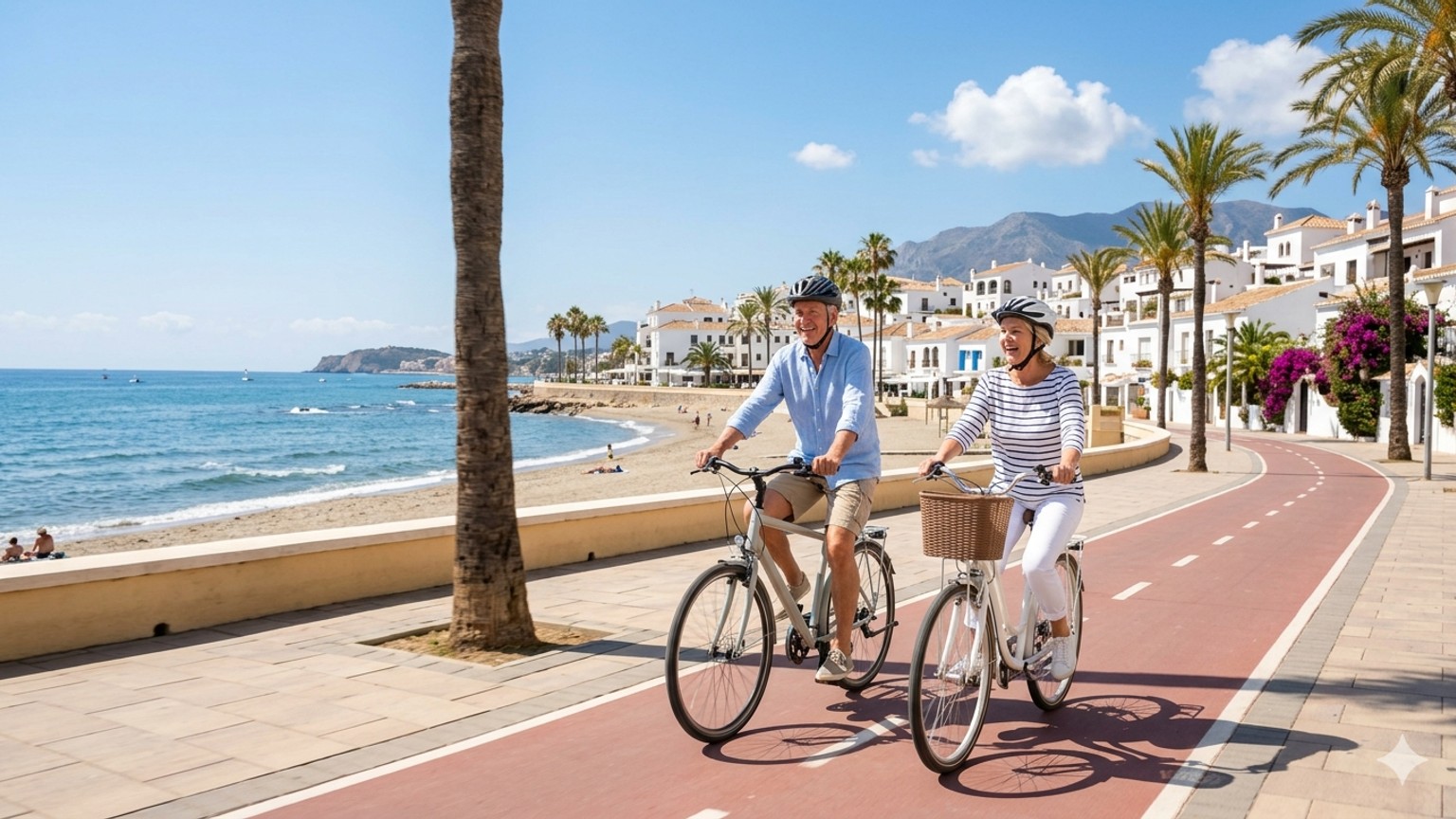
Why Danes Choose Spain
Spain has been a favourite destination for Danish emigrants and retirees for decades. An estimated 50,000 or more Danish citizens live permanently or semi-permanently in Spain, making it one of the largest Danish communities outside Scandinavia. The appeal is clear: over 300 days of sunshine per year, dramatically lower living costs compared to Denmark (consistently ranked among Europe's most expensive countries), affordable property, and a relaxed Mediterranean lifestyle that many Danes find irresistible.
The tradition of Danish "snowbirds" wintering in Spain goes back to the 1970s, and today's Danish community in Spain spans all generations — from retirees seeking warmer winters to young families drawn by the work-life balance, remote workers, and entrepreneurs. Costa Blanca, Costa del Sol, Mallorca, and the Canary Islands are the most popular destinations.
But moving from Denmark to Spain involves far more than packing your bags. Danish tax rules, pension regulations, healthcare transitions, and financial arrangements all require careful planning. This guide walks you through every step.
EU Free Movement: Your Right to Live in Spain
As a Danish citizen — and therefore an EU citizen — you have the fundamental right to live and work anywhere in the European Union, including Spain. You do not need a visa, a work permit, or any special invitation. However, you must register within three months of arrival.
Step 1: Get Your NIE Number
The NIE (Número de Identidad de Extranjero) is your Spanish foreigner identification number. You need it for virtually everything: opening a bank account, buying property, signing a rental contract, setting up utilities, and paying taxes. Apply at the nearest Oficina de Extranjería or designated police station. You will need:
- Valid passport or national ID card
- Completed form EX-15
- Tasa 790 código 012 (approximately €12, paid at a bank)
- Cita previa (online appointment — book well in advance, as slots fill up quickly)
Step 2: Register at the Town Hall (Empadronamiento)
Visit your local Ayuntamiento (town hall) and register on the municipal census. Bring your passport, and either a rental contract or property deed as proof of address. Empadronamiento is essential — it unlocks access to public healthcare, school enrolment for children, and local municipal services. It is one of the most important documents you will have in Spain.
Step 3: Green Certificate (Certificado de Registro de Ciudadano de la UE)
The "green certificate" officially confirms your right to reside in Spain as an EU citizen. Apply at the Oficina de Extranjería. You must demonstrate that you can support yourself financially — through employment, self-employment, pension income, or sufficient savings (typically around €6,000). You also need health insurance coverage. The certificate is permanent and has no expiration date.
Danish Tax Obligations: Skattestyrelsen and Deregistration
Tax is one of the most complex aspects of moving from Denmark to Spain. Denmark's tax system is famously comprehensive, and the exit process must be handled carefully to avoid unpleasant surprises.
CPR Deregistration
When you move permanently to Spain, you must deregister from the Danish CPR system (Det Centrale Personregister) through your local Borgerservice office. This is a critical step — your CPR number continues to exist, but your status changes to "emigrated." Deregistration affects your access to Danish public services, your tax status, and your healthcare coverage.
You should deregister before you leave Denmark or as soon as possible after your move. Failure to deregister can lead to continued Danish tax obligations and complications with Danish authorities.
Fraflytterbeskatning (Exit Tax)
Denmark imposes an exit tax (fraflytterbeskatning) on unrealised capital gains when you leave the country. This applies to shares, bonds, and certain other financial instruments if their total unrealised gain exceeds DKK 100,000. The tax is calculated as if you sold all your assets on the day you deregister.
You can apply for a payment deferral (henstand), which allows you to postpone the actual payment until you realise the gain. However, you must report annually to Skattestyrelsen and may need to provide security. This is an area where professional tax advice is strongly recommended — the rules are complex and the amounts can be significant.
Skattestyrelsen: Reporting Your Move
Notify Skattestyrelsen (the Danish tax authority) about your move. You must file a final Danish tax return for the year of your departure. If you retain income sources in Denmark (rental income from a Danish property, Danish employment income), you remain partially taxable in Denmark on that Danish-source income.
Double Taxation Treaty: Denmark–Spain
Denmark and Spain have a comprehensive double taxation agreement that prevents you from being taxed twice on the same income. The general principle is that you are taxed in your country of residence (Spain, after you move). However, certain types of income have specific rules — Danish government pensions, for example, are always taxed in Denmark. Private pensions and employment income are generally taxed in Spain once you become a Spanish tax resident. Always consult a tax advisor who understands both systems.
Danish Pension in Spain: What You Keep, What You Lose
Pension is often the most important financial consideration for Danes moving to Spain, and the Danish system has several components that are treated very differently when you move abroad.
Folkepension (State Pension) — Beware the Residency Requirement
This is the critical point that many Danes overlook: folkepension has a residency requirement. You must have lived in Denmark for at least 40 years between the ages of 15 and the pension age to receive the full folkepension. For each year less, the pension is reduced proportionally. When you move to Spain, you stop accumulating years toward the folkepension.
If you move to Spain before pension age, your folkepension will be calculated based only on the years you actually lived in Denmark. Moving at age 50 after living in Denmark your whole life means you have approximately 35 years — you would receive roughly 35/40 of the full folkepension. However, if you spent time abroad earlier in life, the reduction could be more dramatic.
The folkepension can still be paid out to you in Spain under EU coordination rules (Regulation 883/2004), but the amount may be significantly less than if you had stayed in Denmark. Contact Udbetaling Danmark well in advance to get a precise calculation.
ATP (Arbejdsmarkedets Tillægspension)
ATP is a mandatory supplementary pension tied to your years of employment in Denmark. It is paid out regardless of where you live, including Spain. The amount depends on how many years you contributed and at what level. ATP Livslang Pension handles the payments. You will need to provide a life certificate periodically.
Arbejdsmarkedspension (Occupational Pension)
Occupational pensions from Danish pension funds (PFA, Danica, Topdanmark, Velliv, Sampension, etc.) are paid out regardless of where you reside. These are your privately accumulated pension savings through employment. Contact your specific pension provider to confirm the terms for overseas payment and any tax implications.
Tjenestemandspension (Civil Service Pension)
If you were a Danish civil servant (tjenestemand), your pension is paid by the Danish state and is typically taxed in Denmark under the double taxation treaty. It is paid regardless of residence.
Taxation of Danish Pension in Spain
Under the Denmark-Spain double taxation treaty:
- Folkepension and ATP: Generally taxed in Spain as your country of residence, but Denmark may also tax them — the treaty allocates taxing rights, and Spain provides credit for Danish tax paid
- Tjenestemandspension: Taxed in Denmark (government pensions are taxed in the paying country)
- Arbejdsmarkedspension: Generally taxed in Spain as your country of residence
- Private pension savings: Taxed in Spain
Spain's progressive income tax rates (19–47%) may be higher or lower than Danish rates depending on your total income. However, the dramatically lower cost of living typically more than compensates. Consult both Udbetaling Danmark and a Spanish tax advisor (gestor fiscal) for your specific situation.
Healthcare: From the Danish Yellow Card to the Spanish System
Denmark's tax-funded healthcare system (the yellow health card / sundhedskort) ceases to cover you once you deregister from CPR and leave Denmark. The transition to Spanish healthcare depends on your situation.
Pensioners: The S1 Form
If you receive a Danish pension, apply for an S1 form (formerly E121) from Udbetaling Danmark before leaving. The S1 certifies that Denmark will pay for your healthcare in Spain. With it, you can register with the Spanish social security system (INSS) and receive a tarjeta sanitaria (health card), giving you access to Spanish public healthcare on the same terms as Spanish residents — at Denmark's expense.
The S1 route is by far the best option for pensioners. Register your S1 with the local INSS office in Spain as soon as possible after arrival.
Workers: Spanish Social Security
If you work in Spain (as an employee or self-employed), you enter the Spanish social security system. Your employer (or you, as autónomo) pays Spanish social contributions, and you receive full access to the Spanish public healthcare system. Your Danish coverage ends.
If you are posted by a Danish employer for a limited period (up to 24 months), you can retain Danish social security coverage via the A1 certificate, issued by Udbetaling Danmark.
Not Working and Not Yet a Pensioner
If you are neither employed nor a pensioner, you need private health insurance. Options include Spanish insurers like Sanitas, Adeslas, and Asisa (from €50–150/month depending on age). Alternatively, Spain offers a convenio especial — you can buy into the public system for approximately €60/month (under 65) or €157/month (65 and over).
Private insurance is also commonly used during the initial transition period before all registrations are complete.
Buying Property in Spain
As an EU citizen, there are no restrictions on Danes buying property in Spain. The process differs from the Danish system but is well-established.
Step-by-Step Process
- Get your NIE number — you cannot buy without it
- Open a Spanish bank account — payments are normally made from a Spanish bank
- Find a property — through agents, Idealista.com, Fotocasa.es, or PropMia
- Reservation contract — pay a reservation fee (typically €3,000–6,000) to take the property off the market
- Arras contract — formal pre-contract with a deposit of 10% of the purchase price. If you back out, you lose the deposit. If the seller backs out, they return double
- Escritura (title deed) — signed at the notary. The remaining balance is paid and ownership transfers
- Registration — the purchase is recorded at the Registro de la Propiedad (land registry)
Purchase Costs
Budget 10–13% on top of the purchase price:
- Transfer tax (ITP): 6–10% depending on the region (Valencia/Alicante region typically 10%)
- Notary fees: €600–1,200
- Land registry: €400–700
- Legal fees: 1–1.5% of the purchase price (always hire your own independent lawyer — never rely solely on the seller's agent)
Mortgages for Foreigners
Spanish banks offer mortgages to foreign buyers, but typically only up to 60–70% of the purchase price (compared to 80–85% for Spanish residents). Interest rates are often variable (Euribor + 1–2%) or mixed. Compare this with taking a mortgage in Denmark and transferring the funds — in some cases, Danish mortgage rates may be more favourable, especially if you still own property in Denmark.
Danish Communities in Spain
Danes in Spain tend to cluster in areas with established Scandinavian communities, making the transition easier and providing a social safety net.
Costa Blanca: Torrevieja Area and Alfaz del Pi
The Costa Blanca is the heart of the Danish community in Spain. The Torrevieja area (including La Mata, Punta Prima, Orihuela Costa, and Los Montesinos) has a substantial Scandinavian population, including many Danes. The Danish Church (Den Danske Kirke) holds regular services and social events. Danish clubs and associations organise gatherings, cultural events, and provide a support network for newcomers.
Alfaz del Pi, located between Benidorm and Altea, is home to one of the largest Nordic communities in Spain. The area has Scandinavian schools, Nordic consulates, and a distinctly Scandinavian atmosphere. The nearby Albir beach and the relaxed pace of life attract both retirees and families.
Costa del Sol: Fuengirola and Surrounding Area
Fuengirola has a large Scandinavian community with Danish, Swedish, Norwegian, and Finnish residents. While there is no dedicated Danish school, international schools and a Scandinavian school provide education options. The area offers a well-developed infrastructure for foreign residents.
Mallorca
Mallorca attracts a somewhat different Danish demographic — more affluent buyers, families, and professionals. Palma has a cosmopolitan international community, and the island offers excellent international schools, direct flights from Copenhagen, and a well-preserved natural environment.
Canary Islands
Gran Canaria and Tenerife have growing Danish communities, particularly popular with retirees seeking year-round warmth. The Canary Islands offer lower IVA (VAT at 7% IGIC instead of 21% on the mainland), slightly lower property prices, and a subtropical climate.
Direct Flights from Denmark
Excellent air connectivity is one of the reasons Spain is so popular with Danes. Direct flights are available from multiple Danish airports:
- Copenhagen (CPH): Alicante (daily, Norwegian, SAS, Ryanair), Málaga (daily), Barcelona (daily), Palma de Mallorca (daily in season), Madrid, Gran Canaria, Tenerife
- Billund (BLL): Alicante (several times per week, Ryanair), Málaga, Palma de Mallorca (seasonal)
- Aalborg (AAL): Alicante, Málaga (seasonal charter and low-cost routes)
Copenhagen to Alicante takes approximately 3.5 hours. Return flights can be found from DKK 500–1,500 when booked in advance. Most Danes living in Spain fly home 3–5 times per year to visit family and handle administrative matters.
Cost of Living: Denmark vs Spain
Denmark is consistently ranked among the most expensive countries in the world, and the cost-of-living difference with Spain is dramatic. Here is a realistic comparison:
Housing
- Denmark: Rent for a 2-bedroom flat in Copenhagen suburbs — DKK 10,000–14,000/month. In Aarhus — DKK 8,000–11,000/month
- Spain: Rent for a 2-bedroom flat in Torrevieja — €400–600/month (DKK 3,000–4,500). In Fuengirola — €600–900/month (DKK 4,500–6,700)
Food and Dining
- Denmark: Monthly groceries for two — DKK 5,000–7,000. Lunch out: DKK 100–150
- Spain: Monthly groceries for two — DKK 2,500–4,000 (€330–530). Menú del día (3-course lunch with drink): €10–14 (DKK 75–105)
Healthcare
- Denmark: Tax-funded, essentially free at point of use (dental and some specialist services excluded)
- Spain: With S1 — free public healthcare. Private insurance: €50–150/month per person depending on age
Other Costs
- Utilities: Spain significantly cheaper — no heating costs in winter in the south, but air conditioning in summer adds €50–100/month
- Car insurance: Cheaper in Spain. Vehicle tax lower
- Alcohol and dining: Dramatically cheaper in Spain — a beer at a bar costs €1.50–3 vs DKK 50–70 in Denmark
- Clothing and electronics: Roughly similar
Summary: A retired Danish couple can realistically save DKK 5,000–10,000 per month by living in Spain compared to Denmark, depending on lifestyle and housing choice. The savings come primarily from housing, food, and the general cost of services.
Children's Education
Unlike Sweden, which has dedicated Swedish schools in Spain, Denmark does not operate Danish curriculum schools abroad. Danish families in Spain have several options:
- International schools: English-language schools following British, American, or International Baccalaureate curricula are available in all major expatriate areas. Fees range from €3,000–10,000 per year
- Scandinavian schools: The Scandinavian school in Alfaz del Pi (Costa Blanca) and similar Nordic schools accept Danish children and teach in Scandinavian languages
- Spanish public schools (colegios públicos): Free of charge. Children typically learn Spanish fluently within 6–12 months through immersion. An excellent option for younger children
- Spanish private/semi-private schools (concertados): Partially state-funded, often with smaller class sizes and bilingual programs
Many Danish families choose international or Scandinavian schools for the initial transition, then move to Spanish public schools as the children become fluent in Spanish. Maintaining Danish language skills at home and through the Danish community is important.
Banking and Money Matters
NemKonto and Danish Banking
Your NemKonto (the default account for government payments) is linked to your CPR number. After deregistration, you can typically keep a Danish bank account, but check with your bank — some require Danish residency. You will need a Danish account if you continue to receive Danish pension payments or have other Danish income.
MobilePay — It Will Not Work Abroad
MobilePay, Denmark's ubiquitous mobile payment app, requires a Danish phone number and a Danish bank account. Once you move to Spain with a Spanish phone number, MobilePay will stop working. This is a practical adjustment many Danes underestimate. In Spain, Bizum is the equivalent peer-to-peer payment app, linked to Spanish bank accounts.
Opening a Spanish Bank Account
You need a Spanish bank account for rent, utilities, mortgage payments, property tax (IBI), and daily spending. Major banks that are experienced with foreign clients include Sabadell, CaixaBank, and BBVA. Visit a branch with your passport, NIE number, and proof of address (empadronamiento). Expect a quarterly maintenance fee of €15–30.
Transferring Money: DKK to EUR
Avoid using traditional bank transfers for currency conversion — they typically charge 2–4% in hidden fees and offer poor exchange rates. Use Wise (formerly TransferWise) or Revolut instead. Wise charges approximately 0.4–0.6% and transfers arrive the same day. Many Danes in Spain use Wise as their primary bridge between DKK and EUR accounts.
Driving Licence
Danish driving licences are valid throughout the EU. You can use your Danish licence in Spain indefinitely as long as it remains valid. When it expires, you exchange it for a Spanish licence at the local Jefatura de Tráfico — no test required for EU licence holders. Spain requires a medical exam (reconocimiento médico, approximately €30–50) for licence renewal, which is done every 10 years (every 5 years for drivers over 65).
Vehicle Registration and Import
If you bring your Danish-registered car to Spain, you must re-register it within 30 days of establishing residency. The process involves:
- ITV inspection: The Spanish equivalent of the Danish syn (vehicle inspection)
- Registration tax (Impuesto de Matriculación): Based on CO2 emissions, can be 0–14.75% of the vehicle's value
- Transfer to Spanish plates: Handled at the Jefatura de Tráfico
- Spanish insurance: Required before registration
Important: once you deregister your vehicle in Denmark, the Danish green owner tax (grøn ejerafgift) stops. Many Danes find it more practical to sell their car in Denmark and buy one in Spain, especially given the registration tax and the fact that right-hand-drive vehicles are not an issue (both countries drive on the right).
Complete Moving Checklist
Before Leaving Denmark
- Contact Udbetaling Danmark to calculate your folkepension entitlement and request S1 form (pensioners)
- Consult a tax advisor about fraflytterbeskatning (exit tax) on unrealised gains
- Deregister from CPR at Borgerservice
- File your move notification with Skattestyrelsen
- Sell or long-term rent out your Danish property to simplify tax obligations
- Check with your bank about keeping your Danish account after emigration
- Arrange health insurance for the transition period
- Book cita previa for NIE number in Spain (can be done before you travel)
- Gather and apostille important documents (marriage certificate, birth certificates, etc.)
- Notify your pension funds (ATP, arbejdsmarkedspension providers) of your move
First Weeks in Spain
- Get NIE number (if not already obtained)
- Register at the town hall (empadronamiento)
- Open a Spanish bank account
- Apply for the green certificate (EU citizen registration)
- Register S1 with INSS (pensioners) or arrange private health insurance
- Get a Spanish mobile number (Movistar, Vodafone, Orange — or cheaper: Digi, Lycamobile)
- Register at your local health centre (centro de salud)
- Set up Wise or Revolut for DKK-EUR transfers
First Year
- Obtain your certificado digital (digital certificate) — essential for online government services
- Set up utilities: electricity, water, internet
- Verify that pension payments are arriving correctly
- Enrol children in school if applicable
- Find a gestor (Spanish administrative advisor) to help with taxes and paperwork
- Register or buy a car in Spain if needed
- File your first Spanish tax return (Modelo 100, typically April–June)
- Send life certificate to ATP / pension providers as required
- Learn basic Spanish — even a little makes daily life significantly easier and richer
Why Granfield Estate?
-
⚑
We live on the coast
Our team lives and works on the Costa Blanca. We know every neighbourhood, every street and the real prices — not from a catalogue, but from daily work on the ground.
-
⚖
In-house lawyer — 10+ years of experience
NIE, bank account, property check, contract, notary — legal support at every step. First consultation free.
-
🏠
Property management
Buying to rent? Our management company handles tenant search, maintenance and all questions.
-
🌐
We speak your language
English, Spanish, Russian, German, Finnish, Swedish and more. Licence RAICV 1663, member of Asivega.
Read also

Residency and Visa Options in Spain 2026: The Complete Guide
11.06.2026
Every route to legal residency in Spain — from EU free movement to the digital nomad and non-lucrative visas, plus what the 2025 Golden Visa abolition means for buyers. Requirements, costs, and timelines for 2026.

How to Move to Spain from Sweden: Complete Guide 2026
20.06.2026
Everything you need to know about moving from Sweden to Spain — EU registration, tax obligations, pension transfers, healthcare, Swedish communities on Costa Blanca, and a full moving checklist.

How to Move to Spain from Germany: The Complete Guide
21.06.2026
Everything German residents need to know about relocating to Spain — from Abmeldung and tax treaties to pensions, health insurance, and finding the right community.