


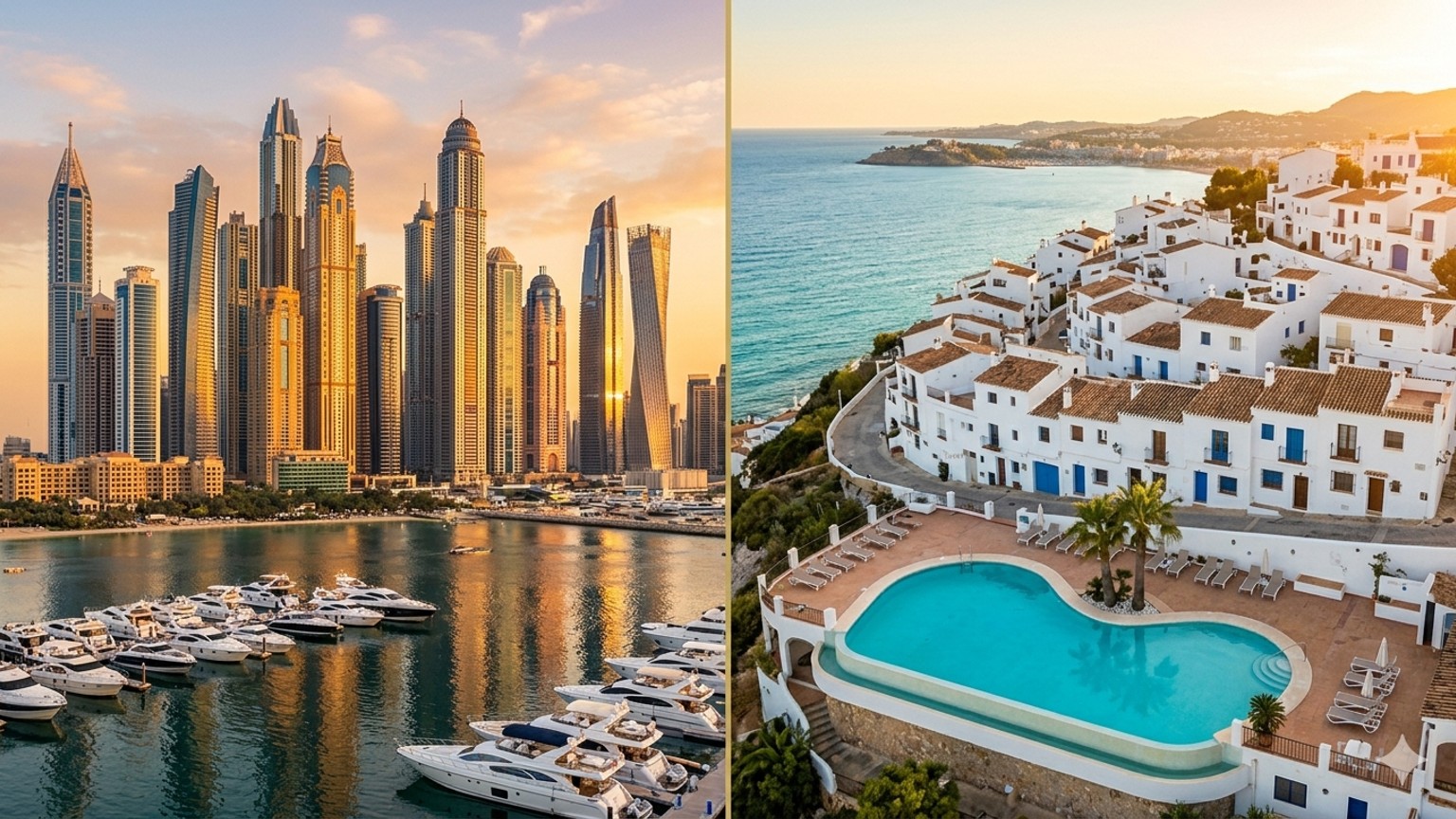
Two Very Different Worlds
Spain and Dubai are both magnets for international property buyers, but they could hardly be more different. Spain offers a Mediterranean lifestyle rooted in centuries of culture, a stable EU legal framework, and a mature property market that has weathered multiple cycles. Dubai offers zero income tax, futuristic architecture, and one of the fastest-growing property markets on the planet.
Choosing between them is not simply a question of numbers. It is a question of what kind of investor you are, what kind of life you want, and how much risk you are willing to accept. In this guide, we compare both markets honestly, using 2026 data, so you can decide which one aligns with your goals.
If you are already leaning towards Spain, you may want to read our 2026 Spanish property market forecast for the latest data on prices and demand.
Quick Comparison at a Glance
| Factor | Spain | Dubai |
|---|---|---|
| Price per m² (mid-range) | €1,500 - €4,000 | €2,000 - €6,000 |
| Gross rental yield | 4 - 7% | 6 - 9% |
| Income tax on rent | 19 - 47% (residents) / 19 - 24% (non-residents) | 0% |
| Transfer tax / fee | 6 - 10% ITP (resale) or 10% VAT (new) | 4% DLD fee |
| Annual service charges | €600 - €2,500 | €3,000 - €8,000 |
| Property residency visa | No (Golden Visa ended 2025) | Yes (10-year, from ~€545K) |
| Currency | EUR | AED (pegged to USD) |
| Summer climate | 25 - 40°C, outdoor living | 40 - 50°C, indoor living |
| Legal framework | EU regulated, strong buyer protections | Freehold zones, RERA regulation |
| Market maturity | Established, centuries-old land registry | Young market (freehold since 2002) |
Property Prices: Where Does Your Money Go Further?
Property prices in both markets vary enormously by location. Here is a realistic breakdown for 2026:
Dubai
- Dubai Marina / JBR: €3,500 - €6,000/m² — waterfront high-rise living, the most popular area for international investors
- Downtown Dubai / DIFC: €5,000 - €10,000/m² — ultra-premium, Burj Khalifa views, high service charges
- Jumeirah Village Circle (JVC): €2,000 - €3,000/m² — budget-friendly, newer developments, further from the coast
- Palm Jumeirah: €6,000 - €15,000/m² — iconic villas and penthouses, trophy asset territory
Spain
- Torrevieja / Orihuela Costa: €1,200 - €2,000/m² — affordable Costa Blanca South, strong rental demand from Northern Europeans
- Benidorm / Calpe: €1,500 - €2,500/m² — established tourist resort, year-round rental income
- Marbella / Golden Mile: €3,000 - €6,000/m² — luxury Mediterranean living, comparable to Dubai Marina pricing
- Barcelona / Madrid: €3,500 - €6,500/m² — major European capitals with strong fundamentals
The key difference: in Spain, your money buys you a tangible lifestyle — terraces, sea views, walkable towns, and year-round outdoor living. In Dubai, similar budgets buy modern high-rise apartments with impressive amenities but a fundamentally different way of life. For more on the Spanish luxury segment, see our guide to luxury property over €500K in Spain.
Tax Comparison: Dubai's "Zero Tax" Is Not the Full Story
Dubai's headline of zero income tax attracts enormous attention, but the full cost picture is more nuanced than most agents will tell you.
Dubai — The Real Costs
- Income tax on rental income: 0% — this is genuine and is Dubai's biggest advantage
- DLD transfer fee: 4% of purchase price — paid on every transaction
- Agent commission: 2% (standard) — paid by the buyer
- VAT: 5% on commercial properties and some services
- Service charges: €3,000 - €8,000 per year — mandatory, paid to the building management, and these have been rising significantly year-on-year
- No capital gains tax: correct, but you pay 4% DLD again when you sell
Spain — Higher Taxes, Lower Hidden Costs
- Income tax on rental income (residents): IRPF at 19 - 47%, but with significant deductions (mortgage interest, depreciation, repairs, insurance). Effective rate for a well-structured rental is often 15 - 25%
- Income tax on rental income (non-residents): flat 19% for EU citizens, 24% for non-EU. EU non-residents can deduct expenses since recent reform
- Transfer tax (ITP): 6 - 10% depending on the autonomous community (one-time, on resale purchases)
- IBI (property tax): €300 - €1,500/year — modest by international standards
- Community fees: €600 - €2,500/year — typically lower than Dubai service charges
For a full breakdown of Spanish buying costs, read our complete guide to property taxes and buying costs. And if you are a high earner considering Spain, the Beckham Law tax regime can reduce your income tax to a flat 24% for up to six years.
Net Tax Impact: A Worked Example
Consider a €300,000 apartment generating €18,000 gross annual rent (6% yield):
Dubai: €18,000 rent minus €5,000 service charges minus €1,000 maintenance = €12,000 net. No income tax. Net yield: 4.0%.
Spain (non-resident EU): €18,000 rent minus €1,200 community fees minus €800 IBI minus €1,000 maintenance = €15,000 taxable. At 19% IRNR with deductions: ~€2,100 tax. Net income: ~€12,900. Net yield: 4.3%.
In this example, the Spanish property actually produces a slightly higher net yield because of the much lower service charges — despite the income tax. The "tax-free" headline does not always translate to higher profits.
Rental Yields: The Numbers Behind the Headlines
Dubai currently offers headline gross yields of 6-9%, which are among the highest of any major international property market. However, there are important caveats:
- Dubai yields are falling. Property prices in Dubai have risen 30-60% since 2021, but rents have not kept pace. A property that yielded 9% in 2021 may now yield 6% at its current value. This compression trend is accelerating.
- Service charges eat into yields. Annual service charges of €3,000-8,000 can reduce gross yields by 1.5-3 percentage points.
- Vacancy risk is real. Dubai's massive construction pipeline (90,000+ units expected in 2026-2028) could increase vacancy rates and put downward pressure on rents.
Spain offers gross yields of 4-7%, which are lower but considerably more stable:
- Yields have been consistent. Spanish rental yields have remained in the 4-7% band for over a decade, with steady upward movement in high-demand areas.
- EUR-denominated. Your income is in the world's second most-traded currency, with no exchange rate risk for European investors.
- Tourism demand is structural. Spain is the world's second most-visited country. Rental demand on the coast is underpinned by 85 million annual tourists, not just a resident expat population.
For the best rental areas in Spain, see our detailed analysis of Spain's highest rental yield areas.
Off-Plan Risks: Lessons from History
Off-plan property is a huge part of the Dubai market, with agents aggressively marketing 1% monthly payment plans and "guaranteed" returns. Before you sign, consider the risks.
Dubai Off-Plan: Buyer Beware
- Developer delays: Projects are frequently delivered 1-3 years late. Some are cancelled entirely. Despite RERA escrow regulations, buyers have limited recourse if a developer goes bankrupt.
- The 2008-2009 crash: Dubai property prices fell 50-60% in 18 months. Many off-plan buyers lost their entire deposit. Projects were abandoned half-built. The Palm Deira and Dubai Waterfront were scrapped. This is not ancient history — it happened within living memory.
- Flipping culture: A large portion of off-plan purchases in Dubai are made by speculators intending to flip before completion. When sentiment shifts, this creates a rush for the exit.
- Payment plan illusion: A "1% per month" payment plan means you are paying full price, not getting a discount. If the market falls 20% during construction, you are locked into paying the full original price for a property worth less.
Spain Off-Plan: Regulated Protection
- Aval bancario: Spanish law (LOE) requires developers to provide a bank guarantee (aval bancario) or insurance for all off-plan deposits. If the developer fails to deliver, your money is returned with interest. This is a legal requirement, not optional.
- Building licence verification: Before construction can begin, the developer must obtain a licencia de obra from the local town hall, involving full planning review.
- Registro de la Propiedad: Spain has a centuries-old land registry system. Title is clear, verifiable, and legally protected.
- The 2008-2013 experience: Spain also suffered a severe property crash, with prices falling 30-40%. But the recovery has been steady, and the structural reforms that followed (stricter lending, aval requirement) make a repeat far less likely.
Residency and Visa Options
Residency is often a major motivation for buying property abroad. Here is where things stand in 2026:
Dubai Golden Visa
Dubai offers a 10-year renewable Golden Visa for property purchases of AED 2 million or more (approximately €545,000). This is straightforward, well-established, and genuinely attractive. The visa allows you to live, work, and sponsor family members in the UAE. There is no minimum stay requirement to maintain the visa, making it popular as a "Plan B" residency.
Spain: Post-Golden Visa Landscape
Spain ended its Golden Visa programme in April 2025. Property purchases no longer grant residency. However, several alternatives exist:
- Non-lucrative visa: For retirees or people with passive income. Requires proof of financial means (~€28,800/year for the main applicant) and private health insurance. No right to work in Spain.
- Digital nomad visa: For remote workers employed by or contracting with non-Spanish companies. Grants 1-year residency, renewable. Requires minimum income of ~€2,520/month.
- Work visa / entrepreneur visa: Standard options if you plan to work or start a business in Spain.
- EU advantage: Any EU/EEA citizen can live in Spain without any visa, simply by registering. This is a massive advantage that Dubai cannot match for European buyers.
The critical difference: Spanish residency gives you access to the entire European Union — freedom to live, work, and travel across 27 countries. A Dubai visa gives you access to the UAE and easier travel to some countries, but it is fundamentally a single-country permission.
Quality of Life: The Factor Most Investors Underestimate
If you plan to spend any time in the property you buy — even a few weeks a year — quality of life matters enormously. This is where Spain and Dubai diverge most dramatically.
Climate
Spain's Mediterranean coast enjoys 300+ days of sunshine per year. Summers are hot (30-40°C) but dry and bearable, especially near the coast with sea breezes. Winters are mild (10-18°C). You can be outdoors year-round — eating on terraces, walking on the beach, cycling, hiking.
Dubai is pleasant from November to March (20-28°C). But from May to October, temperatures regularly exceed 45°C with extreme humidity. Outdoor activity is essentially impossible for five months of the year. Everything moves indoors — malls, indoor ski slopes, air-conditioned everything. If you are buying a "holiday home," you should know that summer is Dubai's off-season for a reason.
Culture and Lifestyle
Spain offers walkable historic towns, world-class cuisine (the Mediterranean diet is a UNESCO heritage), excellent local wine, vibrant street life, public fiestas, and a social culture centred around family and community. Alcohol is freely available, dress codes are relaxed, and individual freedoms are fully protected by EU law.
Dubai offers modern luxury, world-class shopping, fine dining (international cuisine), and impressive entertainment infrastructure. However, it is important to understand the cultural context: alcohol is available but regulated (licensed venues only), public behaviour is subject to laws that differ significantly from European norms, and the social fabric is predominantly expat-driven rather than locally rooted.
Healthcare
Spain has one of the best public healthcare systems in the world, ranked among the top 10 globally. EU citizens have automatic access. Private healthcare is affordable (€80-150/month for comprehensive cover).
Dubai has excellent private healthcare, but it is expensive. Health insurance is mandatory and can cost €2,000-5,000/year. There is no public system for expats.
Historical Stability: What Has Happened Before Can Happen Again
Dubai: A Young Market with Sharp Cycles
Dubai only allowed foreign freehold ownership in 2002. In that short history, the market has experienced at least three major boom-bust cycles:
- 2002-2008: Rapid price increases driven by speculation and off-plan flipping
- 2008-2011: Crash of 50-60%. Mass expat exodus. Developers defaulted. Nakheel nearly collapsed. Abandoned cars lined airport roads.
- 2014-2020: Gradual recovery followed by another decline. Prices fell 30% from 2014 peak to 2020 trough.
- 2021-2025: Strong boom driven by post-COVID demand, Russian capital inflows, and digital nomad migration. Prices in some areas have doubled.
The pattern is clear: Dubai's market is highly cyclical and driven by sentiment, capital flows, and geopolitics rather than by organic domestic demand.
Spain: Painful Lessons, Stronger Foundations
Spain's property crash of 2008-2013 was severe — prices fell 30-40% from the peak, and recovery took nearly a decade in some areas. But the aftermath brought meaningful structural reforms:
- Stricter bank lending criteria (no more 100%+ mortgages)
- Reduced construction — Spain builds far fewer homes today than in 2006, creating a supply deficit in high-demand areas
- A stronger legal framework for buyer protection
- Demand now driven by genuine shortage (local + international) rather than speculation
Since 2015, Spanish prices have recovered steadily at 3-6% per year — far less volatile than Dubai's double-digit swings. For current trends, see our 2026 market forecast.
Resale Liquidity: Can You Sell When You Need To?
Dubai has high transaction volumes and properties sell quickly in good times. But the market is almost entirely driven by expatriates and foreign investors. When sentiment shifts — as it did in 2008 and 2018 — buyers can evaporate overnight. There is limited domestic demand to provide a floor.
Spain has a mix of local and international demand. Spanish buyers account for ~80% of all transactions nationally. On the coast, the mix shifts towards international buyers, but demand comes from dozens of countries (UK, Germany, Netherlands, France, Scandinavia, Belgium). This diversity provides resilience — even when one buyer nationality retreats, others step in.
A useful indicator: Spain processed over 640,000 property transactions in 2025. The market has depth and liquidity that comes from centuries of established property culture.
Currency Risk: EUR vs AED
This is often overlooked but critically important for international investors.
The euro (EUR) is the world's second most-traded reserve currency, backed by the European Central Bank, with deep liquid markets and broadly predictable monetary policy. For European investors, buying in Spain means zero currency risk.
The Emirati dirham (AED) is pegged to the US dollar at a fixed rate of 3.6725 since 1997. This peg has held for nearly 30 years. However:
- The peg's survival depends on the UAE's oil revenues and dollar reserves
- If the US dollar strengthens significantly (as it did in 2022-2023), your property becomes more expensive for non-USD buyers, potentially reducing demand
- If the peg were ever broken or adjusted, the consequences for property values would be severe and immediate
- For European investors, buying in AED/USD means taking on currency risk that does not exist with a Spanish purchase
This is not a prediction that the peg will break. It is a reminder that currency risk is real, asymmetric, and often ignored during boom times.
Who Should Buy Where? Investor Profiles
| Profile | Better Fit | Why |
|---|---|---|
| EU citizen seeking a lifestyle home | Spain | Free movement, no visa needed, outdoor lifestyle, healthcare access, cultural depth |
| Pure yield maximiser (short-term) | Dubai | Higher gross yields, zero income tax, but higher risk and service charges |
| Retiree seeking year-round living | Spain | Mild climate, excellent public healthcare, walkable communities, lower cost of living |
| Non-EU citizen needing residency | Dubai | Golden Visa is straightforward and well-established. Spain no longer offers property-based residency |
| Long-term capital preservation | Spain | EUR-denominated, lower volatility, strong legal protections, diverse buyer base |
| Speculative off-plan investor | Neither (high risk) | Speculation can produce gains in either market but carries significant downside risk in both |
| Family with children | Spain | Public schools, EU educational mobility, outdoor lifestyle, safer for children to grow up |
| High-net-worth tax optimiser | Dubai | Zero income tax is a genuine advantage for high earners. But consider the Beckham Law as an alternative |
| Digital nomad / remote worker | Spain | Digital nomad visa, EU time zone, walkable cities, reliable infrastructure, social life |
Our Honest Assessment
Dubai is a legitimate investment market that offers genuine tax advantages, modern infrastructure, and an efficient buying process. For the right investor — particularly non-EU citizens seeking residency, or high-net-worth individuals optimising for tax — it can make sense.
But the Dubai market carries risks that are often downplayed by the army of social media agents promoting it: sharp cyclical volatility, high and rising service charges, extreme climate limitations, off-plan hazards, and currency risk. The "zero tax" headline is powerful marketing, but it is not the whole story.
Spain offers a more mature, stable, and liveable alternative. Lower gross yields are offset by lower operating costs, stronger buyer protections, EUR stability, and a lifestyle that people genuinely want to live — not just invest in. The absence of a Golden Visa is a drawback for non-EU buyers, but it has also removed speculative demand, which arguably makes the market healthier.
The best investment is the one that matches your real goals, not the one with the most impressive headline number. If you value stability, lifestyle, legal protection, and long-term appreciation in a world-class currency — Spain deserves serious consideration.
Ready to explore the Spanish market? Start with our Costa del Sol property guide or browse the best areas for rental yields.
Frequently Asked Questions
Is property cheaper in Spain or Dubai?
It depends on the area. Budget locations in Spain (Torrevieja, €1,200-2,000/m²) are cheaper than most Dubai areas. However, mid-range Dubai (JVC, €2,000-3,000/m²) is comparable to the Costa Blanca. Premium areas in both countries (Marbella, Downtown Dubai) overlap at €5,000-10,000/m².
Is Dubai really tax-free for property investors?
Dubai has no income tax on rental income, but investors still pay 5% VAT on commercial property, a 4% DLD transfer fee on purchase, and annual service charges of €3,000-8,000. When you add these costs, the effective tax burden is not zero.
Can I get residency by buying property in Dubai or Spain?
Dubai offers a 10-year Golden Visa for property purchases of AED 2 million (~€545,000). Spain ended its Golden Visa in April 2025. Spanish residency options now include the non-lucrative visa, digital nomad visa, or standard work/retirement visas.
Which country has higher rental yields?
Dubai currently offers higher gross yields (6-9%) compared to Spain (4-7%). However, Dubai yields have been falling as property prices rise faster than rents, while Spanish yields remain more stable year-over-year.
What are the biggest risks of buying property in Dubai?
The main risks include off-plan developer delays or cancellations, market volatility (prices crashed 50% in 2008-2009), an expat-driven market that can see rapid outflows, and currency risk if the AED-USD peg were ever adjusted.
Why Granfield Estate?
-
⚑
We live on the coast
Our team lives and works on the Costa Blanca. We know every neighbourhood, every street and the real prices — not from a catalogue, but from daily work on the ground.
-
⚖
In-house lawyer — 10+ years of experience
NIE, bank account, property check, contract, notary — legal support at every step. First consultation free.
-
🏠
Property management
Buying to rent? Our management company handles tenant search, maintenance and all questions.
-
🌐
We speak your language
English, Spanish, Russian, German, Finnish, Swedish and more. Licence RAICV 1663, member of Asivega.
Read also

Rental Investment in Guardamar del Segura: Why the Short-Term Rental Ban Is Actually an Advantage
30.03.2026
Guardamar del Segura is one of the few Costa Blanca towns where the municipality does not issue short-term rental licences. For investors this means stable income without seasonal gaps, and for those buying to live — peace and permanent neighbours instead of noisy tourists.

Apartments and Penthouses in Los Alcázares: Investment Guide
16.04.2026
Los Alcázares is one of the most promising property investment destinations on the Mar Menor coast. Apartments from €90,000, penthouses with terraces from €200,000, seasonal rental yields of 6-9%. We break down property types, real running costs and the best areas.

Rent vs Buy in Spain: Which Makes More Sense in 2026?
13.06.2026
A data-driven analysis of price-to-rent ratios, purchase costs versus accumulated rent, Spanish rental regulations, and tax implications to help you decide whether to rent or buy in Spain.