


Is Spain Safe? What the Numbers Actually Say
One of the first questions people ask when considering a move to Spain — or buying property there — is about safety. The short answer: Spain is one of the safest countries in Western Europe, and considerably safer than several Northern European nations that people tend to assume are low-crime. But generalisations only go so far. This guide breaks down the actual data, explains what types of crime you might realistically encounter, and offers practical advice for foreign residents and property owners.
The statistics referenced here draw primarily from Eurostat, Spain's Ministry of the Interior annual crime reports, and the United Nations Office on Drugs and Crime (UNODC) database. Where possible, figures reflect the most recent complete data available (2024-2025 reporting periods).
Spain's Crime Rate in European Context
According to Eurostat data, Spain's overall recorded crime rate sits below the European Union average. The country consistently reports fewer offences per 100,000 inhabitants than the United Kingdom, France, Germany, Belgium, and Sweden. This often surprises people from Northern Europe, where the perception of Mediterranean countries can be skewed by holiday-related petty theft experiences.
Spain recorded approximately 44-46 offences per 1,000 inhabitants in recent reporting periods. Compare this to France at roughly 55-58, Germany at 65-70, Sweden at 130-140 (Sweden's high figure partly reflects different recording practices, but even adjusted, rates are higher), Belgium at 75-85, and the UK at 80-90. The Netherlands sits around 50-55, making it closer to Spain but still higher.
It is worth noting that crime recording practices vary between countries, which makes exact comparisons imperfect. Some countries record crimes at the point of reporting, others at the point of conviction. Spain's system records at the reporting stage, which means its figures are not artificially deflated by under-recording. If anything, the relatively low rate of formal crime reporting in Spain (many minor incidents go unreported, as in most countries) means the true gap may be even wider.
Violent Crime: Very Low by European Standards
Spain's intentional homicide rate is approximately 0.6-0.7 per 100,000 inhabitants. This places it among the lowest in Europe, comparable to Switzerland and Austria. For context, France sits at around 1.2, the UK at 1.1, Belgium at 1.7, and Sweden — which has seen a well-documented rise in gang-related violence — at approximately 1.2. Germany is around 0.8.
Assault rates follow a similar pattern. Spain reports roughly 40-50 assaults per 100,000 inhabitants causing bodily harm, compared to 200+ in the UK and 150+ in Germany. Street violence in Spanish cities is genuinely rare outside of very specific nightlife contexts (certain club strips in Magaluf or parts of Benidorm at 3am, for instance). Even in Barcelona and Madrid, the cities with the highest crime in Spain, violent incidents against residents are uncommon.
Sexual violence statistics require careful interpretation due to widely varying reporting rates and legal definitions across countries. Spain has expanded its legal definitions significantly in recent years (the "only yes means yes" legislation), which has affected recorded numbers without necessarily indicating an increase in actual incidents.
For expats considering a move: the risk of being a victim of violent crime in Spain is very low, and lower than in most countries they are likely moving from.
Property Crime: The Area That Matters Most for Expats
This is where the picture gets more nuanced, and more relevant for foreign property owners. Spain's property crime rate is moderate by European standards — lower than France, Belgium, or the UK, but not negligible. The types of property crime that affect expats most are car break-ins, home burglaries, and theft from persons (pickpocketing).
Car Break-ins
This is the single most common crime affecting tourists and residents in coastal areas. Rental cars and vehicles with foreign plates are disproportionately targeted. The hotspots are predictable: tourist parking areas near beaches, airport car parks, rest stops along the AP-7, and commercial centre car parks. The thieves typically smash a window, grab visible bags or electronics, and disappear within seconds. It is opportunistic rather than targeted.
Prevention is straightforward: never leave anything visible in a parked car. Nothing. Not a jacket, not a charging cable, not an empty bag. Experienced residents in Spain treat their car interior like a display case — it should look entirely empty.
Home Burglary
Home burglary rates vary significantly by region. The national average sits at around 130-150 burglaries per 100,000 inhabitants. However, coastal provinces with high concentrations of holiday homes see higher rates: Alicante, Málaga, the Balearic Islands, and parts of the Canary Islands all exceed the national average. The logic is simple — empty properties are easier targets, and areas with seasonal residents have many empty properties for months at a time.
Interior provinces and northern regions see substantially lower burglary rates. Castilla y León, for example, has rates below 80 per 100,000.
Pickpocketing and Street Theft
Barcelona has a well-known pickpocketing problem, particularly on Las Ramblas, in the metro, and around tourist attractions. Madrid's central areas (Sol, Gran Vía, tourist zones) also see significant pickpocketing activity. Outside of these two cities, street theft is much less common. In residential areas of Costa Blanca, Costa del Sol, or smaller cities, pickpocketing is rarely an issue for residents going about their daily lives.
Safest Regions in Spain
Spain's Ministry of the Interior publishes regional crime data annually. Consistently, the safest autonomous communities are:
- Castilla y León — the lowest overall crime rate in Spain, roughly 30 offences per 1,000 inhabitants. This vast, sparsely populated interior region includes cities like Salamanca, León, and Valladolid.
- Navarra — low crime, strong local institutions, and a prosperous economy centred on Pamplona.
- La Rioja — Spain's smallest autonomous community, known for wine country. Very low crime rates.
- Asturias — the northern coast, relatively isolated, with strong community bonds and low crime.
- Extremadura — one of the least populated regions, with correspondingly low crime.
- Aragón — interior region with Zaragoza as its main city. Below-average crime rates.
The highest crime rates are found in Ceuta and Melilla (Spain's North African enclaves, which are outliers), followed by the Balearic Islands, Catalonia (driven by Barcelona), and the Comunidad Valenciana (driven partly by the coastal tourist belt).
Coastal Areas: Higher Property Crime, Still Safe
If you are buying property on the Costa Blanca, Costa del Sol, or another coastal area, you should be aware that property crime rates are somewhat higher than the national average. However, "higher" is relative — these areas are still significantly safer than most comparable tourist regions in France, Italy, or the UK coastal towns.
The pattern is seasonal. Burglary and car crime peak in summer (July-September) when tourist areas are crowded and many properties are occupied by unfamiliar short-term renters. There is a secondary peak around Christmas, when some holiday homes stand empty while owners are in their home countries.
Torrevieja and Orihuela Costa: An Honest Assessment
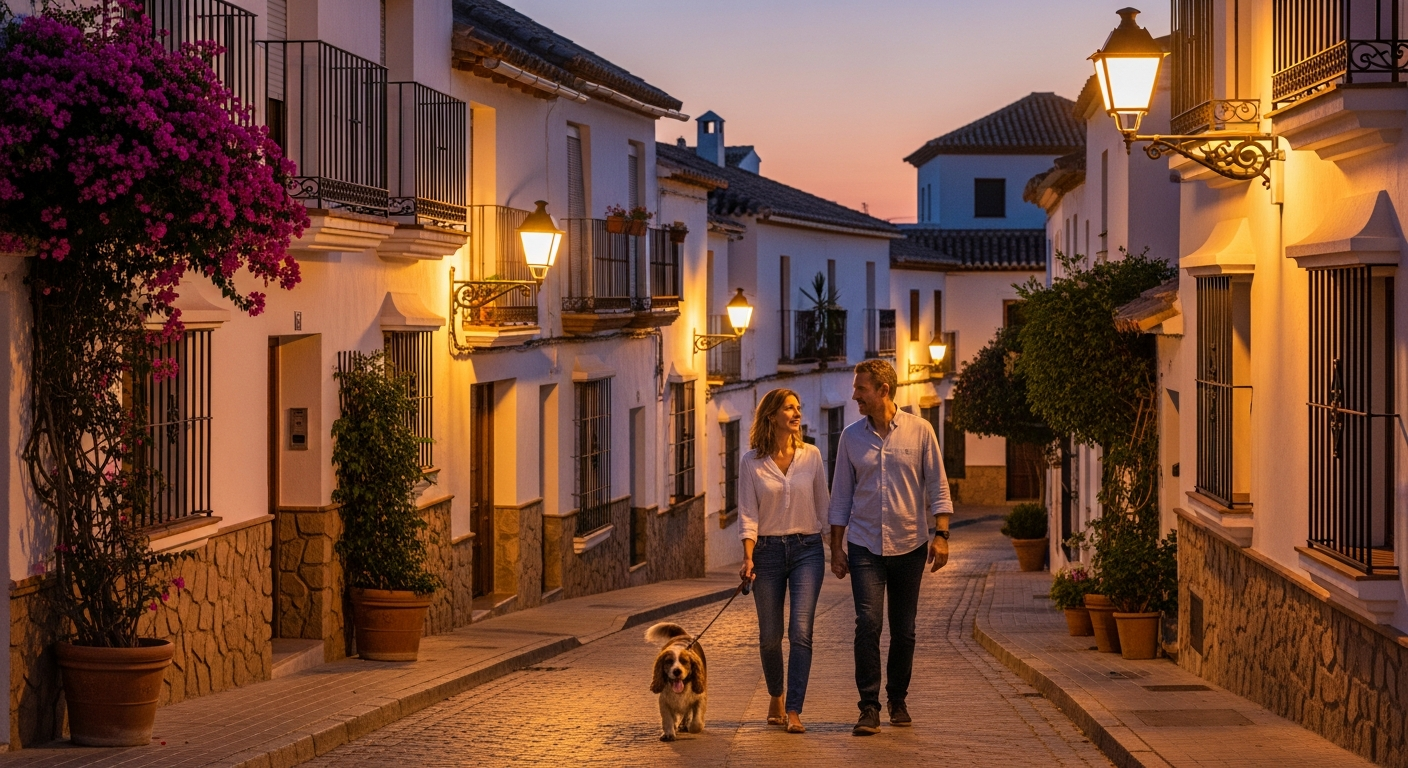
Since many of our readers are looking at property in the Torrevieja-Orihuela Costa corridor, here is a straight assessment. These areas are safe for daily life. People walk around freely in the evening, children play in urbanisation streets, and violent crime against residents is rare. The international community is large, well-established, and generally looks out for each other.
That said, certain issues exist. Car break-ins occur, particularly in summer in beach parking areas and near commercial centres like Habaneras or Zenia Boulevard. Home break-ins happen, mostly targeting clearly unoccupied properties in urbanisations during off-season. La Zenia, Playa Flamenca, and Cabo Roig see occasional burglary waves, typically carried out by organised groups who move through an area over several weeks, then move on.
Lower-income areas on the outskirts of Torrevieja city have somewhat higher petty crime rates. The area around the old town and certain peripheral neighbourhoods occasionally see drug-related activity, though this rarely affects residents who are not involved.
The practical risk for a typical foreign resident: very low for violent crime, moderate-low for property crime if you take standard precautions (which are outlined later in this article). Most long-term expats in the area will tell you they feel safer than they did in the UK, Germany, or Scandinavia.
Scams Targeting Foreigners
While not strictly "crime" in the street-crime sense, scams are one of the biggest real risks for foreigners in Spain, particularly those buying property or setting up new lives.
- Fake rental ads: Listings on platforms like Idealista, Fotocasa, or Facebook groups for apartments that either do not exist or are listed by someone who is not the owner. The scammer collects a deposit and disappears. Red flags: price well below market rate, landlord cannot meet in person, requests payment to a foreign bank account, pressure to transfer money before viewing.
- Dodgy property deals: Unlicensed agents, properties with undisclosed debts or illegal extensions, land sold without proper title, properties built on protected land. This is why using an independent Spanish lawyer (abogado) who is not connected to the selling agent is essential when buying.
- Illegal construction: Particularly in rural areas and some coastal urbanisations, properties may have been extended, had pools added, or even been built entirely without proper licences. These issues can result in demolition orders years later. The local urbanismo department can confirm whether a property has a proper licence of first occupation (licencia de primera ocupación).
- Timeshare pressure: Still active in tourist areas, particularly Costa del Sol. High-pressure sales tactics targeting tourists and new arrivals. Legitimate timeshare exists, but the industry has a long history of abusive practices in Spain.
- Fake utility or tax demands: Phishing emails or calls claiming to be from Suma (tax office), Iberdrola, or other utilities, demanding immediate payment.
Police Forces in Spain: Who Does What
Spain has three main police forces, which can be confusing for newcomers. Understanding which one to contact for what situation is genuinely useful.
Policía Nacional (National Police)
Operates in cities and provincial capitals. Handles serious crime, identity documents (NIE, TIE, passport), immigration matters, and drug trafficking. If you need to report a crime in an urban area, they are usually your first point of contact. Their emergency number is 091.
Guardia Civil
Operates in rural areas, small towns, coastal areas outside major cities, and highways. They handle traffic offences on inter-city roads, environmental crimes, border security, and crime in areas not covered by Policía Nacional. In many coastal urbanisations (including much of Orihuela Costa), the Guardia Civil is the primary police force. Their emergency number is 062.
Policía Local (Municipal Police)
Each municipality has its own local police force. They handle traffic within towns, local bylaws, noise complaints, and minor incidents. They are often the first to respond in urban areas simply because they are nearby. Their emergency number is 092.
General Emergency Number
For any emergency — police, fire, or ambulance — call 112. Operators typically speak Spanish and English, and can connect you to the appropriate service. If in doubt, always call 112.
How to Report a Crime (Denuncia)
Reporting a crime in Spain is done by filing a "denuncia" (formal complaint) at a police station. This is important not only for criminal proceedings but also for insurance claims — most insurance companies require an official denuncia number.
The process is straightforward but can be slow. You will need to visit a police station (comisaría for Policía Nacional, cuartel for Guardia Civil) and provide a statement. Having your NIE or passport is essential. In tourist areas, many stations have English-speaking officers or access to translators during summer months.
For non-urgent crimes (property damage, theft where the perpetrator is gone), you can also file a denuncia online through the Policía Nacional website at denuncias.policia.es. This is available in Spanish and English. You will receive a reference number that you can use for insurance purposes. Note that for some types of crime, you may still need to ratify the online denuncia in person.
Important: filing a denuncia does not mean police will actively investigate. For minor property crimes, the denuncia is primarily a record for your own use (insurance, documentation). This is not unique to Spain — the same is true in most European countries.
Home Security: Practical Measures
If you own property in Spain, particularly a holiday home that stands empty for periods, security is worth investing in. The most common measures:
Alarm Systems
The two dominant providers in Spain are Securitas Direct (now Verisure) and Prosegur. Both offer monitored alarm systems with motion detectors, door/window sensors, cameras, and connection to a central monitoring station. Costs are typically €40-60 per month depending on the package. Both offer app-based monitoring, so you can check your property from abroad. These are well-regarded and widely used — having an alarm sign visible on your property is itself a deterrent.
There are also cheaper unmonitored systems (Ajax, Ring, etc.) that alert you directly via your phone. These are better than nothing but less effective than monitored systems with guaranteed police response.
Community Vigilance
In urbanisations, the community of owners (comunidad de propietarios) often organises informal neighbourhood watch arrangements. Good relationships with neighbours — including permanent Spanish residents — are one of the most effective security measures. People who notice unfamiliar vehicles or activity and communicate quickly can prevent many opportunistic burglaries.
Insurance Requirements
Home insurance (seguro del hogar) is not legally mandatory in Spain unless you have a mortgage (banks require it). However, it is strongly recommended. Most policies cover theft, but check the conditions: many require evidence of forced entry and an official denuncia. Some policies require a minimum standard of security (e.g., reinforced door, window grilles) for theft coverage to apply. Contents insurance usually has sublimits for valuables like jewellery and electronics — check these before assuming you are fully covered.
Crime Rates: Spain vs. European Countries
| Country | Overall Crime Rate (per 1,000) | Homicide Rate (per 100K) | Burglary Rate (per 100K) | Assault Rate (per 100K) |
|---|---|---|---|---|
| Spain | 44-46 | 0.6 | 130-150 | 40-50 |
| United Kingdom | 80-90 | 1.1 | 350-400 | 200+ |
| France | 55-58 | 1.2 | 250-300 | 150+ |
| Germany | 65-70 | 0.8 | 80-100 | 150+ |
| Belgium | 75-85 | 1.7 | 400+ | 180+ |
| Sweden | 130-140 | 1.2 | 150-180 | 200+ |
| Netherlands | 50-55 | 0.6 | 150-180 | 120+ |
| Italy | 40-43 | 0.5 | 200-250 | 50-60 |
| Poland | 25-30 | 0.7 | 50-70 | 30-40 |
Sources: Eurostat, UNODC, national statistical offices. Figures are approximate and reflect the most recent complete reporting periods (2023-2025). Crime recording practices vary by country, so direct comparisons should be interpreted with caution.
Natural Risks in Spain
Safety is not only about crime. Spain has several natural hazards worth knowing about:
DANA Floods
DANA (Depresión Aislada en Niveles Altos) events — also called "gota fría" or cold drop — are intense rainfall events that affect the Mediterranean coast, particularly in autumn (September-November). They can cause devastating flash floods in dry riverbeds (ramblas) and low-lying areas. The 2024 Valencia DANA was a tragic reminder, causing significant casualties and property damage. When buying property on the coast, check flood risk maps and avoid properties in or adjacent to ramblas. Take AEMET (Spain's meteorological agency) red weather alerts seriously — they are not issued lightly.
Forest Fires
Summer fires are a significant risk, particularly in interior areas, hillside urbanisations, and pine forests. Maintain defensible space around properties (clear dry brush), and be aware that some areas require specific fire-prevention measures. Urbanisations in forested areas should have communal fire-prevention plans.
Earthquakes
Very rare and typically minor. The southeast (Murcia, Alicante) is the most seismically active area, but serious earthquakes are extremely uncommon. The 2011 Lorca earthquake (magnitude 5.1, 9 fatalities) was the most significant in modern times. Newer construction meets seismic codes.
Heatwaves
Increasingly common and intense. Summer temperatures above 40°C are normal in much of southern and interior Spain. For retirees and those with health conditions, this is a genuine safety concern. Ensure your property has adequate air conditioning and stay hydrated. AEMET issues heat warnings that should be taken seriously.
Practical Tips for Staying Safe in Spain
- Never leave anything visible in your car. This is the single most practical piece of advice. Absolutely nothing should be visible — not bags, not jackets, nothing.
- Use an alarm system if your property is unoccupied for extended periods. Even a visible alarm box deters opportunistic burglars.
- Build relationships with neighbours. A neighbour who notices unusual activity is your best security system.
- Use a reputable, independent lawyer for any property purchase. Never rely solely on the estate agent's recommended lawyer.
- Be sceptical of too-good-to-be-true rental or property deals. If the price is significantly below market rate, there is usually a reason.
- Register with your country's consulate so you can receive safety alerts and assistance if needed.
- Keep copies of important documents (NIE, passport, insurance policies) both physically and digitally.
- Save emergency numbers in your phone: 112 (general), 091 (Policía Nacional), 062 (Guardia Civil), 092 (Policía Local).
- Take weather warnings seriously. DANA floods and heatwaves are the most significant natural threats. Do not drive through flooded roads.
- Insure your property and possessions adequately. Read the small print, particularly around theft requirements.
The Bottom Line
Spain is a safe country. Statistically safer than the UK, France, Germany, Belgium, and Sweden across most crime categories. The main concerns for foreign residents are opportunistic property crime (car break-ins, home burglary of empty properties) and scams related to property transactions. These risks are manageable with basic precautions.
No country is crime-free, and anyone who tells you a particular area has "no crime" is being dishonest or naive. But the lived experience of the vast majority of foreign residents in Spain — including on the costas — is of feeling safe, relaxed, and considerably less anxious about personal security than they did back home. That matches the data, and it is one of the many reasons people continue to choose Spain.
Frequently Asked Questions
Spain's Crime Rate in European Context?
According to Eurostat data, Spain's overall recorded crime rate sits below the European Union average. The country consistently reports fewer offences per 100,000 inhabitants than the United Kingdom, France, Germany, Belgium, and Sweden. This often surprises people from Northern Europe, where the perception of Mediterranean countries can be skewed by holiday-related petty theft experiences. Spain recorded approximately 44-46 offences per 1,000 inhabitants in recent reporting periods. Compare this to France at roughly 55-58, Germany at 65-70, Sweden at 130-140 (Sweden's high figure partly reflects different recording practices, but even adjusted, rates are higher), Belgium at 75-85, and the UK at 80-90. The Netherlands sits around 50-55, making it closer to Spain but still higher.
Property Crime: The Area That Matters Most for Expats?
This is where the picture gets more nuanced, and more relevant for foreign property owners. Spain's property crime rate is moderate by European standards — lower than France, Belgium, or the UK, but not negligible. The types of property crime that affect expats most are car break-ins, home burglaries, and theft from persons (pickpocketing). Car Break-ins This is the single most common crime affecting tourists and residents in coastal areas. Rental cars and vehicles with foreign plates are disproportionately targeted. The hotspots are predictable: tourist parking areas near beaches, airport car parks, rest stops along the AP-7, and commercial centre car parks. The thieves typically smash a window, grab visible bags or electronics, and disappear within seconds. It is opportunistic rather than targeted.
Coastal Areas: Higher Property Crime, Still Safe?
If you are buying property on the Costa Blanca, Costa del Sol, or another coastal area, you should be aware that property crime rates are somewhat higher than the national average. However, "higher" is relative — these areas are still significantly safer than most comparable tourist regions in France, Italy, or the UK coastal towns. The pattern is seasonal. Burglary and car crime peak in summer (July-September) when tourist areas are crowded and many properties are occupied by unfamiliar short-term renters. There is a secondary peak around Christmas, when some holiday homes stand empty while owners are in their home countries.
Police Forces in Spain: Who Does What?
Spain has three main police forces, which can be confusing for newcomers. Understanding which one to contact for what situation is genuinely useful. Policía Nacional (National Police) Operates in cities and provincial capitals. Handles serious crime, identity documents (NIE, TIE, passport), immigration matters, and drug trafficking. If you need to report a crime in an urban area, they are usually your first point of contact. Their emergency number is 091.
Home Security: Practical Measures?
If you own property in Spain, particularly a holiday home that stands empty for periods, security is worth investing in. The most common measures: Alarm Systems The two dominant providers in Spain are Securitas Direct (now Verisure) and Prosegur. Both offer monitored alarm systems with motion detectors, door/window sensors, cameras, and connection to a central monitoring station. Costs are typically €40-60 per month depending on the package. Both offer app-based monitoring, so you can check your property from abroad. These are well-regarded and widely used — having an alarm sign visible on your property is itself a deterrent.
Why Granfield Estate?
-
⚑
Office on the coast — we live here
Our office is in La Mata, Torrevieja. We know every neighbourhood, every street and the real prices — not from a catalogue, but from daily work on the ground.
-
⚖
In-house lawyer — 10+ years of experience
NIE, bank account, property check, contract, notary — legal support at every step. First consultation free.
-
🏠
Property management
Buying to rent? Our management company handles tenant search, maintenance and all questions.
-
🌐
We speak your language
English, Spanish, Russian, German, Finnish, Swedish and more. Licence RAICV 1663, member of Asivega.
Granfield Estate · Av. Bélgica 1, C.C. Parquemar, La Mata, 03188 Torrevieja · +34 865 44 33 33
Read also

Cost of Living in Spain 2026: Monthly Budget Breakdown
10.06.2026
What it really costs to live in Spain in 2026. Complete monthly budget breakdown for a couple: from €1,500 to €2,500 per month, comfortable but not luxury.

Healthcare in Spain for Foreigners: Complete Guide
12.06.2026
Spain has one of Europe's best healthcare systems. How to access public and private healthcare as a foreigner — EHIC, SIP card, convenio especial, and private insurance explained.

10 Best Beaches on Costa Blanca (and Property Nearby)
17.06.2026
From the golden dunes of Guardamar to the hidden cove of Granadella — the 10 best beaches on Costa Blanca, with Blue Flag status, crowd levels, facilities, and property prices within walking distance.