


Spain vs Turkey: Where to Buy Property in 2026 — Complete Comparison
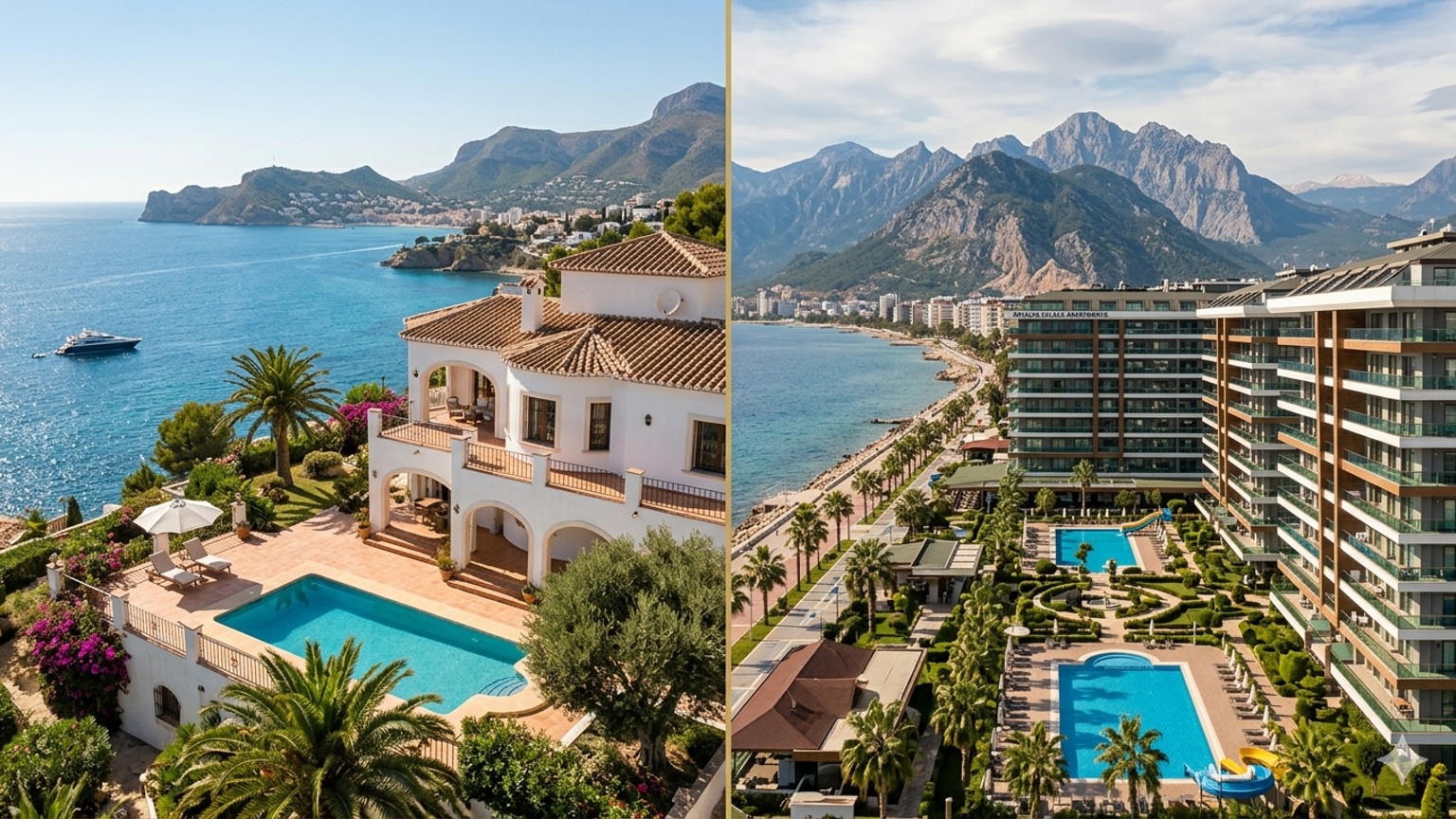
Two Mediterranean Giants — One Smart Investment
Spain and Turkey dominate the wishlists of international property buyers looking for sun, sea, and value. Both countries offer stunning Mediterranean coastlines, warm climates, and prices far below Northern Europe. But beneath the surface, the two markets differ dramatically in legal protection, financial stability, and long-term investment returns.
This guide provides a thorough, data-backed comparison to help you decide where to put your money in 2026. We cover everything from price per square metre to residency rights, currency exposure, and resale liquidity. If you are already leaning towards Spain, check our 2026 market trends analysis for the latest figures.
Quick Comparison Table
| Factor | Spain | Turkey |
|---|---|---|
| Average price (coastal, €/m²) | 1,200 – 3,500 | 800 – 1,500 |
| Gross rental yield | 4 – 7 % | 5 – 8 % |
| Annual holding costs (% of value) | 1.0 – 1.8 % | 0.5 – 1.2 % |
| Purchase tax / VAT | 7 – 10 % (resale) / 10 % (new) | 4 % (title deed fee) |
| Residency via property | Non-lucrative visa / Digital Nomad Visa | Residence permit (≥ $200K) / Citizenship ($400K) |
| EU membership | Yes (since 1986) | No (candidate since 1999) |
| Currency | EUR (€) | TRY (₺) |
| Earthquake risk | Low–moderate | High (active fault zones) |
| Healthcare (WHO ranking) | 7th worldwide | 70th worldwide |
| Schengen zone | Yes | No |
Property Prices: What Your Budget Actually Buys
Turkey — Antalya, Alanya, and Beyond
Turkey's south coast is the prime market for foreign buyers. Prices in Antalya's Konyaalti and Lara neighbourhoods range from €900 to €1,400/m² for new-build apartments. Alanya — hugely popular with Scandinavian and Russian buyers — offers entry points as low as €800/m² in Mahmutlar, though sea-view units in Cleopatra Beach climb to €1,200–1,500/m². Istanbul prices are substantially higher (€2,000–4,000/m² in desirable districts) but attract a different buyer profile.
Headline prices look attractive, but remember: all transactions settle in Turkish Lira, and the currency has lost more than 80% of its value against the Euro over the past five years. A property purchased for $100,000 in 2021 may be worth the same in local currency terms but drastically less when converted back to Euros.
Spain — Costa Blanca, Costa del Sol, and More
Spain's coast offers a wider price spectrum. The Costa Blanca — from Torrevieja to Javea — averages €1,200–2,500/m² depending on the town and proximity to the sea. The Costa del Sol (Marbella, Estepona, Fuengirola) ranges from €2,000 to €4,000/m² and above for luxury stock. More affordable options exist on the Costa Calida (Murcia), where €1,000–1,500/m² can secure a quality new-build with a communal pool.
Key difference: Spanish prices are quoted and transacted in Euros. Your investment is denominated in one of the world's most stable reserve currencies. For a detailed look at what you will pay beyond the headline price, see our buying costs breakdown.
Price per Square Metre — Side by Side
| Location | Price range (€/m²) | Typical 2-bed apartment |
|---|---|---|
| Alanya, Turkey | 800 – 1,200 | €56,000 – €84,000 |
| Antalya centre, Turkey | 900 – 1,400 | €63,000 – €98,000 |
| Torrevieja, Spain | 1,200 – 1,800 | €84,000 – €126,000 |
| Alicante, Spain | 1,500 – 2,200 | €105,000 – €154,000 |
| Fuengirola, Spain | 2,000 – 3,000 | €140,000 – €210,000 |
| Marbella, Spain | 3,000 – 5,000+ | €210,000 – €350,000+ |
Legal Security and Property Rights
Spain — EU-Grade Legal Protection
Spain operates within the European Union legal framework. Property rights are protected by the Registro de la Propiedad — a centralised land registry that records every ownership transfer, mortgage, and encumbrance. Once your purchase is inscribed in the registro, your title is virtually unassailable. The notarial system provides a further layer of protection: every sale must be executed before a notary (notario) who verifies the seller's ownership, checks for outstanding debts, and ensures legal compliance.
If a developer goes bankrupt before completing your property, Spanish law requires bank guarantees (avales bancarios) for off-plan purchases. The 2015 Building Code (Código Técnico de la Edificación) mandates strict structural standards, and building inspections are mandatory. For a step-by-step explanation, read our buying guide.
Turkey — Improving but Gaps Remain
Turkey uses the tapu (title deed) system. While the tapu provides clear proof of ownership, the legal framework is not equivalent to the EU standard. Foreign buyers can purchase in most areas (military zones are excluded), but due diligence is more complex. Developers are not universally required to provide bank guarantees for off-plan purchases — buyer protection depends heavily on the contract and the developer's track record.
The 2023 Kahramanmaras earthquake — which killed over 50,000 people — exposed catastrophic failures in building-code enforcement. Thousands of "earthquake-resistant" buildings collapsed because inspections were inadequate or corrupt. This is not ancient history; it directly affects property investment decisions. If you buy in Turkey, you must independently verify construction quality.
Residency and Citizenship
Turkey — Citizenship by Investment
Turkey offers one of the most straightforward citizenship-by-investment programmes in the world. Purchase property worth at least $400,000, hold it for three years, and you qualify for Turkish citizenship — including a Turkish passport. A residence permit is available for purchases above $200,000. Processing times are relatively fast (3–6 months). This is genuinely attractive for buyers from countries with weak passports.
However, a Turkish passport does not grant EU freedom of movement. You still need Schengen visas for most of Europe. Turkish citizens cannot live and work freely in any EU country.
Spain — EU Residency Advantage
Spain does not offer a direct golden visa through property purchase anymore (the programme was closed in 2025). However, several pathways remain. The Non-Lucrative Visa allows retirees and financially independent individuals to reside in Spain (you must prove income of approximately €2,400/month). The Digital Nomad Visa serves remote workers employed by non-Spanish companies.
The critical advantage: Spanish residency is EU residency. After five years of legal residence, you can apply for permanent residency. After ten years, Spanish citizenship — which gives you an EU passport and the right to live, work, and travel freely across all 27 EU member states plus the Schengen area. This is an incomparably more powerful long-term benefit than Turkish citizenship for most European and international buyers.
Rental Yields — Gross vs Real Returns
Turkey frequently advertises gross rental yields of 5–8%, which looks appealing on paper. But there are critical caveats:
- Income is in Turkish Lira. A 7% yield in a currency losing 20–40% per year against the Euro means your real return is deeply negative.
- Tenant quality varies. The short-term rental market is less regulated but also less reliable in many Turkish coastal towns.
- Management infrastructure is less developed than in Spain's mature tourist market.
Spain's gross rental yields of 4–7% may look lower, but they are paid in Euros. Net yields after community fees, IBI tax, insurance, and management costs typically land between 3% and 5.5%. High-demand areas like Torrevieja, Benidorm, and Fuengirola achieve strong occupancy rates from April to October, with many properties generating 70–85% annual occupancy in popular tourist zones. See our detailed rental yield guide for area-by-area breakdowns.
Rental Yield Comparison
| Metric | Spain (Costa Blanca) | Turkey (Antalya/Alanya) |
|---|---|---|
| Gross yield | 5 – 7 % | 6 – 8 % |
| Annual costs (% of value) | 1.0 – 1.5 % | 0.5 – 1.0 % |
| Net yield (local currency) | 3.5 – 5.5 % | 5 – 7 % |
| Currency depreciation vs EUR | 0 % (is EUR) | 20 – 40 % / year |
| Real net yield (in EUR terms) | 3.5 – 5.5 % | −15 % to −30 % |
Currency Risk — The Elephant in the Room
This is arguably the single most important factor in the Spain-vs-Turkey decision, and it is often glossed over by Turkish property agents.
The Turkish Lira (TRY) traded at approximately 6.9 per Euro in January 2021. By early 2026, the rate exceeds 40 TRY per Euro. That is a depreciation of over 80% in five years. Inflation in Turkey has been running between 40% and 85% annually during this period. The Central Bank of Turkey, under political pressure, has repeatedly cut interest rates when orthodox economics demanded increases — a pattern that shows no sign of reversing.
A Practical Loss Example
Suppose you bought a Turkish apartment for €100,000 (paid in TRY equivalent) in 2021. Even if the property doubled in TRY value, converting back to Euros today would give you roughly €35,000–50,000. You have lost 50–65% of your investment in real terms.
| Date | EUR/TRY Rate | Value of €100K invested in TRY |
|---|---|---|
| January 2021 | ~8.9 | €100,000 |
| December 2021 | ~15.3 | ~€58,000 |
| December 2022 | ~19.8 | ~€45,000 |
| December 2023 | ~32.5 | ~€27,000 |
| December 2024 | ~37.0 | ~€24,000 |
| March 2026 | ~41.0 | ~€22,000 |
These are not abstract figures — they represent real losses experienced by thousands of foreign property buyers. Even accounting for rental income earned during the holding period, the net position is deeply negative in Euro terms.
Spain uses the Euro — one of the world's two dominant reserve currencies. ECB monetary policy targets 2% inflation. Property values in Spain have appreciated 5–8% annually in popular coastal areas over the past three years in nominal EUR terms. Your capital is preserved in a hard currency.
For buyers earning in EUR, GBP, USD, or Scandinavian currencies, the currency risk of Turkey alone may disqualify it as a serious long-term investment. Even if Turkey somehow stabilises the Lira (which most economists consider unlikely under current political conditions), the damage already done to existing investments is irreversible.
Quality of Life
Healthcare
Spain's public healthcare system (Sistema Nacional de Salud) is ranked 7th in the world by the WHO. All residents — including foreign residents — have access to the public system. Private insurance (€50–150/month) provides faster access and English-speaking doctors. Hospitals on the Costa Blanca and Costa del Sol are modern, well-equipped, and accustomed to treating international patients.
Turkey's healthcare has improved significantly, with excellent private hospitals in major cities. However, the public system is less reliable, rural coverage is limited, and the WHO ranks Turkey 70th globally. Medical tourism is a strong point, but living there full-time is a different experience from visiting for a procedure.
Safety and Crime
Spain consistently ranks as one of the safest countries in Europe. Violent crime is extremely low in coastal areas. The biggest risks are petty theft in tourist hotspots — hardly unique to Spain. Turkey's overall crime rate is similarly low, but political instability (the 2016 coup attempt, ongoing conflicts near the Syrian border) and the 2023 earthquake disaster introduce risk factors that Spain simply does not have.
Infrastructure and Connectivity
Spain has world-class infrastructure: high-speed AVE trains connecting major cities, modern motorways, extensive low-cost flight networks (Ryanair, Vueling, EasyJet), and fibre-optic broadband reaching most coastal towns. Alicante airport handles over 15 million passengers per year, with direct flights to virtually every European capital.
Turkey has invested heavily in infrastructure (Istanbul Airport is a mega-hub), but connectivity to smaller coastal towns is less developed. Antalya airport is well-served, but options from smaller towns require transfers. The rail network between cities is limited compared to Spain's AVE system.
Internet and Digital Services
Fibre-optic broadband is widely available in Spain's coastal towns, with speeds of 300–600 Mbps common even in smaller villages. This is particularly important for remote workers and digital nomads. Turkey's internet infrastructure has improved but speeds and reliability vary considerably between smaller coastal locations. Spain is also part of the EU's Digital Single Market, meaning EU roaming charges are eliminated — calls and data usage across the EU cost the same as at home. In Turkey, roaming costs for European mobile plans are significantly higher.
Climate Comparison
Both countries offer Mediterranean climates, but the details differ:
| Factor | Costa Blanca (Spain) | Antalya (Turkey) |
|---|---|---|
| Summer highs | 30 – 34 °C | 35 – 42 °C |
| Winter lows | 6 – 10 °C | 5 – 9 °C |
| Sunshine hours/year | 2,800 – 3,000 | 2,600 – 2,900 |
| Humidity (summer) | Moderate (50–65%) | High (60–80%) |
| Rainfall (annual) | 300 – 350 mm | 1,000 – 1,100 mm |
Spain's Costa Blanca is one of the driest regions in Europe, with comfortable summer temperatures that rarely exceed 34°C. Antalya and Alanya get significantly hotter in July–August (regularly above 40°C with high humidity), which many European retirees find uncomfortable. Antalya also receives three times more rain, concentrated in winter. For more on daily expenses, see our cost of living in Spain guide.
Expat Community and Integration
Spain has hosted large-scale expatriate communities for over 50 years. The Costa Blanca alone is home to an estimated 200,000+ British, German, Scandinavian, Dutch, and Belgian residents. Established English-speaking services are everywhere: doctors, lawyers, estate agents, builders, social clubs, churches, and newspapers. Integration is straightforward because the infrastructure already exists.
Turkey's expat scene is younger and smaller, concentrated mainly around Antalya, Alanya, and Bodrum. The Russian- and German-speaking communities have grown rapidly in recent years, but services in English or other European languages are less widespread outside major hubs. Cultural differences are more pronounced, and the language barrier is steeper (Turkish vs. Spanish — most Europeans find Spanish considerably easier to learn).
Shopping and Daily Conveniences
In Spain's coastal towns, you will find familiar European retail chains (Lidl, Aldi, Mercadona), modern shopping centres, cinemas, gyms, and all daily amenities. The Costa Blanca in particular has numerous international import shops catering to British, Scandinavian, Dutch, and German residents. Turkey's major tourist centres (Antalya, Alanya) offer similar basics, but the product range is narrower and imported goods are significantly more expensive. Moreover, Turkey's ongoing inflation means that daily living costs are rising rapidly in local currency — food inflation in 2023 exceeded 70%.
Education
For families considering relocation, education is a decisive factor. Spain offers a wide range of international schools (British, German, French, and Scandinavian schools across the Costa Blanca and Costa del Sol), and the public school system is free for all registered residents. A Spanish university degree is recognised throughout the EU. In Turkey, international school options are fewer, and a Turkish degree often requires additional validation in EU countries.
Banking and Insurance
Opening a bank account in Spain is straightforward for EU and non-EU residents alike — all major banks (CaixaBank, Santander, BBVA, Sabadell) offer services in English, and many branches along the coast have multilingual staff. Home insurance in Spain is affordable (€150–400/year for a standard apartment) and policies are denominated in Euros. In Turkey, banking services for foreigners are available but more bureaucratic, and insurance policies are in Lira — meaning your coverage erodes in real terms as the currency depreciates. If your property suffers damage, the payout in Lira may be worth significantly less in Euros by the time you receive it.
Resale Potential and Capital Gains
Liquidity
Spain's property market is one of the most liquid in Southern Europe. International buyers are plentiful, mortgage financing is available to foreigners (see our mortgage guide), and the legal framework makes transactions transparent. Reselling a property on the Costa Blanca or Costa del Sol typically takes 3–6 months in a normal market. Major international portals (Idealista, Fotocasa, Rightmove Overseas) list Spanish properties prominently, and estate agents across Northern Europe actively market Costa Blanca and Costa del Sol stock to their domestic clients.
Turkey's resale market is less liquid for foreign-owned properties. Finding a buyer willing to pay in foreign currency — which is what matters for your returns — is harder. Many foreign buyers discover that selling takes 12–18 months and involves significant price negotiation. The Alanya and Antalya markets are saturated with resale listings from other foreign owners also trying to exit, which suppresses prices further.
Capital Gains Tax
| Factor | Spain | Turkey |
|---|---|---|
| CGT rate (non-residents) | 19 % | 15 – 35 % (progressive) |
| Exemption | Over-65 reinvestment exemption | Exempt if held 5+ years |
| Currency of gain | EUR | TRY (inflation erodes real gains) |
Spain charges a flat 19% CGT for non-residents on the profit from a sale. Residents pay 19–28% on a progressive scale. Turkey exempts sales held for five or more years from CGT entirely — on paper, a significant advantage. In practice, however, the five-year holding period combined with Lira depreciation means that many sellers have no real gain in hard-currency terms even though the nominal TRY price may have risen. The irony is bitter: you are exempt from tax on a gain that does not exist in real terms.
It is also worth noting that Spain has double taxation agreements with most European countries and the USA, making tax compliance straightforward. Turkish tax on rental income for non-residents can be complex, and the constant currency fluctuations create additional accounting burdens.
Who Should Buy Where? — Profile-Based Recommendation
| Buyer Profile | Recommendation | Why |
|---|---|---|
| Budget holiday home (< €80K) | Turkey | Lower entry point; acceptable for personal use if currency risk is irrelevant |
| Investment for EUR income | Spain | EUR-denominated yields, legal security, liquidity |
| Retiree (EU citizen) | Spain | EU healthcare, residency rights, mature expat community |
| Retiree (non-EU citizen) | Spain or Turkey | Spain offers better quality of life; Turkey offers easier residency path |
| Digital nomad | Spain | Digital Nomad Visa, EU Schengen freedom, better infrastructure |
| Passport seeker (non-EU) | Turkey | Citizenship at $400K is faster and simpler |
| Family relocation | Spain | Schools, safety, EU rights for children |
| Speculative flip | Neither | Both markets carry risk; Spain offers more predictable capital growth |
The Verdict
For the overwhelming majority of European property buyers, Spain is the stronger investment choice in 2026. The combination of EU legal protection, Euro-denominated transactions, a world-class healthcare system, mature infrastructure, and proven long-term capital appreciation makes it a fundamentally safer and more rewarding destination.
Consider the five-year track record: a €100,000 investment in a Costa Blanca property in 2021 is today worth approximately €125,000–140,000 in a stable hard currency, while generating rental income of €4,000–6,000 per year in Euros. The same €100,000 invested in an Alanya apartment is worth €35,000–50,000 after currency conversion, even if the Lira-denominated price doubled. The numbers speak for themselves.
Turkey still has a place for budget-conscious buyers looking for a holiday home they plan to use personally and who accept the currency risk as irrelevant to their decision, or for non-EU citizens seeking a relatively affordable path to citizenship. But as a financial investment, the currency risk alone makes Turkey a losing proposition for anyone earning in Euros, Pounds, or Dollars.
Ready to explore the Spanish market? Start with our Costa Blanca guide, review the full buying costs, check the residency visa options, and read our step-by-step buying guide to plan your next move.
Why Granfield Estate?
-
⚑
We live on the coast
Our team lives and works on the Costa Blanca. We know every neighbourhood, every street and the real prices — not from a catalogue, but from daily work on the ground.
-
⚖
In-house lawyer — 10+ years of experience
NIE, bank account, property check, contract, notary — legal support at every step. First consultation free.
-
🏠
Property management
Buying to rent? Our management company handles tenant search, maintenance and all questions.
-
🌐
We speak your language
English, Spanish, Russian, German, Finnish, Swedish and more. Licence RAICV 1663, member of Asivega.
Read also

Rental Investment in Guardamar del Segura: Why the Short-Term Rental Ban Is Actually an Advantage
30.03.2026
Guardamar del Segura is one of the few Costa Blanca towns where the municipality does not issue short-term rental licences. For investors this means stable income without seasonal gaps, and for those buying to live — peace and permanent neighbours instead of noisy tourists.

Apartments and Penthouses in Los Alcázares: Investment Guide
16.04.2026
Los Alcázares is one of the most promising property investment destinations on the Mar Menor coast. Apartments from €90,000, penthouses with terraces from €200,000, seasonal rental yields of 6-9%. We break down property types, real running costs and the best areas.

Rent vs Buy in Spain: Which Makes More Sense in 2026?
13.06.2026
A data-driven analysis of price-to-rent ratios, purchase costs versus accumulated rent, Spanish rental regulations, and tax implications to help you decide whether to rent or buy in Spain.